
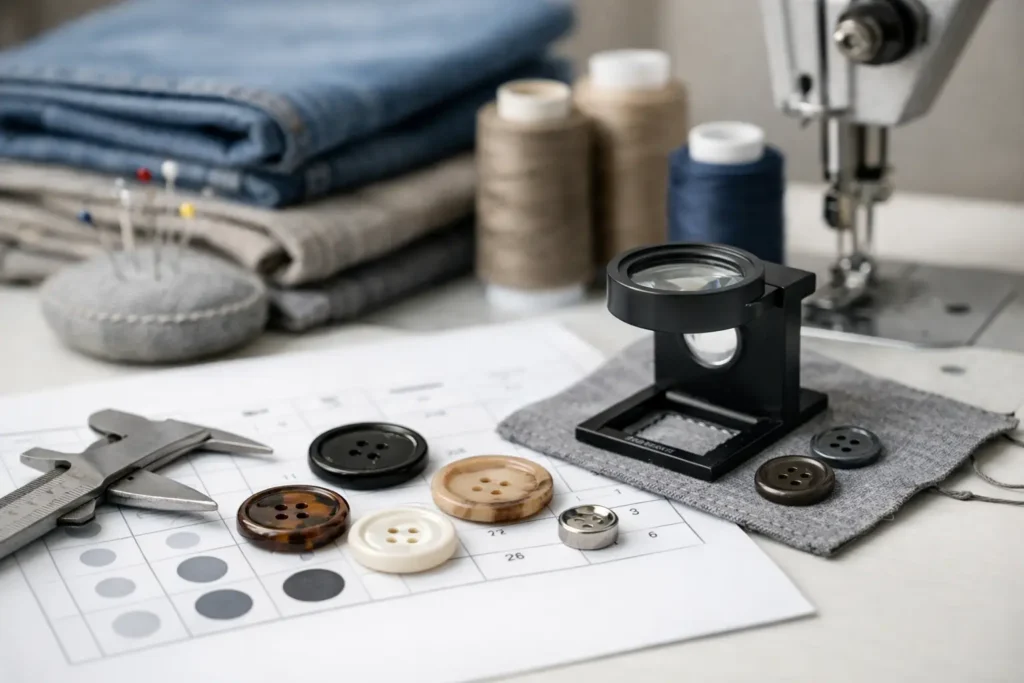
A button can be visually approved, correctly priced, and available for bulk production, yet still create a late-stage problem if its material, attachment, coating, or documentation was never defined against the finished garment’s intended market. This garment button compliance guide helps product teams turn a button concept into a production-ready specification with clearer controls before bulk approval.
For apparel brands and manufacturers, button compliance is not a single supplier declaration or a generic test request. It is the process of identifying what the button must do, what it is made from, how it is attached, where the finished garment will be sold, and what evidence the customer or supply chain requires. The correct scope depends on the product category, wearer, market, material, construction, and order route.
Start With the Garment, Not the Button
A custom button should be evaluated as part of a garment system. A two-hole resin button on an adult shirt has a different use profile from a metal shank button on outerwear, a snap-style construction on childrenswear, or a decorative button placed close to the face or neckline. The same visual design can require different development decisions when the end use changes.
Before selecting a material, define the garment’s target customer, intended wearer, selling markets, washing or dry-cleaning requirements, expected lifespan, and placement of the button. Also confirm whether the button is functional, decorative, removable, or used with a separate fastening component. These details determine which risks should be reviewed and which documentation may be needed.
The brand, importer, or responsible product organization normally sets the applicable requirements for the finished product. A button factory can support material and construction review, sampling, and production controls, but a generic button description should not be treated as proof that every garment application meets every market requirement.
Garment Button Compliance Guide: Define the Specification
A production-ready button specification goes beyond diameter and color. It converts a design direction into measurable information that a factory, garment maker, and quality team can follow consistently.
At minimum, the specification should identify the button material, size in millimeters or Ligne, thickness, hole or shank construction, finish, logo method, color reference, and approved visual standard. It should also state the garment style, button location, attachment method, and intended care process.
For custom developments, include the following details in the technical package:
- Material and finish, such as corozo, metal, resin, shell, horn, wood, ceramic, or a defined recycled-content material
- Button dimensions, including diameter, thickness, hole diameter, shank profile, or back construction
- Decoration requirements, including engraving, debossing, embossing, laser marking, print, plating, or painted fill
- Color target, such as a Pantone reference, approved swatch, physical standard, or lab-dip direction
- Garment application, attachment thread, sewing method, reinforcement, and expected care conditions
This level of detail prevents a common sourcing mistake: approving a digital rendering or an unmeasured reference button as though it were a final manufacturing standard. A rendering can communicate shape and branding intent. It cannot confirm edge feel, hole usability, coating appearance, weight, thread clearance, or attachment behavior on the actual garment.
Material Selection Changes the Review Scope
Each button material has its own production variables. Natural materials such as corozo, horn, shell, and wood can show variation in grain, tone, pattern, and surface character. That variation may be desirable, but the acceptable range should be agreed during sampling rather than disputed after delivery.
Metal buttons require clear definition of base material, construction, finish, and any decorative treatment. A plated look, antique effect, enamel-style fill, or laser-marked logo may affect appearance after garment washing, abrasion, pressing, or dry cleaning. Resin buttons need controlled color development, mold definition, and finish consistency. Ceramic buttons may require careful consideration of shape, thickness, and garment application because their visual character comes with different handling considerations than a standard polyester-style button.
Claims about recycled content, restricted substances, material origin, or environmental attributes should be verified for the specific material, supplier chain, order, and destination market. A material name alone does not establish the evidence needed for a brand claim.
Review Construction and Attachment Early
Attachment is often where button performance is won or lost. A properly made button can still fail in use if the garment sewing method, thread choice, stitch count, backing support, or button position is unsuitable for the garment fabric and use case.
Two-hole and four-hole buttons generally need confirmation that the hole size supports the intended sewing thread and machine setup. Shank buttons need a shank profile that gives adequate sewing clearance without causing instability or excessive movement. For thicker fabrics, bulky plackets, coated textiles, or padded garments, the garment factory may need to adjust thread length, reinforcement, or attachment procedure.
Request a sewn garment sample whenever the application is critical. Reviewing loose buttons alone does not show whether the button sits correctly, pulls against the fabric, catches during wear, or remains visually balanced after pressing and care processing. This is especially relevant for uniforms, workwear, outerwear, childrenswear, and garments with repeated laundering expectations.
Build Sampling Into the Approval Process
Sampling should answer production questions in sequence. The first sample may confirm material direction, shape, size, and logo placement. A later sample may refine color, finish, edge treatment, and surface details. The final approved sample should become the reference for bulk production.
Pantone matching also needs practical expectations. Pantone is a color target, not a guarantee of identical appearance across every material and finish. A matte resin, polished corozo, painted metal, and laser-marked surface will reflect light differently. Color tolerance should therefore be reviewed against physical samples under the lighting conditions relevant to the brand’s approval process.
Where performance review or laboratory evaluation is required, agree the scope before production. Confirm what sample type is needed, whether evaluation applies to the loose button or finished garment, the quantity required, the responsible party, and the timing. The result and applicability must be assessed for the actual material, construction, garment use, and supply route rather than assumed from an earlier or similar development.
Request Documentation That Matches the Order
The best documentation package is specific enough to support the purchase order and simple enough for teams to use. It should align the button factory, garment maker, sourcing team, and quality function around the same approved version.
Depending on the project, the buyer may request an approved button sample, dimensional specification, material description, color reference, finish approval, production lot identification, packing details, and any project-specific declarations or evaluation documents required by the customer. If a logo, tooling, or special construction is involved, retain the approved artwork and tooling reference with the order record.
Do not rely on a general statement carried over from another style or season. Changes that appear minor – a different plating source, resin grade, pigment, paint, button thickness, shank design, or manufacturing location – can change the appropriate review scope. Documentation should be refreshed when the product configuration or supply route changes materially.
Control Bulk Production Against the Approved Sample
Bulk quality review should compare production buttons with the approved physical standard, not only with a drawing. Key checks typically include dimensions, hole or shank formation, logo readability, finish consistency, color range, sharp edges or surface defects, and packing accuracy.
Acceptable variation should be practical and defined. Natural materials cannot be expected to look identical piece by piece, while a molded logo button may require tighter visual consistency. The correct tolerance depends on the material and design. A brand should decide which characteristics are essential to the collection and which variations are inherent to the chosen material.
NZXTRIM can coordinate custom button development from specification review through physical sampling and bulk production planning. For any compliance-sensitive program, the most useful starting point is a complete garment brief rather than a photo alone: material direction, artwork, size, construction, target market, garment application, care expectations, required evidence, quantity, and delivery window.
Avoid Late Changes That Reopen the Review
The most expensive compliance issue is often not a failed button. It is a late change made after approvals are assumed to be complete. Switching from a four-hole construction to a shank, changing a painted finish to plating, increasing button thickness, replacing a natural material with resin, or moving to a new garment factory can all justify another review.
Keep a change-control process between design, sourcing, quality, and production teams. If any approved feature changes, compare the new version against the original requirement before it enters bulk production. This keeps visual decisions, manufacturing decisions, and required evidence connected.
A well-specified button gives the garment team something more useful than a finished trim sample: it gives them a repeatable basis for ordering, sewing, checking, and approving the next production run.