
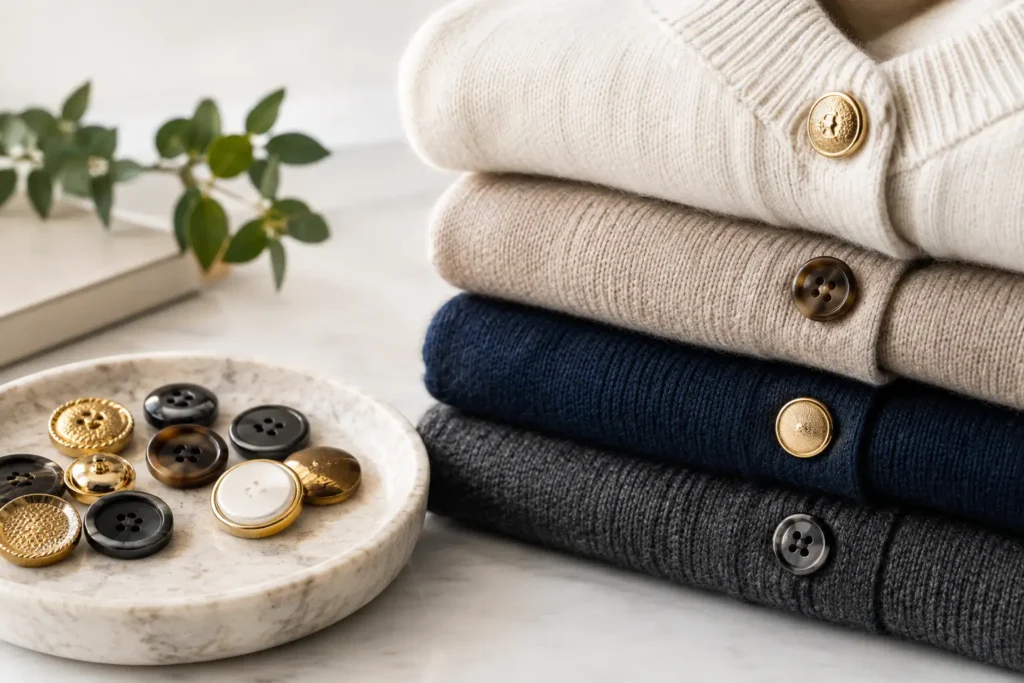
A luxury knitwear button is rarely a minor trim decision. On a fine-gauge cardigan, polo, vest, or knitted jacket, it sits close to the face and is handled repeatedly. The right button styles for luxury knitwear reinforce the garment’s yarn quality, silhouette, and price position. The wrong choice can make a considered knit look generic, add unnecessary weight to the placket, or create avoidable stress during wear and laundering.
For production teams, the strongest starting point is not a mood board. It is a button specification that connects the visual direction to yarn gauge, placket construction, end use, care method, and expected production volume. A polished horn-look button may suit one merino cardigan program, while a flat corozo button or a lightweight resin construction may be the better production choice for another.
Button Styles for Luxury Knitwear: Start With the Garment
Luxury knitwear commonly calls for restraint. Buttons should feel intentional without competing with stitch texture, rib trims, jacquards, or a distinctive yarn blend. This does not mean every program requires a plain four-hole button. It means the construction and finish need to support the garment rather than become an isolated decoration.
First, assess the knit structure. Fine-gauge cashmere, merino, silk blends, and compact cotton knits often work well with slim, flat buttons that sit close to the placket. Chunkier lambswool, brushed yarns, heavy ribs, and cardigan jackets can carry more dimension, including thicker rims, shank constructions, or larger diameters. A button that is proportionate on a bulky cable knit may look heavy and distort a lightweight jersey stitch.
The buttonhole is equally important. A knit buttonhole can stretch differently from a woven one, particularly where the placket is soft or loosely constructed. The specified button diameter, edge profile, and thickness should be reviewed against actual buttonhole samples, not only a digital drawing. A thick button with a sharp edge may be difficult to pass through a compact knitted buttonhole, even when its nominal diameter appears correct.
Material Choices and Their Production Trade-Offs
Material affects appearance, touch, machining options, color development, and consistency from sampling through bulk production. It should be selected for the specific garment program, not simply because it is associated with a luxury category.
Corozo for a Natural, Refined Surface
Corozo is often specified for luxury knitwear because it offers a dense, matte-to-satin appearance with natural visual character. It can be dyed, engraved, debossed, or developed in clean solid colors. Its quieter surface makes it especially suitable for elevated essentials, fine cardigans, and knit polos where the button should look substantial but not glossy.
Corozo is a natural material, so surface grain and color response can vary more than on fully synthetic materials. This variation may be desirable in a natural-button concept, but the acceptable tolerance should be agreed during physical sampling. If a Pantone reference is required, it should be treated as a target for the selected material and finish, rather than assumed as an exact universal match.
Horn and Horn-Look Options
Genuine horn can bring depth, translucency, and irregular tonal movement that works well with premium wool, cashmere, and heritage-inspired knitwear. Natural horn variation is part of its character. It also means that color, pattern, and translucency will not be identical button to button.
Where a more controlled appearance is needed, horn-look resin can offer a similar directional effect with greater repeatability in tone and pattern placement. The decision depends on the design intent. A program seeking natural individuality may prefer genuine horn, while a collection requiring close visual consistency across multiple factories or delivery windows may favor an engineered alternative.
Shell, Ceramic, Metal, Wood, and Resin
Shell provides light reflection and a fine surface that can elevate lightweight knitwear. It is often best suited to garments where a delicate, dressier effect is intended. Because shell is comparatively thin and has a distinct natural surface, construction details should be evaluated on physical samples.
Ceramic buttons can create a smooth, tactile, artisanal look, especially for statement cardigan styles. Their weight and thickness need careful consideration on soft knitted plackets. Metal can provide a tailored or decorative direction, but it may be too heavy for certain gauges and can change how the placket hangs. Wood offers warmth and texture, yet its finish and care expectations must align with the garment’s intended use.
Resin remains highly useful in luxury knitwear when the brief calls for consistent color, controlled marbling, pearl effects, translucent looks, or lightweight custom shapes. It can also be a practical choice when a logo, a precise visual effect, or a larger button format needs to be produced consistently. Recycled-content options may be available for some constructions, but the material composition and any related claims must be verified for the specific button development and supply route.
Construction: Flat, Rimmed, Shank, or Covered
A button style is more than its face design. The back construction changes the garment’s feel, sewing process, and wearing performance.
Flat two-hole and four-hole buttons are widely used for knitwear because they distribute attachment across the placket and maintain a low profile. Four-hole constructions can offer a more secure visual attachment and allow different stitch patterns, although the final sewing method remains the garment factory’s decision. Two-hole buttons create a cleaner face and often suit minimal designs.
A rimmed button adds visual definition without requiring a large increase in diameter. It can frame an engraved logo or create a classic cardigan appearance. Deep rims, however, can collect lint or make a small button look overly formal on casual knitwear.
Shank buttons create separation between the button face and garment. They can work well on thicker knits, textured yarns, or styles where the designer wants more dimension. On fine-gauge knits, a shank can pull the placket outward if the button is too heavy or the backing is not properly considered. A shank construction should therefore be sampled on the actual knit, with the intended sewing thread and buttonhole.
Covered buttons can create a coordinated look using the garment fabric or a complementary textile. For knitwear, the covering material needs to be assessed for fraying, stretching, and long-term appearance. A visual concept may look correct in a development presentation yet be unsuitable for repeated buttoning or the selected care process.
Size, Ligne, and Proportion
Button sizing should be stated in millimeters and, where useful for sourcing communication, Ligne. A common knitwear range may include smaller front placket buttons, slightly larger collar or outerwear-style buttons, and coordinated smaller sizes for pockets or cuffs. There is no single luxury size standard because proportion depends on the garment scale.
For a fine-knit cardigan, a compact button can preserve a clean vertical line. For a relaxed, heavy-gauge cardigan, increasing the diameter may improve functionality and visual balance. Thickness matters alongside diameter. A large, thin button may look elegant but feel insubstantial, while a thick button can appear premium but may be impractical for the buttonhole.
Specify the face diameter, thickness range, hole diameter or shank dimensions, edge profile, and back shape. If the button has an asymmetric shape, directional grain effect, or placed logo, define orientation requirements as well. These details prevent a factory-ready specification from being reduced to only a reference image.
Branding and Finish Without Overdesigning
Luxury knitwear branding often benefits from subtlety. Laser marking, engraved logos, debossed marks, raised details, and discreet back marks can all be considered, depending on material and button geometry. A shallow deboss may be appropriate for a matte corozo button, while a fine laser mark may suit selected resin or wood developments.
Small logos have limits. Legibility depends on button size, material surface, finish, and the depth or contrast of the mark. A detailed emblem that looks clear at artwork scale may not reproduce cleanly on a 15 mm button. Simplifying the logo or moving identification to the back can produce a better result than forcing intricate artwork onto a small face.
Finish selection should also relate to the yarn. Matte, satin, polished, pearlescent, washed, and antique effects create very different impressions. A high-gloss finish can offer deliberate contrast against dry wool, while a matte surface may better complement brushed cashmere or textured cotton. Request physical finish references before approving a direction for bulk development.
Sampling Before Bulk Commitment
For luxury knitwear, physical sampling is the point where design intent becomes a production decision. A button sample should be reviewed on the actual garment or a representative knit swatch, not in isolation. Check visual proportion, buttonhole passage, placket drape, stitching position, face orientation, and whether the finish supports the collection’s intended appearance.
NZXTRIM can develop custom button samples from approved artwork, size requirements, material direction, and color references. For custom shapes, logos, or specialized constructions, tooling requirements and development timing need to be confirmed early. MOQ and bulk lead time also depend on the selected material, construction, finish, and order requirements, so they should be reviewed once the specification is sufficiently defined.
When the garment program has particular care, durability, chemical, or market-entry requirements, define the required review scope at the beginning of development. Material suitability and any documentation needs must be confirmed for the exact button, garment application, order, and supply route.
The most useful next step is simple: assemble one representative knit swatch, the intended buttonhole measurement, a size target, and a clear material direction. That small package gives a button manufacturer enough information to turn a luxury knitwear idea into a sample that can be evaluated honestly on the garment.