
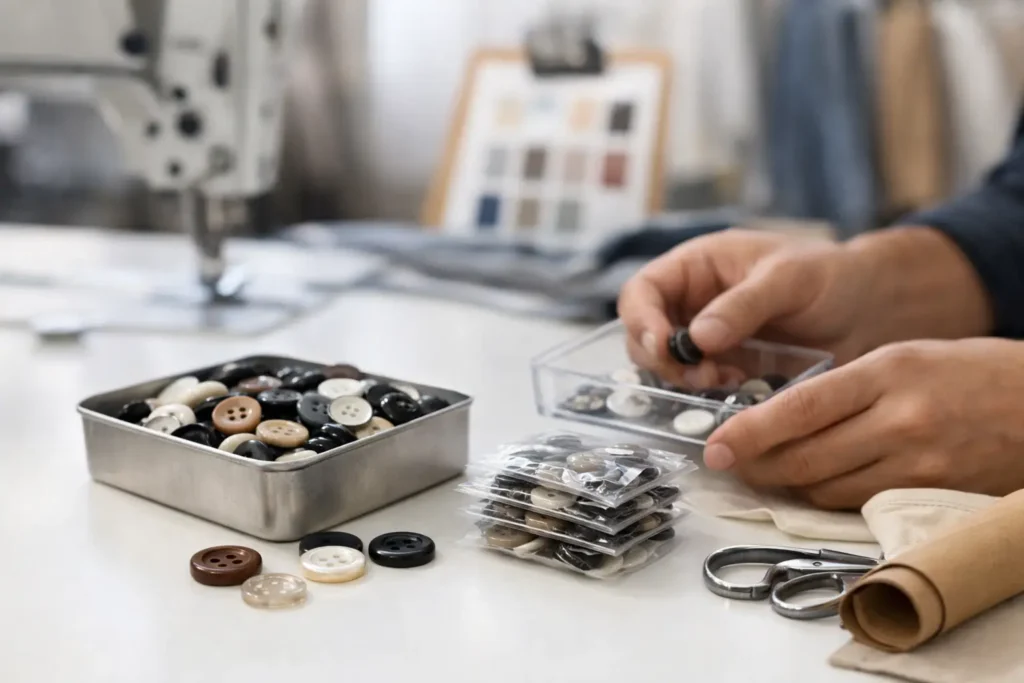
A new collection can be delayed by something as small as a button. A garment may be fully approved, yet the trim supplier requires quantities that exceed the launch plan. Low MOQ button orders give brands and manufacturers a practical way to develop custom buttons without committing to unnecessary inventory before market demand is proven.
For emerging labels, capsule collections, uniform programs, and seasonal fashion lines, lower minimums are not simply a purchasing preference. They are a supply-chain decision. The right factory must still deliver consistent materials, accurate colors, functional sizing, and repeatable quality, even when the first order is relatively small.
Why Low MOQ Button Orders Matter for Apparel Production
MOQ means minimum order quantity: the lowest quantity a supplier can manufacture economically for a specific button design. It is often influenced by material preparation, mold requirements, machine setup, dyeing or coloring processes, finishing work, and packaging. A simple stock-style button may support a lower MOQ than a fully custom button with a new logo mold, plated metal finish, or special color effect.
For apparel buyers, a lower MOQ reduces the financial risk of product development. Instead of ordering enough buttons for a large production forecast, a brand can purchase what is needed for sampling, a limited launch, a buyer presentation, or a first production run. This is especially valuable when sizing, color direction, or retail demand has not yet been confirmed.
Low quantities also help product teams make better decisions. A custom resin button may look different once it is sewn onto a finished jacket. A horn-style button may need a different surface polish to match the intended luxury positioning. A smaller initial order creates room to review the result in actual garments before scaling the design.
That said, low MOQ does not mean every specification can be produced at the lowest possible cost. Buyers should expect unit pricing to be higher when setup costs are spread over fewer pieces. The objective is not always the cheapest button price. It is to purchase the right quantity, at the right quality level, with a production plan that can scale when the collection succeeds.
Which Button Types Work Best at Low Quantities?
The most suitable material depends on the garment category, required appearance, expected order volume, and customization level. During early development, materials with flexible coloring and molding options can often be more practical than processes requiring extensive tooling or specialized finishing.
Resin buttons are a common choice for custom apparel projects because they can be produced in many shapes, colors, patterns, and finishes. They work well for shirts, blazers, knitwear, outerwear, uniforms, and fashion collections. Depending on the design, resin can replicate natural looks such as horn, shell, stone, or tortoiseshell while providing more controlled color consistency.
Corozo buttons offer a natural, premium appearance and are widely used in tailored garments, sustainable collections, and high-end casualwear. Their grain and dye response create character, but natural variation should be discussed early if a highly uniform appearance is required.
Metal buttons can be appropriate for denim, workwear, military-inspired styles, uniforms, and luxury outerwear. They offer strong branding opportunities through logo engraving, embossing, plating, and custom shapes. However, custom metal tooling, plating specifications, and detailed logos may raise the practical MOQ or lead time.
Ceramic, horn, recycled, and specialty buttons can add distinctive value to a collection, particularly when material storytelling matters. These options should be evaluated not only for appearance, but also for durability, sewability, consistency, and replacement availability. A factory should help the buyer compare these trade-offs rather than recommend one material for every project.
Stock Components Versus Fully Custom Development
One of the clearest ways to control minimums is to distinguish between customization levels. Using an existing button shape with a selected color, size, or finish may require less setup than creating a completely new design. This approach can be ideal for brands that need a distinctive result but are working with limited launch quantities.
A fully custom button may involve original artwork, a new mold, engraved branding, special edge details, custom holes, or a unique surface effect. These details build brand identity, but they can add development time and cost. For a first order, some buyers choose an existing base shape and reserve custom tooling for the style once repeat demand is established.
How to Plan Low MOQ Button Orders Correctly
A clear inquiry helps a button factory assess feasibility quickly. Sending only a reference photo may be enough to start a conversation, but it is rarely enough to quote or produce accurately. The more complete the product brief, the fewer revisions are needed during sampling and production.
Specify the button material or desired look, diameter in millimeters or lignes, thickness, hole style, quantity per garment, required order quantity, and target delivery date. Include the garment type and fabric when possible. A heavy wool coat, a lightweight rayon blouse, and industrial workwear can require very different button performance.
For custom colors, provide a physical swatch or recognized color reference whenever possible. Screen images are useful for direction, but they cannot reliably control production color. The same applies to surface finish. Terms such as “matte,” “vintage,” or “polished” should be supported by a sample, photo reference, or approval standard because interpretation can vary.
Buyers should also calculate quantity beyond the garment count. Production orders need an allowance for sampling, quality inspection, losses during sewing, repairs, and future replacements. The exact buffer depends on the garment and factory process, but ordering only the exact number of buttons needed for finished units can create avoidable problems later.
Confirm the Scale-Up Plan Before Approving Samples
The first order should not be treated as an isolated transaction. If a style performs well, the brand may need a larger replenishment order quickly. Before final approval, confirm whether the same mold, color formula, material source, and finishing process can be maintained for future production.
This matters most for custom buttons and natural materials. A supplier may be able to produce a small run successfully, but a reliable long-term program requires documented specifications and controlled production standards. Ask how samples are retained, how color is approved, what tolerances apply to size and thickness, and how repeat orders are checked against the approved standard.
At NZXTRIM, this development-to-production approach supports buyers who need flexibility at the beginning without losing control when quantities increase. The goal is to make the approved button specification usable for both small runs and larger OEM production.
Quality Control Still Applies to Small Orders
A lower MOQ should never mean lower inspection standards. Buttons need to be checked for dimensions, hole formation, edge smoothness, surface defects, color variation, finish consistency, and functional strength. For metal buttons, plating quality and logo clarity are particularly important. For resin and natural-material buttons, buyers should consider acceptable variation alongside the desired design effect.
Quality requirements should match the garment’s position in the market. A luxury label may need close visual matching and refined finishing. A uniform supplier may prioritize repeatable color, attachment durability, and dependable replenishment. Neither standard is automatically better, but each must be defined before production begins.
Packaging also deserves attention. Mixed sizes, scratches during transport, or missing counts can disrupt an apparel factory’s sewing line. Clear labeling by style, color, size, and quantity helps prevent errors when buttons arrive at the garment factory or distribution center.
When a Higher MOQ Is the Better Decision
Low MOQ is valuable when demand is uncertain, but it is not always the most cost-effective choice. If a brand has confirmed orders, a stable core style, or a long-running uniform contract, ordering a higher quantity can reduce unit cost and provide better production continuity. It may also support more advanced customization, including proprietary molds and detailed branding.
The decision depends on inventory risk versus production efficiency. For a limited collection, smaller quantities may protect cash flow and reduce dead stock. For a proven style, higher volumes can protect against material changes, price fluctuations, and missed replenishment windows.
The most dependable button supplier will explain both options clearly: what can be done at a low minimum, what changes at higher volumes, and which specifications should be locked before production. Start with a button brief that reflects the garment’s real needs, approve a sample against a defined standard, and build a repeat-order plan before the collection reaches the market.