
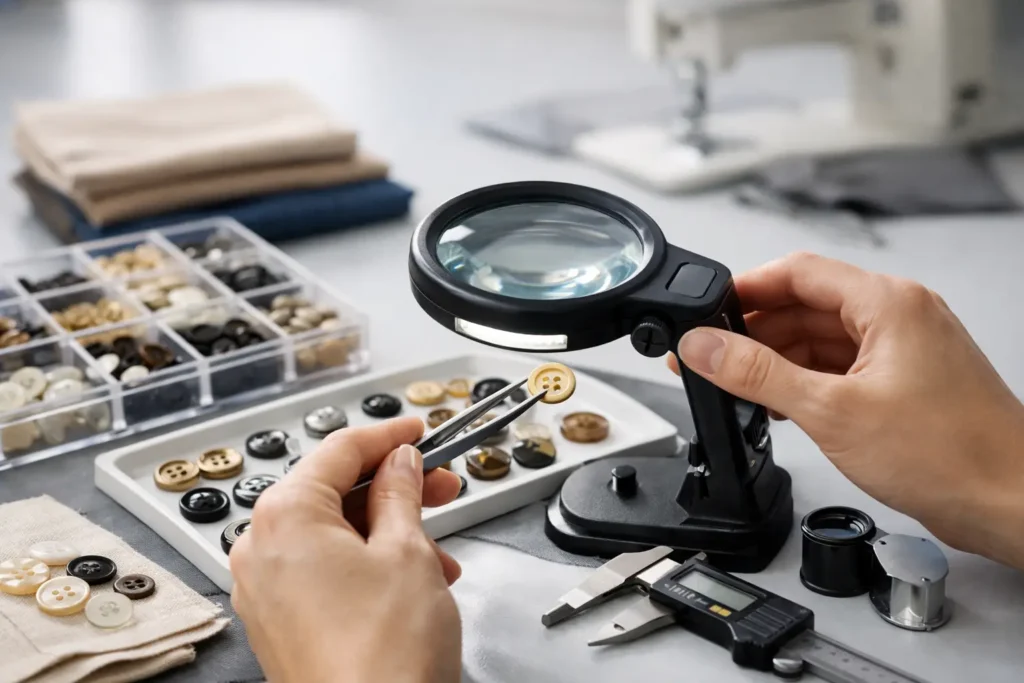
A button can match the artwork and still fail the garment program. It may look correct under showroom lighting but shift in color beside the fabric, feel too light for a coat front, rotate poorly through the buttonhole, or lose logo definition after a wash process. Button sample evaluation is the point at which a visual concept becomes a controlled production decision.
For apparel teams, the purpose is not simply to approve an attractive sample. It is to confirm that the approved button can be reproduced at the required scale, within workable tolerances, using an agreed material, construction, finish, and inspection standard. A physical sample provides evidence that a render, material swatch, or digital color reference cannot.
What button sample evaluation should confirm
A useful evaluation starts with the garment specification, not the button in isolation. The team should review the button against the actual fabric, buttonhole, thread, care process, and intended use. A lightweight resin button may be appropriate for a shirting program but unsuitable for a heavy outerwear front, while a metal button may require a different attachment approach than a four-hole corozo style.
The evaluation should establish whether the sample meets the approved visual direction and whether its construction is suitable for production. These are related, but they are not the same decision. A good-looking first sample may still need changes to improve strength, attachment performance, color consistency, or repeatability.
Material should be assessed first. Corozo, horn, shell, wood, resin, ceramic, metal, and recycled-content materials each have different natural variation, molding behavior, finishing options, and surface characteristics. Natural materials can show grain, tone, or pattern differences that are inherent to the material. Those variations should be defined as acceptable or unacceptable before bulk production rather than treated as unexpected defects afterward.
Color review also needs practical context. Pantone references are useful starting points, but the final appearance can be affected by the base material, finish, translucency, gloss level, texture, and lighting. A dyed corozo button and a molded resin button may interpret the same target color differently. Review the button beside approved fabric and under the lighting conditions relevant to the product review process.
Evaluate the sample on the garment, not only in a tray
A tray sample is useful for checking dimensions and finish, but garment application reveals issues that a loose button can hide. Sew the sample onto the intended garment or a representative fabric panel. Button through the specified buttonhole repeatedly. Check whether the button lies flat, whether the shank orientation is correct, and whether the button scale supports the garment silhouette.
For a two-hole or four-hole button, assess hole diameter, hole spacing, hole edge smoothness, and the visual relationship between thread and button face. For shank buttons, assess shank height, shank opening, centering, and the clearance needed for the garment thickness. A shank that is too short can pull against a thick placket. One that is too high can create unwanted movement or a loose appearance.
Size must be confirmed in both millimeters and Ligne where relevant to the buyer’s specification. A small size difference can affect buttonhole fit, placket balance, and the visual rhythm of a garment front. The approved specification should identify the nominal size and the acceptable dimensional tolerance for the specific design.
The same principle applies to thickness. A button may be within the intended diameter but still look or perform incorrectly if it is too thin, too domed, or too heavy. For uniform, workwear, outerwear, or high-use apparel, the team should consider the intended wear conditions early. Required performance checks and any testing scope should be confirmed for the exact button material, garment application, order, and supply route.
Review logo detail at production scale
Custom logos often need the closest review. Engraved, debossed, embossed, laser-marked, printed, and molded details each have limits based on the button material, size, surface shape, and finish. Fine lettering that reads clearly on a large development sample may fill in, soften, or become difficult to inspect on a smaller bulk button.
Evaluate logo depth, line thickness, placement, orientation, and legibility from normal viewing distance. If the logo includes a filled color, confirm its edge definition and whether the color application suits the material surface. A logo should not be approved only because it is visible under magnification. It must be reproducible and inspectable in normal production conditions.
When a design includes front and back features, define both. The back can affect sewing behavior, mold parting lines, branding requirements, and quality inspection. An approved front-face image alone is rarely enough for a custom button program.
Separate development samples from bulk approval samples
Not every sample answers the same question. Early samples may be intended to confirm material direction, size, shape, or logo placement. They are valuable, but they should not automatically become the bulk production reference.
A development sample may use provisional color, preliminary tooling, or a finish that still requires adjustment. A bulk approval sample should reflect the agreed production route as closely as practical, including the selected material, construction, finish, logo method, and target color. If any element remains provisional, record it clearly rather than allowing an informal assumption to become the production standard.
This distinction reduces a common sourcing problem: a team approves a concept sample, while the factory receives incomplete instructions for bulk. The result is often disagreement about whether a variation is a defect or an expected outcome of an unspecified production detail.
Create an approval record that production can use
The sample itself is only one part of approval. The production record should translate the physical button into clear specifications. It should identify the button style, material, size, thickness or profile, hole or shank construction, finish, color reference, logo artwork version, logo method, and approved visual standard.
Photographs are helpful, especially for showing the approved face, back, edge, and garment application. However, photographs should support the physical sample rather than replace it. Camera settings and screen displays can alter color and gloss perception.
For programs with multiple sizes or colorways, approve each meaningful variation. A 15 mm button is not simply a scaled-down version of a 25 mm button when it includes molded branding or fine engraving. Likewise, a matte black finish may need a separate review from a glossy black finish, even when the underlying button construction is the same.
The approval record should also state how natural variation, surface marks, color tolerance, and finish variation will be assessed. This is particularly relevant for horn, shell, wood, corozo, and recycled-content materials, where appearance can vary by material lot or process. Any recycled-content claim or material composition requirement must be verified for the specific material and order.
Resolve trade-offs before tooling and bulk scheduling
Button development often involves trade-offs. Deeper engraving can improve logo visibility but may change the button face or require a different tool approach. A highly polished finish can make a button look more refined but may reveal handling marks more readily. A very tight color target can require more development work and may be less practical across materials with natural variation.
MOQ, tooling, and lead time should be discussed alongside the sample review, not after approval. A design that is feasible for a prototype may have different commercial implications once the required order quantity, number of sizes, number of colors, and custom tooling needs are known. The most efficient route is usually the one that aligns design intent with a production method that can be controlled repeatedly.
NZXTRIM can review physical button samples against the intended garment application and help convert the approved direction into a production-ready specification. The earlier material, construction, and logo requirements are clarified, the fewer decisions remain open when bulk planning begins.
A well-evaluated button sample does more than confirm appearance. It gives the design, sourcing, and factory teams one practical reference for making the same button again, with fewer assumptions between approval and production.