
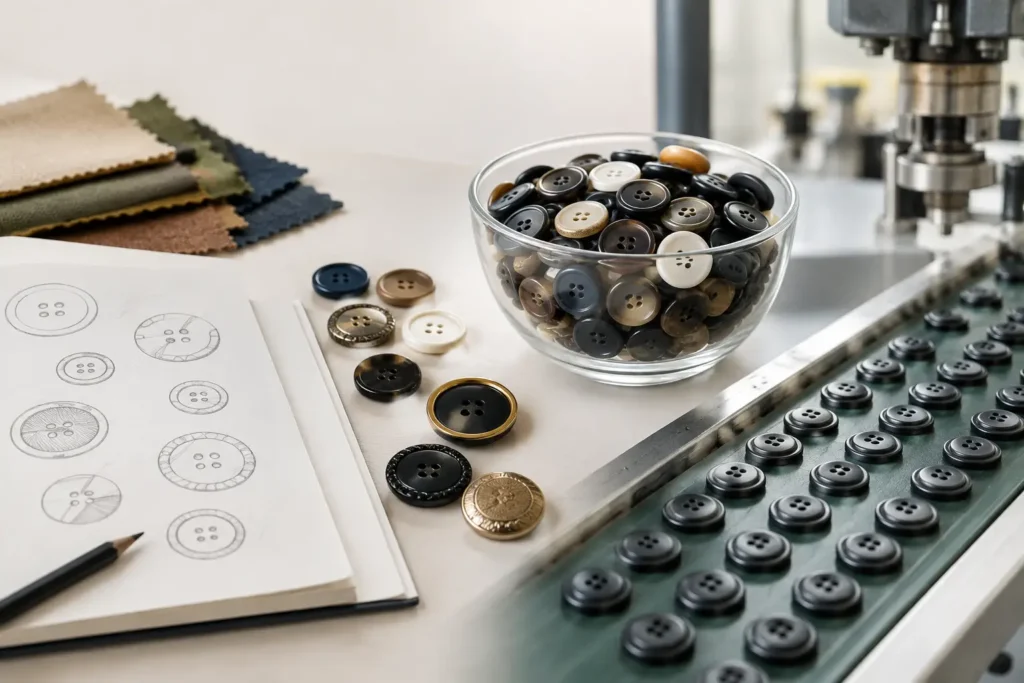
A button can look correct in a digital sketch and still fail the production brief. The issue may be a logo that is too fine for the selected material, a shank that does not suit the garment thickness, or a finish that changes after repeated washing. For fashion buttons, the commercial result depends on translating a visual direction into specifications a factory can sample, review, and repeat in bulk.
For apparel teams, buttons are not minor finishing details. They affect garment appearance, hand feel, attachment method, wear performance, packing, and perceived value. A well-defined button program also reduces late-stage changes, especially when a collection includes several colors, sizes, or factories.
What Makes Fashion Buttons Production-Ready?
A production-ready button brief goes beyond a reference image. It identifies the intended material, size, construction, color target, logo treatment, surface finish, and use case. It should also state where the button will be used: a lightweight blouse, tailored jacket, denim overshirt, knit cardigan, uniform, or outerwear piece may require very different construction decisions.
The first question is not simply, “What style do we want?” It is, “What must this button do on the finished garment?” A decorative metal button for a fashion jacket may prioritize relief detail and plated appearance. A shirt button may need consistent hole geometry and a smooth edge for automated or manual sewing. A button on a workwear program may need a different review process based on the garment’s wash, wear, and attachment requirements.
Visual concepts are useful starting points, but they are not final specifications. Before tooling or bulk approval, confirm dimensions, tolerances, material behavior, and the practical limitations of the chosen logo method.
Start With Material and Construction
Material selection influences both appearance and manufacturability. Corozo can provide a natural, refined surface and can be dyed, engraved, or laser marked depending on the development route. Resin supports broad color development and many shapes, while metal can create weight, defined edges, and plated finishes. Shell, horn, wood, ceramic, and recycled-content materials each bring their own visual character and processing considerations.
No material is automatically the right answer. Natural materials can show variation that is part of their character, while engineered materials may offer more controlled visual consistency across a production run. Metal may be appropriate when a garment needs dimensional branding, but its weight and attachment construction need review. Ceramic can create a distinctive surface, but feasibility depends on button geometry, edge requirements, and the intended end use.
Construction matters just as much as material. The common choices are sew-through buttons, shank buttons, snap-compatible components, and specialty constructions. A two-hole or four-hole button works differently from a shank button during garment assembly. Hole diameter, hole spacing, shank height, and back profile should be selected with the sewing process and garment fabric in mind.
Size should be specified in millimeters and, where relevant to the buying team, Ligne. A nominal size alone may not be enough for a custom development. Thickness, dome height, edge profile, and usable sewing area can change the final result even when the face diameter is identical.
Turn a Design Direction Into a Clear Specification
The strongest development briefs bring design, technical, and purchasing information together early. This is particularly useful when several factories will sew the same style or when a button must coordinate with zippers, labels, or emblems.
A practical specification typically records:
- Button material and any required material appearance
- Diameter, thickness, profile, and construction type
- Hole count, hole diameter, spacing, or shank dimensions
- Base color, Pantone reference where applicable, and finish expectation
- Logo artwork, logo position, and preferred marking method
- Quantity by style, size, and colorway
- Garment application, anticipated care conditions, and delivery requirements
Pantone references are useful for color development, particularly with resin and dyed materials, but they are a target rather than a universal guarantee. Material base tone, surface texture, gloss level, batch conditions, and lighting can affect perceived color. A physical approval sample is the right point to confirm an acceptable tolerance for the specific button and garment program.
Artwork also needs technical review. Fine lines, small lettering, and shallow details may not reproduce equally in engraving, debossing, embossing, laser marking, or molded relief. A logo that reads clearly at 30 mm may lose definition at 15 mm. In many cases, simplifying a mark slightly produces a cleaner and more repeatable button without changing its brand recognition.
Choose a Logo Method for the Material, Not Just the Look
Logo treatment should match the material and desired surface effect. Engraving and debossing create recessed detail. Embossing creates raised detail and can be effective when the design needs tactile definition. Laser marking can offer precise surface graphics on suitable materials, although contrast and appearance vary with the substrate and finish. Molded logos can be appropriate for resin developments where the artwork and button geometry support the tooling approach.
The trade-off is usually between detail, depth, cost structure, and repeatability. A highly detailed custom face may require tooling and longer development coordination than a stock-shape button with a simpler mark. Tooling can be worthwhile for a program expected to continue across seasons, but it should be evaluated against forecast quantity, launch timing, and the likelihood of design changes.
Sampling Is Where Assumptions Become Decisions
Physical sampling should be treated as a technical checkpoint, not a formality. It allows teams to assess the button on actual fabric, under normal viewing conditions, and alongside related trims. A sample can reveal that a polished finish is too reflective, a natural material varies more than expected, or a shank sits too high on a lightweight garment.
Review samples for face appearance, logo legibility, color, edge quality, hole or shank construction, back finish, and attachment suitability. When possible, sew the sample onto the intended fabric and assess it after relevant garment processing. If the program has specific wash, dry-cleaning, corrosion, pull, or other performance expectations, define the applicable requirements before bulk production. The appropriate assessment scope depends on the material, construction, garment category, and supply route.
NZXTRIM coordinates custom button projects by converting approved design intent into material and production details, with physical sampling used to align the buyer, garment factory, and bulk manufacturing plan.
Plan MOQ, Lead Time, and Bulk Consistency Together
MOQ, development timing, and unit cost are connected. A custom material, new shape, special plating, multi-color program, or dedicated logo tooling can change the production plan compared with a standard construction. Rather than treating MOQ as a single number, review it by material, size, colorway, construction, and whether new tooling is required.
Lead time should include more than bulk manufacturing. Allow time for artwork confirmation, material review, sample development, revisions, approval, bulk scheduling, inspection, packing, and international delivery planning. A late logo adjustment can affect multiple steps, especially if it changes tooling or the marking method.
Consistency in bulk begins with an approved reference. The approved sample, written specification, artwork version, color standard, and packing requirements should be controlled together. For natural materials, teams should agree in advance which variation is acceptable. For plated, painted, dyed, or laser-marked buttons, appearance expectations should be reviewed against the actual finish rather than a generic visual description.
Build Quality Review Into the Order, Not After It
A useful quality review checks the characteristics that matter to the garment program. Depending on the product, this may include dimensions, visual defects, logo placement, color appearance, hole or shank construction, finish condition, and packing count. The review plan should be agreed early enough to influence production, not introduced only after goods are complete.
It also helps to separate critical requirements from preferences. A specific hole diameter may be critical to sewing. Minor natural grain variation may be acceptable if it fits the approved sample. This distinction gives both the buyer and manufacturer a clearer basis for bulk review and avoids rejecting normal material character that was never defined as a defect.
The most efficient button development starts with a complete brief, then uses a physical sample to settle the details that a drawing cannot prove. When the material, construction, logo, approval standard, and delivery plan are aligned before bulk release, fashion buttons become a controlled part of garment production rather than a late-stage sourcing risk.