
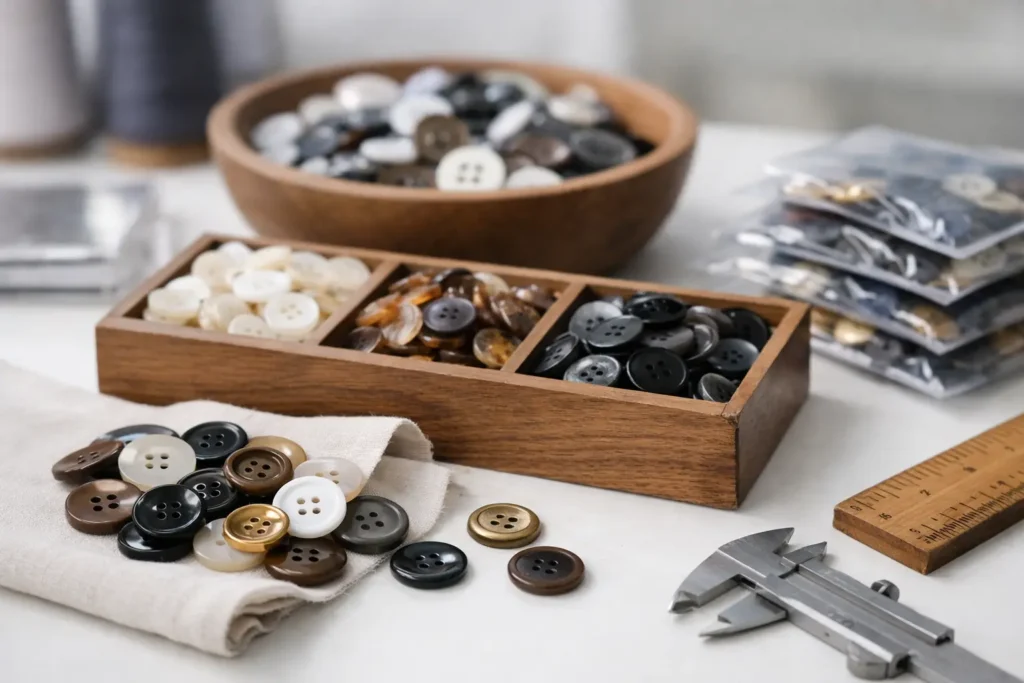
A custom button can look small on a garment spec sheet, yet its production requirements affect costing, development timing, and inventory risk. Button minimum order quantities are not arbitrary factory rules. They reflect the material, tooling, process setup, finishing requirements, and quality controls needed to make your design consistently at production scale.
For apparel brands, garment factories, and sourcing teams, the right question is rarely simply, “What is your MOQ?” A more useful question is, “What production route will deliver this button at the required quality, quantity, and delivery date?” Understanding the answer helps buyers avoid unexpected sampling costs, impractical color requests, and late changes after bulk fabric has already been committed.
What Button Minimum Order Quantities Actually Mean
A minimum order quantity, or MOQ, is the smallest quantity a factory can produce while maintaining a commercially practical production process. It is usually stated per design, size, color, and finish rather than per overall purchase order.
For example, a brand may need 5,000 buttons in total for a jacket program. If the jacket uses a 20 mm front button in matte black, a 15 mm cuff button in matte black, and a separate logo button for an inner detail, those can be three individual production items. Their quantities, tooling needs, and manufacturing methods may differ even when they belong to one garment collection.
MOQ is also different from a sample quantity. A prototype run can prove a shape, logo, color, or surface treatment, but it is not produced under the same conditions as bulk goods. Sampling is a development service. Bulk MOQ is the point at which material preparation, machine setup, molding, finishing, inspection, and packing can be organized efficiently.
Why Custom Button MOQs Vary
The biggest driver is whether your button uses an existing production route or requires new development. An existing stock shape in a standard material and color can often be produced at a lower quantity than a newly molded logo button with a special finish. Every additional customization step introduces preparation work that must be spread across the order.
Material Selection Changes the Production Method
Resin buttons can be made in a broad range of colors, patterns, and shapes, but custom molds, special effects, and color matching may require minimum material batches. Recycled resin can add another layer of planning because the available base material and color consistency must be confirmed before production.
Natural materials follow different constraints. Corozo buttons require selection and cutting from natural tagua nuts, so size, thickness, dye absorption, and natural grain influence yield. Horn buttons vary naturally in tone and pattern, which is part of their appeal, but buyers should define an acceptable color range rather than expect every piece to be identical.
Metal buttons may require die casting, stamping, electroplating, enamel filling, or logo engraving. Ceramic buttons need molding, firing, glazing, and careful handling through the production process. Each material has its own setup requirements, lead time, and achievable MOQ. Lower quantity is possible in some cases, but the unit cost may rise sharply.
Tooling Is Often the Deciding Factor
A new mold, die, or stamping tool is a one-time investment in a specific design. If your button has a custom silhouette, raised logo, recessed emblem, unique shank construction, or proprietary pattern, tooling is likely required.
This does not mean a custom design is unsuitable for a smaller collection. It means the commercial plan should be clear. A premium brand launching a limited run may choose to pay tooling costs for a signature button because the detail supports its retail positioning. A uniform supplier with recurring orders may distribute the tooling cost over several future deliveries. For a one-season item with uncertain demand, an existing shape with custom engraving or finishing may be the more practical solution.
Color, Finish, and Decoration Add Setup Work
A button that appears simple can involve several process stages. Color matching may require lab dips or trial batches. A metal button may need brushing, antique plating, lacquer protection, and laser marking. Resin can be polished, pearlized, marbled, or given a soft-touch surface. Printed graphics and hand-applied effects require additional controls.
When quantities are low, these setup stages carry more cost per piece. When quantities increase, fixed preparation costs are divided across more buttons, making the price structure more efficient. This is why a factory may offer several pricing tiers rather than one universal MOQ.
How to Plan an Order Around Button MOQs
Start with the garment bill of materials, not only the number of finished garments. Calculate the number of buttons per garment, then include a sensible allowance for production loss, replacements, testing, and future service needs. A shirt requiring eight buttons for 1,000 units does not necessarily mean an order of exactly 8,000 buttons is enough.
The allowance depends on the product category and supply plan. Uniform programs, workwear, and repeat styles often benefit from extra stock for replacement garments. Fashion collections with a fixed delivery window may need reserve quantities in case final garment inspection identifies damaged or missing trims. Your button supplier can help determine an appropriate overage based on the material and packing method.
Next, separate the designs by size, color, and construction. Do not assume that two sizes of the same logo are automatically one SKU. A 24L front button and a 16L cuff button may need separate molds or production adjustments. The same applies to sew-through and shank versions of a similar design.
Provide the factory with the intended quantity at the beginning of development. A design that is technically possible at 1,000 pieces may have a very different recommendation at 50,000 pieces. Early quantity information allows the manufacturer to advise on material choice, mold layout, finishing method, and the most cost-effective way to achieve the intended appearance.
Lower MOQ Options Without Compromising the Garment
Low MOQ does not need to mean low quality. It requires choosing the right level of customization for the order volume. For emerging brands, an existing button shape paired with a custom color, laser logo, engraved mark, or selected finish can create a distinctive result without the full cost of a newly engineered mold.
Another option is to standardize button details across related styles. If several garments can use the same branded button in different quantities, the total demand can support a more favorable production run. This approach is especially useful for capsule collections, schoolwear, hotel uniforms, and private-label programs where visual consistency matters across multiple garments.
Buyers can also consider ordering buttons for more than one production delivery when the design is confirmed and storage conditions are suitable. This can reduce repeat setup costs, but it should be weighed against cash flow, color-change risk, and the possibility of a future garment redesign. Natural materials and plated metal components should be packed and stored correctly to protect their appearance over time.
Information That Helps a Factory Quote Accurately
An accurate MOQ and price quotation begins with a complete specification. A reference image is helpful, but it does not replace production details. The factory needs the button size, material preference, thickness, hole or shank construction, quantity by size and color, logo artwork, finish, and required delivery date.
It also helps to state what matters most if trade-offs are necessary. For some buyers, exact Pantone color matching is non-negotiable. For others, a close visual match with faster production is acceptable. A luxury outerwear brand may prioritize the weight and depth of a horn-effect button, while a large apparel factory may prioritize repeatable color and automated sewing performance.
At NZXTRIM, development discussions are most effective when the garment use is included alongside the design request. A button for lightweight fashion shirting, heavy denim, knitwear, children’s apparel, or industrial uniforms faces different durability, attachment, wash, and appearance requirements. The best MOQ recommendation supports both the design intent and the garment’s real production conditions.
Ask About Lead Time, Not Only Quantity
MOQ is closely connected to delivery planning. Custom tooling, material sourcing, sampling, approval, bulk production, inspection, and international shipping all require time. A lower MOQ request may be feasible, but it may not always be the fastest route if a special material batch or outside finishing process is needed.
The safest approach is to confirm the production schedule before finalizing garment delivery dates. Approve samples against the actual material and finish wherever possible, especially for logo buttons, natural materials, metallic plating, and custom colors. A clear approved sample becomes the reference for bulk quality inspection and reduces disagreement later in the supply chain.
A well-planned button order is not about forcing every design into the lowest possible minimum. It is about selecting a production method that protects your garment quality, supports your brand identity, and gives your team confidence when bulk production begins.