
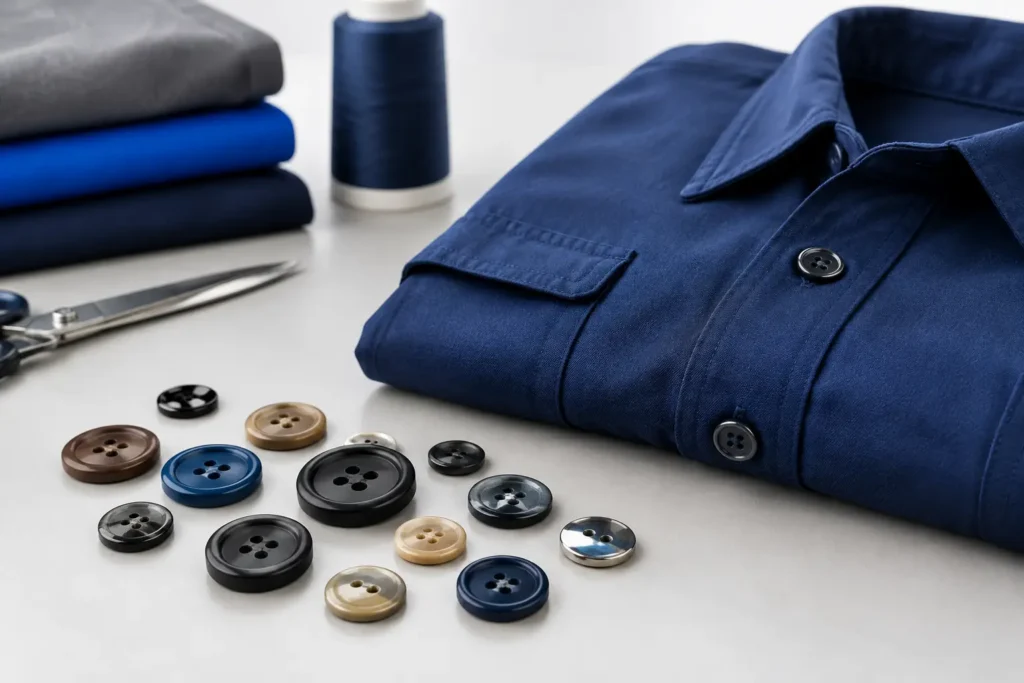
A workwear button may be small, but it is repeatedly pulled, pressed, washed, exposed to abrasion, and judged by the people wearing the garment every day. The best buttons for workwear programs are not defined by appearance alone. They are the buttons specified around the garment’s use case, fabric weight, fastening load, laundering method, branding requirements, and production volume.
For a uniform, utility overshirt, service jacket, or industrial-inspired apparel line, the right choice is usually a production decision rather than a styling decision. A button that looks correct on an initial sample can still be unsuitable if its construction, finish, attachment method, or color variation is not aligned with bulk production conditions.
Selecting the Best Buttons for Workwear Programs
Start with the garment category and the operating environment. Lightweight staff shirts, canvas chore coats, utility trousers, and insulated outerwear do not place the same demands on a closure. The best specification must account for where the button sits, how often it will be opened, the thickness of the button stand, and the likely laundering process.
Material selection comes first, but material alone does not determine suitability. Button diameter, thickness, hole or shank construction, rim profile, and finish all affect the finished garment. A 24L four-hole button might work well on a work shirt placket, while a 32L or 36L button may be more appropriate for a heavier overshirt or jacket. The correct Ligne size should be confirmed against the garment sample, buttonhole dimensions, and sewing thread selection rather than chosen from a digital artwork alone.
Resin buttons for broad workwear applications
Resin and polyester-style button constructions are often practical for workwear collections because they offer broad options for shape, color development, surface effect, and logo treatment. They can be produced as standard four-hole buttons, two-hole buttons, shank buttons, or custom molded forms. For programs requiring a branded uniform appearance across several garment styles, this flexibility can simplify visual coordination.
A resin button can be produced in solid colors, mottled effects, horn-look effects, or more restrained matte finishes. However, a visual effect approved on a prototype should not be treated as a final bulk standard without a physical pre-production reference. Tone, translucency, marbling, and surface texture can vary according to the selected material formulation, finish, and production process.
For dark workwear, a low-gloss or matte resin finish can reduce the appearance of surface scuffing compared with a highly polished visual direction. That said, the best finish depends on the garment’s intended presentation. A branded hospitality uniform may need a cleaner, more refined surface than a field overshirt designed around a rugged utility aesthetic.
Metal buttons for jackets and branded outerwear
Metal buttons are commonly considered for work jackets, denim-inspired garments, outerwear, and heritage utility programs. They provide weight and a distinct tactile impression, and they can support logo engraving, debossing, embossing, or other custom branding approaches depending on the button construction.
The trade-off is that metal is not a single material specification. Base metal, construction method, plating or coating direction, logo relief, edge treatment, and attachment method all need definition. A button intended for a front closure has different practical requirements from a decorative cuff button. The garment fabric also matters: a heavy canvas can support a more substantial button than a lightweight poly-cotton shirt.
When a finish is important, specify it clearly using physical references where possible. Terms such as antique brass, black nickel, gunmetal, or matte black describe a visual direction, but they do not replace an approved finish sample. Finish appearance and tolerance should be reviewed for the specific material, order, and production route.
Natural materials and specialist looks
Corozo, horn, shell, wood, and ceramic can create distinctive workwear details, particularly for premium heritage collections, contemporary uniforms, or limited product capsules. Their visual character can be valuable when the button is intended to contribute to the garment identity rather than disappear into the fabric.
These materials require a more deliberate specification process. Natural grain, tone, pattern, and surface variation are part of the material character. They should not be specified as if they will match a flat synthetic color exactly. For programs requiring strict visual consistency across large quantities, a molded or resin-based alternative may be easier to control. For programs where authentic variation is desired, the approved sample should define the acceptable range.
Construction Matters as Much as Material
A workwear button must be appropriate for the way it is sewn and used. Two-hole and four-hole sew-through buttons are widely used on shirts, overshirts, trousers, and jackets because they sit close to the garment and allow the sewing operation to be reviewed clearly. Shank buttons can suit outerwear or structured garments, but they require enough clearance and reinforcement to avoid stressing the fabric.
Button thickness should be considered alongside the fabric stack. A thick button on a narrow placket can create an awkward closure, while a thin button on a heavy twill jacket may look underscaled and feel insubstantial. The rim also matters. A recessed sew-through area can help protect the thread visually, whereas a flat face may better suit a minimal branded design.
Do not finalize a button based only on a CAD drawing or artwork rendering. A physical sample sewn onto the actual garment fabric gives product teams a more reliable view of proportion, buttonhole fit, hand feel, and logo visibility. It also allows the garment factory to assess the practical sewing method before bulk production begins.
Specify Branding Without Losing Production Clarity
For workwear programs, branding is often most effective when it is controlled rather than oversized. A small engraved logo on a metal button, a debossed mark on resin, or a subtle laser-marked detail can support brand recognition without competing with the garment’s function.
The artwork needs to be assessed against button size and manufacturing method. Fine lines, small lettering, and tightly spaced logo details may not reproduce clearly at every diameter. A logo that reads well on a 36L button may need simplified artwork for a 20L cuff button. Product teams should provide vector artwork, the intended logo orientation, size range, and finish direction early in development.
Pantone references can guide color development for dyed or molded buttons, but a Pantone code is not by itself a bulk approval standard. Material base color, texture, gloss level, and viewing conditions affect perceived color. For that reason, a physical color sample or approved standard should be used to establish the acceptable target and tolerance for the actual order.
Build Sampling Into the Workwear Development Plan
Sampling is where a visual concept becomes a production-ready button specification. The most useful sample request identifies the material, size in Ligne and millimeters, shape, thickness, hole or shank construction, color or finish, logo method, and intended garment application. If there are several garment styles in the program, identify whether one button must work across all styles or whether separate sizes are planned for fronts, pockets, cuffs, and waistbands.
Tooling may be required for custom shapes, custom logo molds, or specialist constructions. This should be discussed before the design is treated as final, as tooling requirements can affect development timing and the economics of an order. MOQ and production lead time should also be confirmed per material, construction, customization level, and quantity. A stock-style shape with a custom color may follow a different path from a fully custom branded metal button.
Before approving bulk production, review physical samples for the details that affect real garments: diameter, thickness, edge profile, hole placement, logo legibility, color, finish, and attachment appearance. Where a workwear buyer has defined performance, laundering, brand, or market requirements, the required testing and documentation scope should be agreed for the specific button, garment, and supply route. Requirements should not be assumed to transfer from one material or program to another.
Plan Quality Review Around What Can Vary
A useful bulk quality review does more than check whether the button resembles the approved sample. It identifies the characteristics that need control for the program: size tolerance, shape consistency, hole or shank formation, surface condition, finish appearance, and logo definition. For mixed-material or natural-material buttons, it should also establish what degree of visual variation is acceptable.
Packaging and delivery planning matter as well. A button can arrive in good condition and still create factory delays if packs are not identified by size, color, finish, or garment application. Clear item codes and approved sample references help prevent a cuff button, pocket button, and front closure button from being confused during garment production.
NZXTRIM can support this process from initial feasibility review through physical sampling, bulk quality review, and international delivery planning. The most effective inquiries begin with the garment use, button specification, artwork, target quantity, and required delivery window.
The right workwear button is the one that remains visually appropriate after the garment has moved from a design board to a sewing line, a wash process, and repeated daily use. Specify it early, sample it on the real fabric, and approve it as a controlled production component rather than a final styling detail.