
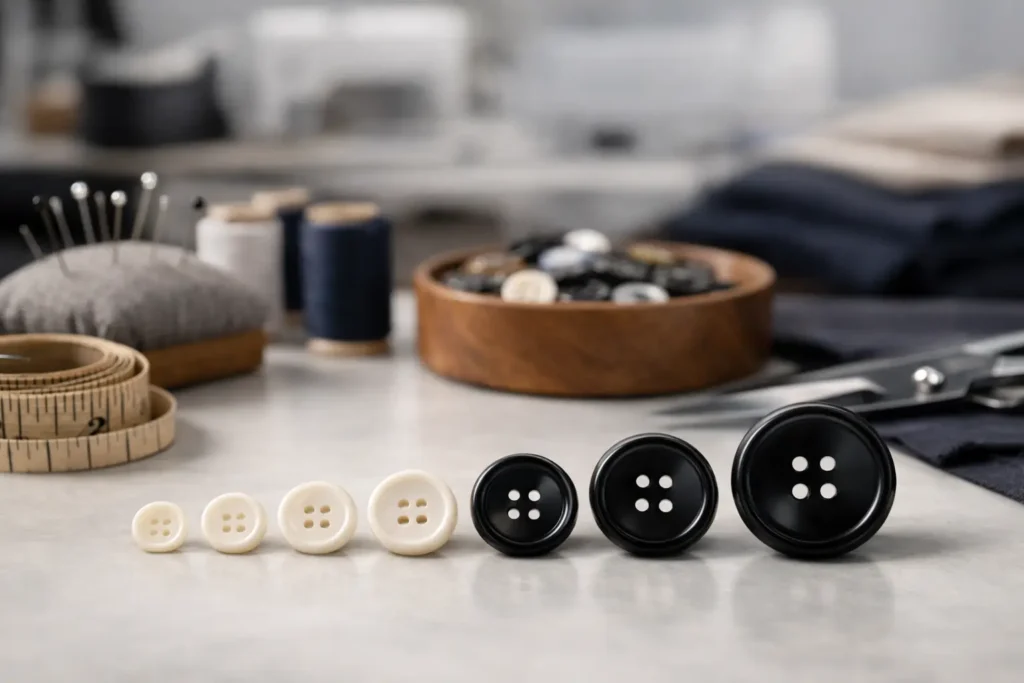
A button that looks balanced on a prototype can look undersized once a garment is graded, washed, pressed, and displayed on a hanger. This clothing button size guide helps apparel teams specify button diameters with the garment’s purpose, fabric weight, construction, and production requirements in mind. The goal is not simply to choose a standard size. It is to select a button that performs reliably and supports the intended brand appearance at bulk scale.
Why button size is a production decision
Button diameter affects more than the visual finish of a garment. It influences buttonhole dimensions, sewing operations, reinforcement requirements, packaging protection, and the customer’s experience when fastening the garment. A small difference of 1 or 2 mm can change the perceived quality of a shirt placket or the balance of a tailored jacket.
For product developers, the right size depends on proportion. A lightweight blouse may need a refined 10 mm to 12 mm button, while a winter coat may require a 25 mm to 30 mm button with enough visual weight to suit its fabric and silhouette. Choosing a size by appearance alone can create problems when the selected material, thickness, or shank construction is introduced.
The best specification considers the complete garment. Fabric thickness, interfacing, buttonhole type, wear frequency, and washing method all matter. A button for a fashion sample may be acceptable at one size, but a uniform program or large wholesale order requires a more controlled technical decision.
Clothing button size guide: mm, ligne, and common uses
Button sizes are most commonly stated in millimeters, although ligne is still widely used in button manufacturing and sourcing. One ligne equals 0.635 mm. For practical apparel development, millimeters are usually easier to communicate across design, technical, and factory teams.
The following ranges are common starting points. They should be adjusted based on the garment design and button material.
| Button size | Approximate ligne | Typical apparel use | |—|—:|—| | 8-10 mm | 13-16L | Babywear, delicate blouses, fine shirt details | | 11-13 mm | 18-20L | Women’s blouses, lightweight shirts, cuffs | | 14-16 mm | 22-25L | Standard shirts, polos, casual dresses | | 17-19 mm | 27-30L | Overshirts, lightweight jackets, knitwear | | 20-23 mm | 32-36L | Trousers, cardigans, blazers, workwear | | 24-28 mm | 38-44L | Coats, heavy jackets, outerwear | | 30 mm and above | 48L+ | Statement outerwear, duffle coats, specialty garments |
These ranges are reference points rather than fixed rules. A 15 mm corozo button has a different presence from a 15 mm polished metal button, and a thick 20 mm resin button may appear larger than a flatter button of the same diameter. Surface finish, edge profile, thickness, and color all affect visual scale.
Standard shirt button sizes
For most adult woven shirts, 10 mm to 12 mm buttons are common on the collar, collar stand, cuffs, and front placket. Some brands use 11.5 mm or 12 mm as a consistent shirt-button standard because it offers a good balance of handling, durability, and appearance.
A more casual shirt, overshirt, or flannel style may use 14 mm to 16 mm buttons. This larger scale works especially well with heavier fabrics, visible topstitching, and relaxed silhouettes. If a shirt has a front placket button at 15 mm, using a smaller size at the collar or cuffs can be appropriate, but the size difference should feel intentional rather than accidental.
Jacket, blazer, and coat button sizes
Tailored blazers often use 18 mm to 23 mm buttons, depending on lapel width, fabric weight, and the number of front buttons. Sleeve buttons are commonly smaller than front buttons, often around 15 mm to 18 mm. This creates hierarchy and keeps the sleeve detail proportional.
For coats and heavy outerwear, 25 mm to 30 mm is a frequent range. Wool coating, padded jackets, and dense workwear fabrics need buttons with enough diameter and thickness to remain functional through the buttonhole. Larger is not always better: an oversized button can pull the front edge, distort the buttonhole, or feel inconvenient in use.
Pants, denim, and utility garments
Trouser buttons are commonly 17 mm to 20 mm, particularly for waistband closures. A flat four-hole button is suitable for many tailored pants and uniforms, while a shank button may be preferred where fabric thickness or a cleaner face appearance is required.
Denim and utility garments often use 17 mm metal tack buttons, although exact sizes vary by brand and construction. The fastening system must be selected as a unit. A metal tack button cannot be specified only by cap diameter; the post length, backing component, fabric thickness, and pull-strength requirements must also be confirmed.
Match button size to material and thickness
Diameter is only one part of a button specification. A production-ready brief should also define material, thickness, hole configuration or shank type, finish, and acceptable tolerance.
Resin buttons offer broad flexibility in color, transparency, marbling, imitation horn effects, and custom shapes. They can be made in many standard and custom diameters, but thickness should be matched to the fabric and sewing method. A thick button on a fine fabric can create puckering, while a thin button on heavy brushed fabric may sit too close to the garment and become difficult to fasten.
Corozo buttons provide a natural, premium appearance and are often selected for shirts, knitwear, tailored garments, and sustainable collections. Because corozo has a distinctive grain and matte depth, it can appear visually substantial even at smaller sizes. Horn buttons have similar considerations, with natural variation that should be managed through approved color and grain standards.
Metal buttons can look visually dominant, especially in polished finishes or high-contrast colors. A 15 mm gold metal button may be more noticeable than a 20 mm matte resin button. For uniforms, jeans, and outerwear, metal components also require corrosion, plating, and attachment testing suited to the intended use.
Buttonholes must be planned with the button
A buttonhole should not be finalized before the production button is approved. The buttonhole length needs to accommodate the button’s usable diameter and thickness, while still holding it securely during wear. A round, domed button usually requires more opening allowance than a flat button with the same diameter.
As a practical starting point, buttonholes are often made slightly longer than the button diameter. The final allowance depends on the button profile, fabric recovery, machine setting, and whether the buttonhole is a straight, keyhole, or bound construction. Stretch fabrics and bulky fabrics need additional testing because the buttonhole can distort under tension.
For bulk production, use actual approved buttons during buttonhole trials. Digital renderings, supplier photos, and nominal dimensions are not enough. A button specified as 18 mm may have an edge profile or manufacturing variation that changes its passing fit.
Tolerances and consistency for bulk orders
Fashion brands often focus on the nominal button diameter, such as 15 mm or 20 mm. For production, acceptable tolerance is equally important. The tolerance should be realistic for the chosen material and manufacturing process while remaining tight enough to protect garment consistency.
Custom molded resin buttons can generally support controlled dimensions and repeatable shape across large orders. Natural materials such as horn and corozo require a different approach because visual variation is part of their character. The diameter can be controlled, but color, grain, and surface pattern should be approved within an agreed sample range rather than treated as identical from piece to piece.
Quality control should check diameter, thickness, hole placement, shank strength, surface defects, color consistency, and finishing quality. For logo buttons, artwork position and legibility also require inspection. These details become especially important when buttons are produced in multiple colors, sizes, or repeat purchase orders.
How to specify the right button size to a factory
A clear button request reduces sampling rounds and prevents misunderstandings between design, sourcing, and production teams. Include the button diameter in millimeters, material, thickness target, hole or shank construction, finish, color reference, quantity, and garment application. If the button is intended for a specific buttonhole, provide the buttonhole specification or a garment sample whenever possible.
It is also useful to identify which sizes belong to each garment location. For example, a blazer may require 22 mm front buttons and 16 mm sleeve buttons in the same material and finish. This avoids mismatched tones or surface treatments when sizes are developed separately.
For custom projects, request physical samples before approving mass production. Sampling confirms not only size, but also hand feel, sewing performance, color match, and the way the button reads against the actual fabric. NZXTRIM supports this development process from material selection and prototype sampling through controlled bulk production for apparel brands and manufacturers.
A well-sized button is rarely noticed as a separate component by the end customer. It simply makes the garment feel considered, functional, and complete. That is exactly the result a good button specification should deliver.