
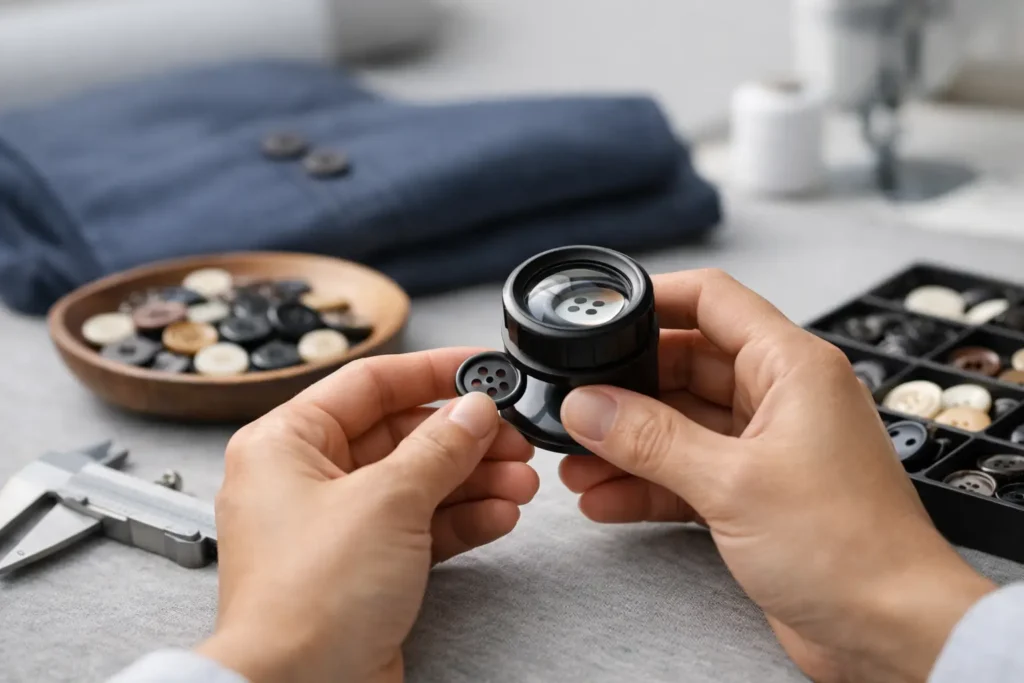
A button that cracks after dry cleaning, loses its finish during washing, or arrives in a slightly different shade can undermine an otherwise well-made garment. Clothing button quality control is not a final inspection task alone. It is a production system that begins with material selection and continues through molding, finishing, sewing tests, packing, and shipment.
For apparel brands, garment factories, and sourcing teams, button consistency affects more than appearance. It influences production efficiency, return rates, compliance confidence, and the customer’s perception of garment quality. A dependable button supplier should be able to define quality standards before production starts, verify them during manufacturing, and maintain them across every carton in a bulk order.
Why Button Quality Requires Factory-Level Control
Buttons are small components, but they work under repeated mechanical stress. They are pulled during dressing, exposed to laundering chemicals, pressed by ironing equipment, and sometimes subjected to dry cleaning, abrasion, saltwater, or high heat. The required performance depends on the garment category.
A decorative metal button for a fashion blazer may need exceptional plating consistency and scratch resistance. A resin button for children’s apparel may require careful edge finishing, secure construction, and material controls appropriate to the customer’s market requirements. A corozo button for a premium shirt needs stable color absorption, clean holes, and a uniform natural appearance without being artificially identical.
This is why acceptable quality cannot be defined only as “looks good.” The correct standard depends on the button material, end use, garment care label, attachment method, target price, and brand expectations. Factory quality control converts these variables into clear, measurable acceptance criteria.
Clothing Button Quality Control Starts Before Sampling
Many bulk-production problems originate in an approval process that was too vague. A physical sample should establish more than the button shape and color. It should also confirm dimensions, material, logo details, hole configuration, surface treatment, finish level, and acceptable variation.
For custom buttons, approved artwork and technical specifications should identify the diameter, thickness, back type, logo position, color reference, and finish. If a button is made from natural horn, corozo, or shell, the specification should acknowledge natural grain and tone variation. Trying to force natural materials into an unrealistically uniform appearance can create unnecessary rejection rates and may reduce the material’s authentic character.
Color approval deserves special attention. A color chip, Pantone reference, approved master sample, or garment fabric swatch gives the factory a practical benchmark. However, color can appear different under daylight, warm indoor lighting, and retail lighting. For buttons with transparent resin, pearl effects, metallic plating, or mottled finishes, the base material and surface texture can also influence the final shade.
At NZXTRIM, the sampling stage is used to align these details before a custom mold or bulk production is released. A clear approved sample becomes the production reference for inspectors, operators, and the customer’s quality team.
Material Inspection Prevents Hidden Defects
Raw materials determine the durability and appearance of the finished button. Resin compound, metal blanks, corozo nuts, horn pieces, ceramic bodies, pigments, plating chemicals, and recycled materials should be checked before they enter production.
For resin buttons, factories monitor material quality, pigment distribution, mold flow, and curing conditions. Poor curing can lead to brittleness, warping, or surface marks that may not be obvious at first glance. For metal buttons, the base metal, stamping quality, soldering or assembly strength, and plating preparation all affect long-term performance.
Natural materials require a different approach. Corozo and horn can show variation in grain, density, and color because each piece originates from a natural source. Good control means sorting materials appropriately, setting realistic visual standards, and rejecting pieces with cracks, weak areas, or unacceptable staining. It does not mean eliminating every natural difference.
Recycled buttons also need disciplined incoming inspection. Sustainable content is valuable to many brands, but recycled feedstock can vary more than virgin material. The factory must control color matching, material stability, and surface quality batch by batch rather than assuming one successful run guarantees the next.
What Is Checked During Button Manufacturing?
In-process inspection identifies defects when they can still be corrected efficiently. Rather than waiting until the finished goods stage, trained quality staff and production operators should inspect critical points throughout manufacturing.
The exact checkpoints differ by material and construction, but they commonly include:
- Diameter, thickness, weight, hole size, and hole spacing against the approved specification.
- Surface quality, including scratches, bubbles, sink marks, chips, sharp edges, stains, and uneven polishing.
- Logo engraving, embossing, printing, or laser marking for legibility, position, and depth.
- Color, gloss, plating tone, and finish consistency against the approved sample.
- Shank attachment, rivet security, two-piece assembly, and other structural details where applicable.
Measurements should be taken with suitable gauges rather than visual judgment alone. A small diameter deviation may seem minor, but it can interfere with automatic sewing equipment or fail to fit the garment’s buttonhole. Similarly, blocked or poorly drilled holes can slow down sewing lines and create costly rework at the garment factory.
For molded buttons, mold maintenance matters as much as inspection. Worn cavities, incomplete filling, unstable temperature settings, or inconsistent pressure can produce dimensional variation across a production run. For metal buttons, worn stamping dies and inconsistent plating processes can create sharp edges, uneven logos, or color variation between lots.
Performance Testing Must Match the Garment
Visual approval is only one part of button quality. Performance testing confirms whether the button can withstand the conditions it will face after the garment leaves the factory.
Wash testing can reveal color bleeding, finish loss, cracking, corrosion, or distortion. Dry-cleaning testing is relevant for suits, coats, formalwear, and other garments with dry-clean-only care instructions. Abrasion testing may be valuable for metal finishes and high-contact uniform applications. Pull testing helps assess shank strength and the integrity of assembled button components.
There is no single test plan that fits every button. A lightweight decorative button on a runway garment and a heavy-duty button on workwear should not be evaluated by the same performance threshold. Brands should share intended use and care requirements early, allowing the supplier to recommend appropriate materials, finishes, and test methods.
Trade-offs are real. A highly polished surface may show scratches more easily than a matte finish. Certain plating colors may require extra protection for frequent laundering. A natural material may offer premium character while carrying more visual variation than a molded resin alternative. Quality control helps buyers make these decisions deliberately rather than discovering limitations after bulk delivery.
Final Inspection and Packing Control
Final inspection verifies that finished buttons meet the approved standard before packing. This stage usually combines visual review, dimensional checks, functional sampling, and quantity confirmation. Inspection should be based on a defined sampling method and agreed acceptance level, particularly for large wholesale orders.
Inspectors compare bulk goods with the approved master sample and separate defects such as incorrect color, damaged surfaces, distorted shapes, incomplete logos, blocked holes, weak shanks, or mixed sizes. They also check for lot-to-lot consistency. A carton that contains buttons from different color batches can create visible variation on a finished garment, even when each individual batch appeared acceptable on its own.
Packing is part of quality control, not an afterthought. Buttons need packaging that prevents scratching, deformation, moisture exposure, oxidation, and mixing during transportation. Metal buttons may need protective separation or anti-tarnish measures. Delicate ceramic or shell buttons may require compartmentalized protection. Every carton should have clear labels for style, size, color, quantity, production lot, and customer reference.
Accurate packing also supports garment-factory efficiency. When a sewing line receives clearly identified, correctly counted button lots, it can avoid delays caused by recounting, sorting, or searching for the right size.
How Buyers Can Build Better Quality Specifications
The strongest supplier relationships begin with specific information. When requesting samples or quotations, provide the button’s intended garment use, material preference, dimensions, required quantity, target delivery date, logo artwork, color reference, and expected care conditions. If the button must meet a particular testing protocol or market requirement, state it before development begins.
It also helps to identify which characteristics are non-negotiable and where reasonable variation is acceptable. For example, a luxury brand may require highly consistent logo placement but accept natural grain variation in horn buttons. A uniform supplier may prioritize wash durability and exact color matching over decorative surface complexity.
Buyers should request pre-production samples for custom programs, especially when changing material, finish, mold, plating, or color. Once approved, the sample should remain the reference throughout mass production. This reduces subjective disagreements and gives both the brand and factory a common standard.
A button is often the part of a garment customers touch first and notice last. Treat it as a controlled product component from the earliest design discussion, and it can reinforce the quality promise built into every garment.