
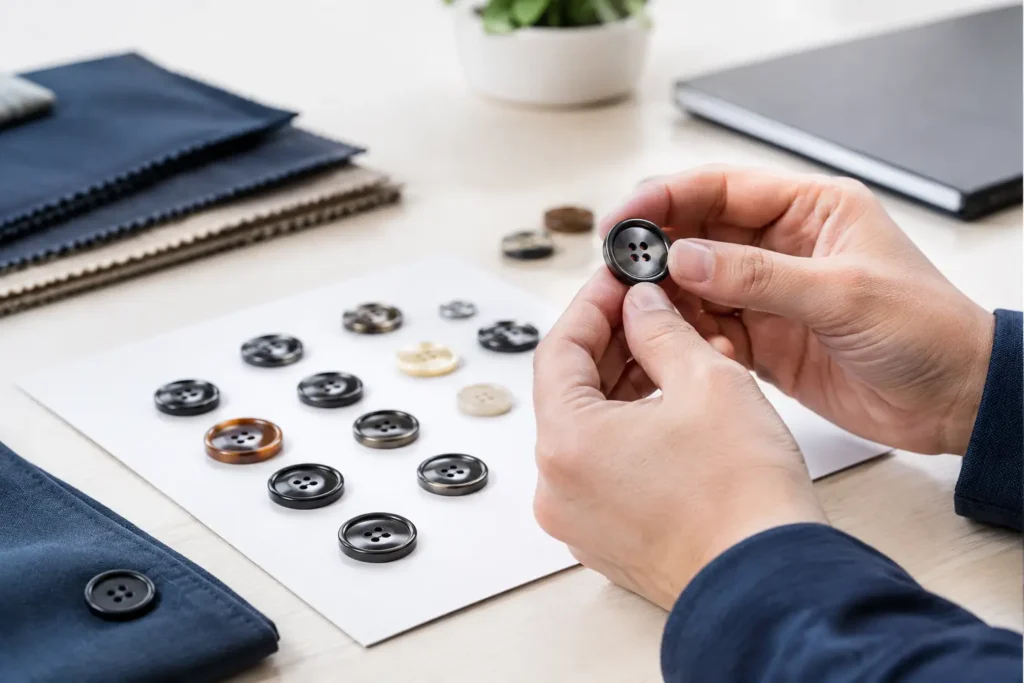
A sample approval review is the point where a button concept becomes a production instruction. For apparel teams, this review should do more than confirm that a sample looks right on a table. It should establish whether the approved button can be reproduced consistently across bulk production, in the specified material, construction, color, and finish.
A physical sample is valuable because custom buttons combine visual design with manufacturing variables. A logo may be clear in a digital rendering but shallow after molding. A Pantone reference may look suitable on a resin chip but shift on natural horn, shell, wood, or corozo. A metal finish may change with the base material, shape, engraving depth, or surface treatment. The approval process is where those differences are identified before a bulk order is released.
For NZXTRIM projects, the most useful approval is not simply “approved as shown.” It is approval against a documented specification that gives the factory, garment manufacturer, and buyer the same reference point.
What a Sample Approval Review Must Confirm
The review should begin with identity: is this the correct button for the correct garment style? Confirm the material, size in millimeters or Ligne, button shape, hole arrangement, shank construction, edge profile, and intended placement. These details can sound basic, but small differences affect sewing, garment drape, and the overall appearance of a finished style.
Material should be confirmed by name rather than by appearance alone. A dark natural material and a dark molded material may look similar in a photograph, yet they have different variation, weight, surface character, and production process. If the button is specified as recycled-content resin, corozo, shell, horn, wood, ceramic, metal, or another specialist material, that designation should appear in the approval record. Material claims, recycled-content scope, and related documentation must be verified for the specific order and supply route rather than assumed from a prior sample.
Color review also needs a defined basis. For dyed, molded, painted, or coated buttons, record the supplied Pantone reference where applicable, together with the approved physical standard. Pantone is a target, not a guarantee that every material will reflect light in the same way. Gloss level, texture, button thickness, and the material underneath a coating can all affect how color is perceived.
Natural materials require a different approach. Corozo, horn, shell, and wood can show grain, tonal movement, growth marks, or other inherent variation. The buyer should decide whether the approved sample represents a preferred look, an acceptable range, or a tightly controlled selected appearance. Without that decision, a natural feature may later be mistaken for a quality issue when it is actually part of the material character.
Confirm the construction, not only the face
The back of the button deserves the same attention as the front. A two-hole or four-hole button should be reviewed for hole diameter, spacing, countersink shape, and edge smoothness. A shank button should be checked for shank position, opening size, and alignment. For covered, composite, or assembled constructions, confirm the joining method and whether the visible face remains stable after normal garment handling.
Construction affects how a button runs through garment assembly. If the sewing equipment, thread size, or attachment method has constraints, share them before sample approval. A button that appears correct visually may create avoidable sewing difficulty if its holes are too small, too close together, or insufficiently countersunk for the intended thread.
For metal buttons, assess the relationship between the face, back, rim, and attachment feature. For molded buttons, look at parting lines, gate positions, molding marks, and surface consistency. These details may be acceptable when agreed in advance, particularly on small components, but should not be left to interpretation after bulk production begins.
Reviewing Logos and Surface Detail
Custom branding often creates the largest gap between a visual concept and a production-ready button. Engraving, debossing, embossing, laser marking, printed graphics, and molded logos each have practical limits based on material, button diameter, line weight, and surface texture.
During review, confirm the logo artwork version, orientation, position, scale, and legibility. Fine text that is readable at a large artwork scale may fill in, soften, or lose definition on a small button. Deep relief can create a stronger shadow effect, but it may alter the face profile or require different tooling. A shallow mark can be more subtle and easier to reproduce, but it may be less visible on a textured or low-contrast surface.
The correct question is not only, “Does the logo look good?” It is, “What level of definition is acceptable in bulk at this size and material?” If the design depends on a specific contrast between a recessed logo and the surrounding surface, document that feature in the approval comments. A clear written observation is more useful than relying on memory when several garment styles are being developed at once.
Use a Controlled Sample Approval Review Process
A practical review process limits subjective feedback and prevents a revised sample from introducing unintended changes. Begin by comparing the sample with the approved artwork, specification sheet, material reference, and garment component. Review under consistent lighting where possible, especially for dark shades, metallic finishes, translucent resin, and natural materials.
Record observations in terms that production teams can act on. “Make it better” is not actionable. “Increase logo depth slightly,” “move the shank to center,” “reduce visible gate mark on the lower edge,” or “match the approved warm gray reference more closely” gives a clear direction. If the buyer accepts a feature as-is, state that acceptance directly rather than leaving it unmentioned.
Photographs are useful for sharing feedback across sourcing, design, and factory teams, but they should support rather than replace the physical sample. Camera settings, screen calibration, and lighting can change color and surface appearance. Keep the approved sample identified with its style number, revision number, date, and relevant material code. This becomes the retained reference for bulk production review.
Where several sizes of the same button are required, approve each size or clearly define which features may vary by size. A logo, hole layout, rim width, or shank proportion that works on a 24 Ligne button may not translate directly to a smaller size. The same applies to different colorways. A construction approved in matte black may need separate assessment in pearl, transparent, or metallic finishes.
Decide What Is Critical and What Can Vary
Not every feature needs the same control level. A useful approval separates critical requirements from acceptable production variation. Critical requirements might include the correct material designation, button size, hole or shank construction, logo identity, and intended color family. Acceptable variation may include minor tonal movement in natural material, small surface differences inherent to a finish, or detail changes that are not visible in the finished garment.
This distinction helps purchasing and quality teams make faster decisions later. It also avoids rejecting bulk buttons for traits that were foreseeable and acceptable at the sample stage. Conversely, it prevents a visually attractive first sample from being treated as a standard when it cannot reasonably be repeated across the required production quantity.
The balance depends on the garment program. A luxury outerwear button may justify close control of natural material selection and logo finish. A large uniform program may prioritize stable dimensions, consistent attachment construction, and repeatable color appearance. A fashion capsule may accept more material variation if that variation is part of the intended design expression.
Release Bulk Production With a Complete Record
Bulk production should be released only after the final sample status is clear: approved, approved with stated comments, or revised sample required. If changes are requested, confirm whether they affect tooling, material selection, finish, price basis, minimum order quantity, or production timing. Even a small artwork adjustment can require a new tooling review or another physical sample.
The release record should identify the approved sample and capture the final specification: button style number, material, size, color reference, construction, logo method, finish, quantity by size or color, and packing expectations. It should also note any agreed natural variation, visual tolerance, or special handling point. This is particularly useful when the button will be reordered months later or used across multiple garment factories.
Sample approval does not eliminate every production decision. It gives those decisions a shared framework. When the factory and buyer can refer to the same physical standard and written requirements, questions can be resolved against evidence rather than opinion.
Treat the approved button as a working production reference, not a ceremonial sign-off. The clearer the review record, the easier it is to protect design intent while keeping bulk manufacturing practical.