
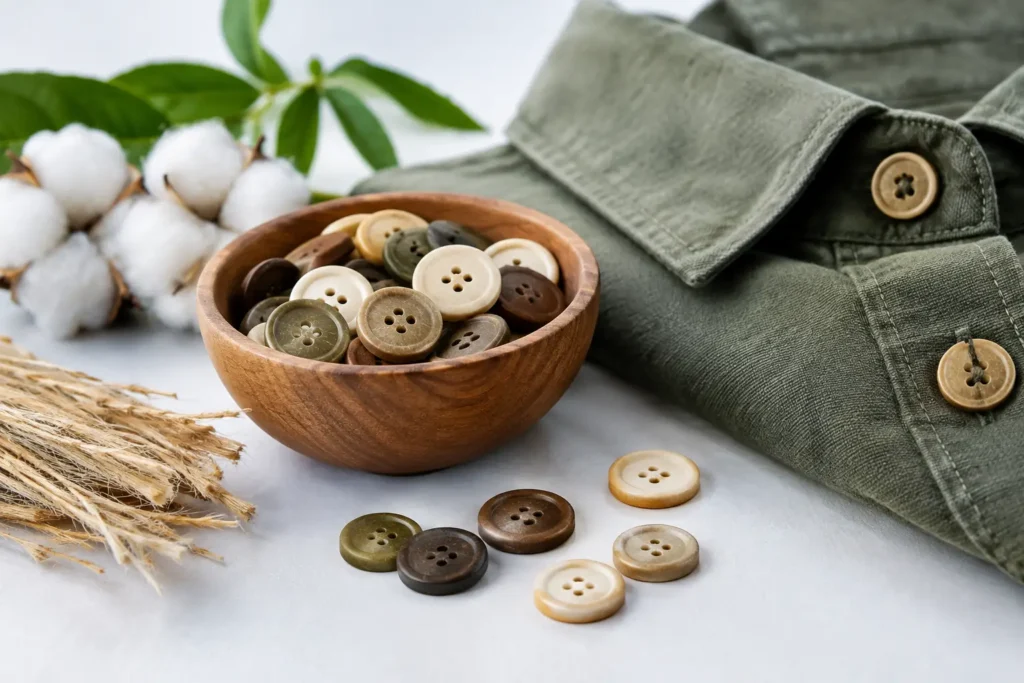
Biobased buttons are not one standard product category. For an apparel development team, the useful question is not simply whether a button is biobased, but which portion of its material comes from biological feedstock, how it is constructed, and whether it can meet the garment’s visual, wear, and production requirements.
A button may be made from a naturally derived material such as corozo, wood, shell, or horn. It may also use a molded compound that incorporates plant-derived content. These options differ materially in appearance, machining behavior, color response, dimensional consistency, and available construction. A clear specification is therefore more valuable than a broad material claim.
What makes a button biobased?
In manufacturing terms, biobased generally refers to material derived wholly or partly from renewable biological sources rather than fossil-based feedstocks. That definition does not automatically describe the complete button, its dyes, pigments, coatings, backing components, or packaging. Nor does it establish a particular environmental outcome for a finished garment program.
For sourcing purposes, the term should be treated as a starting point for technical discussion. Ask what material is being proposed, whether it is natural or compounded, what supporting documentation may be available for the intended order, and which claims can be substantiated for the selected supply route. If a brand has internal material-policy requirements, these should be shared before sampling rather than added after tooling has begun.
Corozo is often considered first because it is a hard, naturally derived vegetable ivory material with a distinctive fine grain. It can be dyed, engraved, lasered, or polished, depending on the target effect. Its natural variation is part of its character, but it also means that exact uniformity should not be assumed in the same way as with a fully molded synthetic button.
Wood, horn, and shell can also fit a material-led design direction. Each brings its own visual properties: wood has grain and porosity, horn has organic depth and tonal variation, and shell can provide natural luster. These materials require a different approval mindset from a flat-color resin button. A reference image may communicate the intended style, but a physical sample is needed to define the acceptable range of grain, shade, surface marks, and polish.
Selecting biobased buttons by garment use
The right material depends on the garment category before it depends on the story attached to the material. A shirt button, a coat button, and a workwear closure face different stresses, thickness requirements, laundering expectations, and attachment methods.
For shirting, developers often prioritize low profile, clean sew-hole formation, consistent diameter, and reliable color coordination across sizes. Corozo can be suitable where a natural material appearance is desired, provided the selected construction and finish are reviewed in wash trials relevant to the garment. For tailored jackets and outerwear, thicker button profiles, two-piece constructions, shanks, or metal-backed designs may be considered, but the suitability of a natural or biobased face material depends on the intended wear conditions.
Uniform, workwear, children’s apparel, and performance-oriented products need particularly early review. Requirements may involve repeated laundering, dry cleaning, abrasion, pull force, chemical exposure, or other program-specific evaluations. A visual concept cannot confirm performance. The garment maker, brand, and button supplier should agree on the testing scope, button placement, and final construction for the exact program.
Size should be specified in both millimeters and Ligne where relevant. A request for a “20L button” is useful, but it should also state the required diameter, thickness, sew-hole diameter or shank type, and any tolerance that matters for automated sewing or existing buttonhole dimensions. This avoids a common development issue: a button looks correct on a presentation board but is not compatible with the factory’s production process.
Construction matters as much as feedstock
A biobased material can be used in several button constructions. The simplest is a four-hole or two-hole sew-through button. This format is practical for many shirts, blouses, knitwear pieces, and casual garments because the attachment method is familiar and the face can remain relatively flat.
A shank button creates a different garment silhouette and may be appropriate for jackets, dresses, or heavier outerwear. It also adds a construction decision. The shank may be formed as part of the button body or added as a separate component, and the selected method affects tooling, assembly, durability review, and material disclosure. If a program aims to make a specific biobased-content statement, every component should be considered rather than evaluating only the visible face.
Composite designs are often commercially sensible. For example, a natural-material face may be paired with another supporting component to achieve the required shape or attachment method. This can broaden design options, but it should not be described as a single-material button unless the full construction supports that description. Product developers should decide early whether their priority is the natural visual effect, the proportion of biobased input, a particular construction, or a defined performance target. Those priorities can conflict.
Color, logos, and surface development
Color development is one of the main areas where production expectations need to be realistic. Natural materials can accept dye or surface treatment differently from molded materials. Base tone, grain, density, and absorbency can influence the final result. A Pantone reference can guide development, but a physical approved sample remains the practical control point for bulk production.
Dark shades, washed effects, vintage finishes, and tonal variation may work particularly well with natural substrates. Clean pale shades or tightly controlled seasonal colors can require more development and may show batch-to-batch variation more readily. The appropriate color tolerance should be agreed during sampling, especially where buttons must coordinate with dyed fabric, thread, labels, or other trims.
Brand identification can be developed through engraving, debossing, embossing, laser marking, or a combination of methods. The best method depends on the material, button size, artwork line weight, and desired legibility. Fine logos that read clearly on a digital render can fill in, soften, or become difficult to see on a small curved surface. NZXTRIM reviews artwork as a production feature, including minimum detail, logo placement, and the need for tooling or sample trials.
Sampling before bulk approval
A production-ready button specification should include more than a material name and diameter. It should record the approved material and construction, size, thickness, hole or shank details, finish, color reference, logo artwork, packing requirement, and quantity by size. If the button will be used across several garments, list each application rather than assuming one construction suits every style.
Physical sampling is where appearance and manufacturability meet. Review samples under the lighting used for fabric approval, attach them to the actual garment fabric where possible, and inspect both the face and back. Check sewability, buttonhole fit, edge feel, logo clarity, and visual consistency across a small group of pieces. For natural materials, define which variation is acceptable rather than rejecting every difference from a computer-generated expectation.
Tooling may be required for custom shapes, certain logos, molds, or specialized constructions. Tooling timing and cost treatment vary by design, quantity, and material, so they should be confirmed before a launch calendar is finalized. A standard round shape with a simple laser mark may follow a different route from a custom domed button with a recessed emblem and a separate shank.
MOQ, lead time, and supply planning
There is no universal MOQ or lead time for biobased buttons. The material availability, button size range, custom color work, tooling, finish, quantity, and sample approval cycle all affect the production plan. Small runs can be feasible in some cases, while custom development across multiple sizes or colors may require a larger order basis to support consistent bulk manufacturing.
Lead-time planning should include artwork confirmation, material review, sampling, revisions, approval, bulk production, quality review, packing, and delivery coordination. Teams often lose time by treating button selection as a final styling task. For a custom program, it is more effective to develop buttons alongside fabric and garment construction, particularly when color matching or testing is required.
For brands making material-related claims, retain the approved specification and any applicable supplier records with the purchase documentation. Claims should match the exact button material and finished construction supplied, not a general category description or an early design concept.
The strongest starting brief is simple: provide the garment type, target button size, construction, color reference, artwork, expected order quantity, delivery window, and any required evaluations. That gives the development team enough information to turn a biobased button idea into a sample that can be assessed honestly on the garment it is meant to serve.