
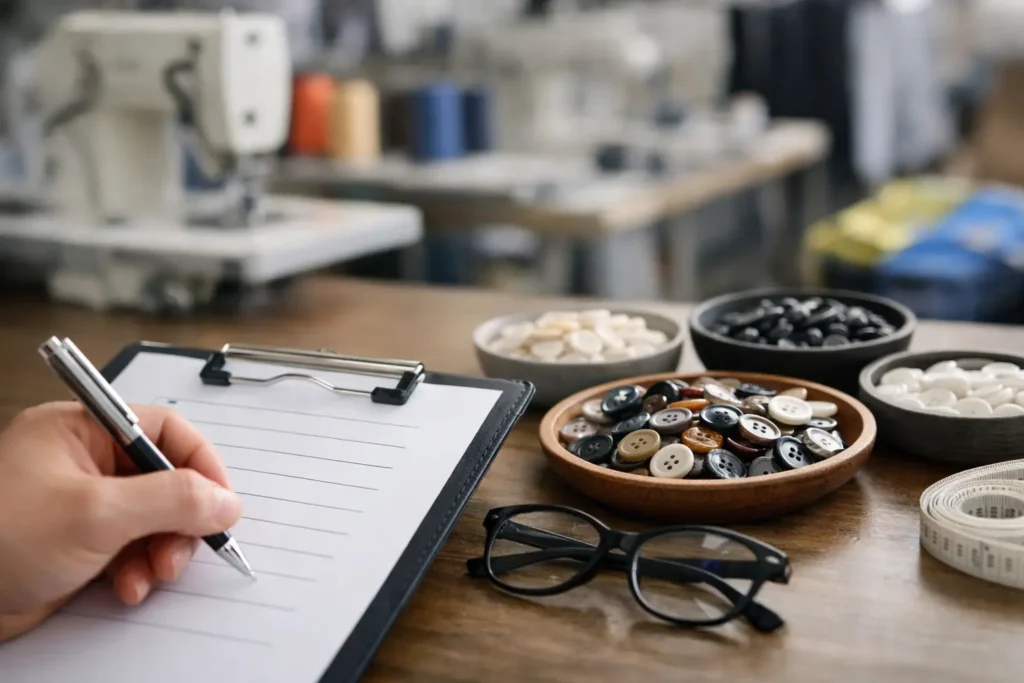
A button factory audit should answer a practical question before an apparel order moves forward: can this supplier reproduce the approved button accurately, at the required volume, and within the delivery window? A button may be small, but inconsistent color, weak shanks, rough edges, incorrect logo details, or late deliveries can hold up an entire garment shipment.
For clothing brands, garment factories, and sourcing teams, an audit is not simply a factory visit. It is a structured review of how a button manufacturer controls materials, development, production, inspection, packing, and communication. The goal is to reduce avoidable risk before a custom design becomes a bulk order.
Why a Button Factory Audit Protects Your Production
Buttons are functional trims and visible brand details. A premium resin button with a cloudy finish, a corozo button with uneven dye penetration, or a metal button with plating variation can change the perceived quality of a garment. When the same issue appears across thousands of units, the cost is far greater than replacing a few components.
A factory audit helps buyers distinguish between a supplier that can make an attractive sample and one that can manage repeatable mass production. This distinction matters most for custom buttons involving engraved logos, special colors, multiple finishes, unusual shapes, or strict shade requirements.
The depth of the audit should match the project. A simple stock polyester button for a basic uniform order may need a focused supplier review and pre-production sample approval. A luxury collection with custom horn, ceramic, metal, or recycled-material buttons may justify a more detailed assessment of material sourcing, finishing methods, traceability, and quality records.
Start With Factory Identity and Production Scope
Confirm who will actually manufacture the buttons. Some suppliers operate their own production facility, while others are trading companies, development offices, or mixed sourcing organizations. A trading partner can be useful, but buyers should understand where molds are made, where production occurs, and who controls quality during each stage.
Ask the factory to explain its core production categories. Resin, corozo, horn, ceramic, and metal buttons have different manufacturing processes, equipment needs, and quality risks. A facility experienced in resin molding may not have the same level of control over ceramic firing or metal stamping. Specialized production knowledge is especially valuable when the design requires precise logo engraving, a multi-layer effect, a custom shank, or a difficult color match.
Review whether the supplier can support the full project cycle: design review, material recommendation, prototype development, mold creation, bulk manufacturing, inspection, and export packing. A factory with clear ownership across these stages can usually resolve technical issues faster than a supplier that must coordinate several outside parties.
Check Material Control Before Reviewing Finished Buttons
The finished sample is only part of the quality picture. Stable button quality starts with incoming material control. During a button factory audit, ask how raw materials are received, identified, stored, and released to production.
For resin buttons, this includes resin grade, pigments, fillers, and any recycled content claims. For natural materials such as corozo or horn, the factory should show how it sorts material for density, grain, thickness, and natural variation. Natural materials are not perfectly uniform, and that is often part of their appeal. The key is whether the supplier defines acceptable variation and can keep it consistent with the approved sample.
For metal buttons, review the base metal, plating specification, coating process, and protection against scratches or corrosion. If the button will be used on outerwear, workwear, uniforms, or childrenswear, the expected performance conditions should be agreed before production begins.
Material documentation does not need to be excessive for every order, but it should be sufficient for the product category and buyer requirements. If your brand needs recycled content, restricted-substance compliance, or specific country-of-origin information, raise these requirements during development rather than after bulk production has started.
Review Development, Molds, and Sample Approval
Custom button projects often succeed or fail during sampling. The audit should show how the factory turns a drawing, logo file, reference garment, or physical sample into production-ready specifications.
A dependable supplier should confirm the button diameter, thickness, hole size or shank construction, edge profile, logo position, finish, and color target. For engraved logos, examine whether the artwork is reviewed for legibility at the final button size. Fine details that look clear on a digital file may fill in or soften during molding, polishing, plating, or coating.
Mold management is another critical point. Ask how molds are numbered, stored, maintained, and linked to the approved design. This is particularly important for repeat orders. A well-managed mold system protects design consistency and reduces the chance of producing a similar but incorrect version of a button.
Sample approval should be documented. The approved sample should clearly identify the material, finish, color, size, and revision. If the buyer approves a sample with natural material variation, both parties should agree on what remains acceptable in bulk production. This prevents disputes caused by expectations that were never defined.
Inspect Process Controls on the Production Floor
A production floor review should focus on controls, not just machinery. Advanced equipment is valuable, but experienced operators, defined work instructions, and in-process checks are what keep a large order consistent.
Observe how the factory separates different orders, colors, sizes, and finishes. Mixed production can create avoidable errors when parts are not clearly labeled. For custom buttons, work orders should connect each batch to the correct specification, mold, material, and quantity.
Ask where inspections take place during production. A factory should not rely only on final inspection after every button has been completed. Checks at key stages can identify problems early, such as incorrect dimensions after molding, uneven drilling, poor logo definition, surface defects, or finish variation.
The exact tests depend on the button type and garment use. Useful checks may include diameter and thickness measurement, hole alignment, shank integrity, visual surface inspection, color comparison under controlled lighting, coating adhesion, and corrosion-related testing for applicable metal products. For a button intended for heavy garments, shank strength and structural durability deserve more attention than they would for a lightweight fashion blouse.
Verify How Quality Standards Are Defined and Recorded
A buyer should be able to ask, “What is acceptable, and how do you prove it?” The answer should include clear specifications and inspection records, not only a verbal promise of quality.
Review the factory’s approach to acceptable quality levels, defect classification, sampling methods, and corrective action. Critical defects may include sharp edges, broken shanks, wrong logos, incorrect sizes, or unsafe construction. Major and minor defects will vary by product, but the factory should have a consistent way to identify, isolate, and address them.
Color control requires special attention. Button colors are affected by material, batch variation, lighting, surface texture, and finishing. A matte resin button and a glossy resin button can appear different even when they use the same pigment formula. Ask whether the factory uses approved color standards, batch samples, and controlled lighting for comparison.
When color matching to fabric is required, provide the actual fabric or an approved standard whenever possible. Digital images are useful for communication, but they are not reliable final color references because screens and photography change appearance.
Assess Capacity, Lead Times, and Delivery Discipline
A factory may have enough equipment for a large order but still lack the planning discipline to meet a garment production schedule. Ask about normal sampling lead times, mold lead times, bulk production lead times, monthly capacity, peak-season scheduling, and how urgent orders are handled.
Capacity claims should be considered alongside the complexity of the button. A standard two-hole resin button can often be produced faster than a custom metal button requiring stamping, engraving, plating, and protective finishing. Low MOQ projects may require more setup time per unit, while large programs need strong batch control and realistic production planning.
Review packing methods as well. Buttons should be counted accurately, protected from scratching or moisture where needed, and packed in a way that supports receiving at the garment factory. Carton labels should make it easy to identify the style, color, size, quantity, purchase order, and production batch.
Reliable delivery also depends on communication. Buyers should know who provides production updates, when approval is required, and how a potential delay will be reported. Early notice gives a sourcing team options. Late notice often leaves none.
Use the Audit Results to Build a Better Supplier Relationship
An audit should not be treated as a pass-or-fail exercise based only on whether a factory looks polished. The stronger question is whether the supplier understands its own processes, identifies risks honestly, and has a practical method for controlling them.
Document agreed actions after the review. This may include sending revised color standards, clarifying defect limits, approving a production sample, improving carton labels, or confirming a test requirement. These details turn an audit from a report into a production tool.
For custom button programs, the best manufacturing relationship is built through precise specifications, early technical discussion, and repeatable approval procedures. NZXTRIM supports this process from material selection and prototype development through bulk production and delivery, helping apparel buyers move from a button concept to a dependable production standard.
Before releasing your next bulk order, make the audit serve the garment, not the paperwork. A supplier that can explain how it protects your design, controls variation, and responds when conditions change gives your team greater confidence at every production stage.