
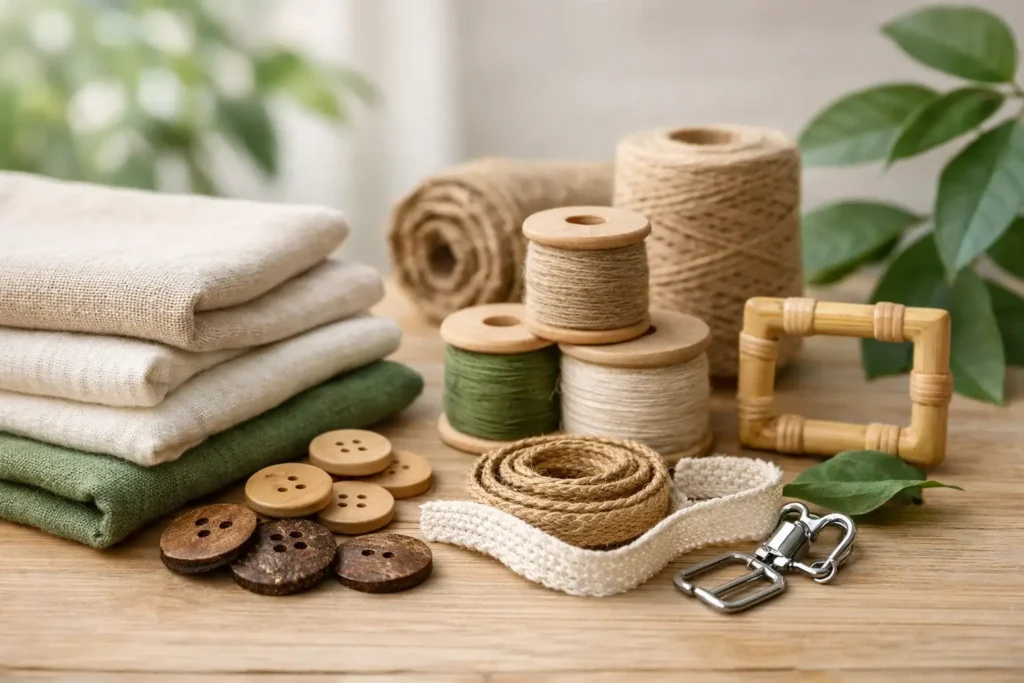
A garment’s environmental profile is not defined by its main fabric alone. Buttons, zippers, labels, cords, rivets, and packaging details may represent a small percentage of total material weight, but they strongly affect recyclability, durability, product appearance, and sourcing complexity. Sustainable fashion trims give apparel teams a practical way to improve these details without compromising the quality standards required for commercial production.
For brands, designers, and garment manufacturers, the right decision is rarely about choosing the material with the strongest environmental claim. It is about selecting a trim that fits the garment’s use, supports the intended design, can be produced consistently, and has credible material documentation. A button that looks excellent in a sample but chips during washing, creates color variation in bulk production, or cannot be sourced on schedule is not a sustainable choice in practice.
What Makes a Trim More Sustainable?
A sustainable trim should be evaluated across its full production and use cycle. The source material matters, but so do service life, manufacturing efficiency, compatibility with the garment, and end-of-life considerations. For example, a durable recycled polyester button may be appropriate for a technical outerwear program, while a natural corozo button may better suit premium shirting or tailored apparel.
The most reliable approach is to ask specific sourcing questions. What is the trim made from? Is recycled or renewable content verified? How is the finish applied? Can the supplier maintain the same quality across production batches? Does the trim withstand the garment’s care requirements? These details separate a considered material choice from a general marketing claim.
A trim also needs to match the product’s commercial reality. A luxury coat, school uniform, workwear garment, and fashion blouse have very different requirements for abrasion resistance, heat resistance, color fastness, button pull strength, and order volume. Sustainable development works best when design, purchasing, and manufacturing teams review these requirements at the beginning of the project rather than after samples have been approved.
Sustainable Fashion Trims: Material Options
There is no single best material for every garment category. Each option involves trade-offs in appearance, performance, price, tooling, and supply availability.
Recycled Resin and Recycled Polyester Buttons
Recycled resin buttons are widely used because they offer flexible color matching, shape development, logo customization, and dependable performance. Depending on the production method and material source, recycled content can be incorporated into button programs while maintaining a polished, horn-look, matte, transparent, or high-gloss surface.
For brands working with seasonal color palettes, recycled resin can be particularly practical. Custom molds allow teams to develop distinctive shapes, and pigment matching supports a coordinated garment finish. However, recycled content claims should be supported by supplier documentation, and brands should confirm whether a specific visual effect or color formula affects the percentage of recycled material that can be used.
Corozo Buttons
Corozo is a natural material made from the tagua palm seed. It is valued for its dense structure, natural grain, and premium hand feel. Corozo buttons can be dyed in a wide range of colors and work especially well for shirts, knitwear, blazers, trousers, and heritage-inspired collections.
Its appeal comes from both appearance and material origin, but it is not automatically right for every application. Natural variation is part of corozo’s character, which may not suit programs demanding perfectly uniform surface patterns. Buyers should also confirm dyeing performance, color consistency, and the desired finish during sampling, especially for large orders or repeat programs.
Horn and Horn-Effect Buttons
Genuine horn buttons offer a distinctive natural appearance and are often selected for premium tailoring and luxury garments. Because horn is a natural material, pattern and tone vary from piece to piece. That variation can add value to a refined collection, but it requires clear sample approval standards.
For brands seeking a similar visual direction with more controlled production consistency, horn-effect resin buttons may be a better choice. The decision depends on brand positioning, target price, material policy, and the level of natural variation the customer expects.
Metal Trims and Recycled Metal Content
Metal buttons, snaps, eyelets, rivets, and badges provide strength and a premium visual identity. They are common in denim, uniforms, workwear, outerwear, and leather goods. Recycled metal content may be available for selected trim types, while plating, coating, logo engraving, and corrosion resistance must still be carefully managed.
Metal trims should be tested for the garment’s intended use. A finish that performs well on a fashion jacket may not be suitable for industrial workwear, coastal environments, or frequent commercial laundering. Material declarations and restricted substance compliance should be reviewed as part of the development process, not treated as a final purchasing document.
Natural Fiber and Cellulose-Based Details
Cotton cords, paper-based hang tags, woven labels, wood buttons, and other cellulose-based accessories can support a lower-impact material story when properly sourced. These materials often create a warm, tactile look that suits casualwear, childrenswear, resort collections, and brands with natural design language.
Their limitations need equal attention. Some natural fiber trims have lower abrasion resistance or may change appearance after repeated washing. Wood can vary in grain and may require protective finishing. Paper components are generally more appropriate for packaging and branding than for permanent garment closures. The design team should define the expected wear conditions before locking the material specification.
Design for Durability and Easier End of Life
The most overlooked sustainability feature of a trim is its ability to keep a garment in use. A well-made button with correct hole spacing, edge finishing, thickness, and tensile strength can prevent avoidable repairs or garment rejection. This is especially relevant for uniforms, childrenswear, denim, outerwear, and garments that receive frequent washing.
Compatibility also matters. A garment made from one dominant material may be easier to recycle if its trims can be removed or are made from compatible materials. That does not mean every product must use a single material. Metal snaps may be essential for performance, and a contrasting button may be central to the design. The goal is to make intentional choices and communicate them clearly through product specifications.
Avoid unnecessary decoration where possible. A garment can gain strong brand identity from one well-designed custom button rather than multiple layered components with short-term visual appeal. Custom logo engraving, unique molds, laser marks, and carefully selected finishes can create distinction without adding excessive trim complexity.
What Apparel Buyers Should Confirm Before Production
Sustainable trim sourcing requires the same discipline as any technical component. Sampling should confirm more than color and appearance. Teams should review dimensions, weight, attachment method, surface quality, edge smoothness, care performance, and packing method. For buttons, this includes button pull strength and resistance to cracking, chipping, or discoloration under normal use conditions.
For larger programs, establish an approved standard sample and clear tolerances. Natural materials need acceptable variation limits, while recycled materials may require an agreement on speckling, shade range, or surface character. These standards help avoid disputes when bulk production begins.
Documentation should be proportionate to the program and customer requirements. Depending on the material and market, buyers may request recycled-content evidence, material declarations, restricted substance test reports, country-of-origin information, and production batch traceability. A responsible supplier should explain what documentation is available for the selected trim rather than making broad claims that cannot be verified.
MOQ and lead time deserve early discussion as well. Custom molds, special colors, complex plating, and unique surface finishes can extend development time. A factory partner with sampling capability, color matching experience, and stable production planning can help brands make sustainable choices without creating avoidable delays in the garment calendar.
Building a More Reliable Trim Program
The strongest trim programs are built around repeatable specifications. Instead of selecting a different button construction for every season, brands can develop a core library of approved materials, sizes, finishes, and colors. This improves purchasing efficiency, reduces sampling waste, and makes it easier to maintain consistent garment quality across factories and markets.
NZXTRIM supports this process through custom button development, material selection, mold production, logo engraving, color matching, quality control, and bulk manufacturing. For apparel teams, the value of a factory partnership is not only access to more material options. It is the ability to move from an approved concept to stable production with clear standards for quality and delivery.
The best next step is to start with one garment category and one trim family. Define the required performance, desired material direction, target price, and visual standard, then request samples that can be reviewed under real wear and care conditions. That practical process turns sustainable fashion trims from a broad objective into a product decision that can hold up in production and in the customer’s wardrobe.