
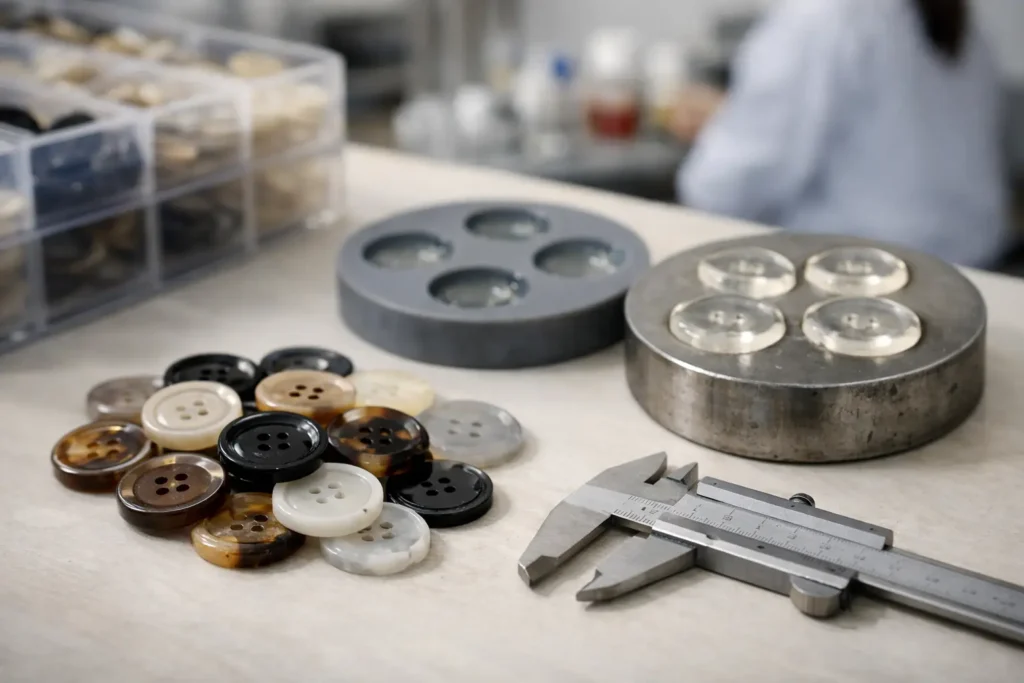
A button can be a small component with a large effect on a garment’s perceived value. Poor color consistency, weak shanks, rough edges, or uneven polishing can make an otherwise well-made garment feel unfinished. Choosing the right resin buttons manufacturer is therefore not only a purchasing decision. It is a product-development and supply-chain decision that affects design accuracy, production efficiency, and brand presentation.
For apparel brands, garment factories, and sourcing teams, the best manufacturing partner is one that can translate a design concept into repeatable bulk production. That means more than producing an attractive first sample. It means controlling material formulation, molds, color, finishing, inspection, packing, and delivery across every production run.
What a Resin Buttons Manufacturer Should Control
Resin buttons are valued for their design flexibility. They can be produced in a broad range of colors, patterns, sizes, shapes, and finishes, making them suitable for shirts, blouses, knitwear, jackets, uniforms, outerwear, childrenswear, and fashion collections. However, that flexibility also creates more variables that must be managed correctly.
A capable manufacturer should control the process from raw material selection through final packing. Resin composition influences hardness, weight, appearance, machining performance, and color stability. Different resin materials may be selected depending on whether the buyer needs a lightweight shirt button, a substantial coat button, a pearl-effect fashion button, or a durable component for workwear and uniforms.
The mold is equally important. A precisely made mold supports consistent dimensions, clean edges, stable hole placement, and repeatable surface details. For custom buttons with logos, crests, patterns, or nonstandard profiles, mold accuracy determines whether the final product reflects the approved design. A factory should be able to assess whether an artwork concept is practical for production before tooling begins, especially when fine engraving or complex three-dimensional details are involved.
Finishing is where many resin buttons gain their character. Depending on the design, the surface may be polished, matte, brushed, marbled, pearlescent, transparent, frosted, dyed, laser engraved, or printed. The right finish depends on the garment and target market. A polished imitation horn button may suit premium tailoring, while a matte solid-color button can be more appropriate for uniforms or contemporary casualwear.
Customization Starts Before Sampling
A reliable resin buttons manufacturer does not treat customization as a choice between a catalog item and a completely new mold. Many projects sit between those two options. An existing shape can often be adapted through a custom color, engraved logo, revised hole configuration, or special finish. This can reduce development time and tooling cost while still giving the garment a distinct branded detail.
For a fully custom project, the development discussion should begin with the garment’s functional and visual requirements. Buyers should define button size, thickness, attachment method, color reference, finish, quantity, intended garment use, and required delivery date. If a physical reference button or fabric swatch is available, it provides a stronger basis for matching than a screen image alone.
Color matching deserves special attention. Resin colors can look different under showroom lighting, daylight, and production-floor lighting. Translucent, marbled, pearlized, and mottled effects can also vary more than a flat opaque color. A professional supplier should clarify the acceptable tolerance before mass production and submit samples for approval. For programs that will be reordered over multiple seasons, retaining approved samples and color references helps maintain consistency.
It also helps to discuss the fabric early. A dark button may disappear against a textured wool coating, while a high-gloss button can look too formal against washed cotton. Button material, color, and finish should support the fabric hand and the garment’s price position rather than compete with them.
The Sample Is a Production Test, Not Just a Design Check
A sample should confirm more than appearance. Product developers should inspect its diameter, thickness, hole size, hole spacing, edge quality, back profile, logo clarity, and surface finish. If the button uses a shank, the shank attachment and pull strength should be considered as well.
The sample stage is also the right time to identify production risks. Very thin buttons may require careful handling. Highly detailed logos may need adjustment for legibility at a small scale. Certain marbled patterns will naturally have variation, which can be desirable, but it should be approved as part of the intended look. Clear decisions at sampling prevent disputes once bulk production is underway.
Quality Control That Supports Bulk Apparel Production
For a fashion brand, button quality is not limited to whether a single piece looks good. Bulk quality means that buttons remain consistent across thousands or millions of pieces, packed accurately, and delivered in a condition that supports efficient garment sewing.
A factory’s quality-control process should include incoming material checks, in-process inspection, and final inspection before shipment. During production, teams should monitor size, thickness, hole formation, surface defects, color consistency, polishing quality, and structural integrity. Finished buttons should be checked for scratches, cracks, burrs, incomplete drilling, uneven edges, and visible contamination.
The inspection standard should fit the product. Premium fashion buttons with polished surfaces may require tighter cosmetic control than workwear buttons. At the same time, uniform and industrial apparel programs may place greater emphasis on durability, repeatability, and stable replenishment. There is no single standard that suits every project. The right standard is the one agreed upon before production begins.
Packing matters as well. Buttons with glossy, plated, printed, or delicate surfaces need suitable protection to minimize scratching during transport. Clear carton marking, size identification, color coding, and quantity labeling help garment factories receive and issue trims efficiently. These practical details are easy to overlook until a production line is waiting for the correct button lot.
Capacity, MOQ, and Delivery Need to Match Your Program
The right supplier is not necessarily the factory with the largest stated capacity. It is the factory whose equipment, planning process, and communication style fit your order profile. A startup label may need a manageable minimum order quantity for a first collection. A major garment manufacturer may need dependable capacity for recurring seasonal programs. Both require clear information, but their production needs are different.
Ask early about sample lead times, mold-development timing, bulk production schedules, packing methods, and shipment preparation. Custom molds generally add time to a project, while standard shapes with custom colors may move faster. Complex effects, multiple colorways, and special surface treatments can also affect the schedule. A dependable manufacturer explains these variables before accepting an unrealistic delivery date.
It is also wise to plan for reorders. If a collection sells through quickly, can the supplier reproduce the same color and finish? Are molds retained and identified properly? Is the material available for future production? For brands building long-term core styles, these questions can be more valuable than achieving the lowest initial unit price.
Why Manufacturing Experience Changes the Result
Resin button production combines machinery, material knowledge, and hands-on finishing experience. Automated equipment supports scale and dimensional consistency, but experienced technicians still play an important role in color evaluation, polishing judgment, defect detection, and problem solving during development.
NZXTRIM supports OEM and ODM button projects from design review and material selection through sample development, bulk production, inspection, and global delivery. For buyers, working with a single manufacturing partner can simplify communication when a project requires custom molds, logo details, specific finishes, and coordinated production planning.
The most productive supplier relationship is built on clear specifications and early communication. Share the garment use, target price level, expected quantity, quality expectations, and deadline at the start. A serious factory can then recommend a resin button construction that is attractive, manufacturable, and appropriate for the production plan.
A well-chosen button should arrive at the sewing line ready to perform, while still giving the finished garment a detail customers notice when they pick it up. That is the practical standard worth setting for every custom button project.