
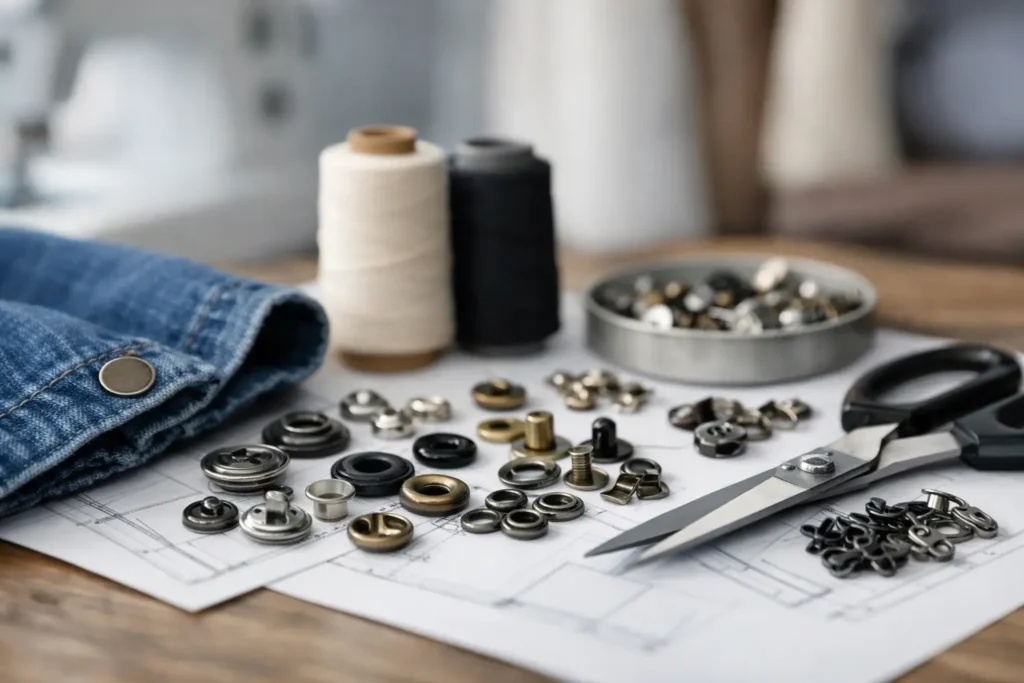
A fastener that looks correct on a tech pack can still delay an entire garment program. The usual causes are not dramatic: an unspecified shank, an unapproved finish, a logo that is too fine for the chosen process, or a sample that was never evaluated on the actual fabric. To understand how to source apparel fasteners effectively, treat each fastener as a production component with a defined material, construction, performance requirement, approval route, and delivery plan.
For most apparel programs, the first sourcing decision is not the supplier. It is whether the visual concept has been translated into a specification a factory can quote, sample, and reproduce at bulk scale.
Start with the garment, not the fastener catalog
A button, snap, zipper, hook, eyelet, cord stopper, or buckle must work with the garment’s end use. A lightweight viscose blouse and a heavy canvas overshirt may use a similar-looking button, but their required construction, attachment method, weight, and pull resistance can be very different. Outerwear, uniforms, children’s garments, denim, knitwear, and occasionwear each create different demands.
Begin by identifying where the fastener sits on the garment and what it needs to do. Is it purely decorative, load-bearing, exposed to repeated laundering, in contact with skin, or likely to receive abrasion from bags, belts, or equipment? A front closure button must be considered differently from a cuff button or a decorative button placed where it will not carry tension.
This stage also prevents material-led mistakes. Natural materials such as corozo, horn, shell, and wood can bring distinct character, but variation in grain, tone, or surface is inherent. Resin can support controlled color development and varied shapes, while metal can create weight, shine, and dimensional detail, subject to the selected base material and finish. Recycled-content options may be available for some constructions, but the actual recycled content and any related claim must be confirmed for the exact material and order.
Build a production-ready fastener brief
A mood board, reference photo, or 3D render is useful for direction, but it is not a complete manufacturing specification. Suppliers need enough information to assess feasibility and distinguish a concept sample from a bulk-production item.
For a button program, a practical brief should cover these distinct inputs:
- Material or preferred material family, such as metal, resin, corozo, shell, ceramic, wood, horn, or recycled material option
- Size in millimeters and, where relevant, Ligne, plus thickness and target weight if those affect the garment
- Construction, including 2-hole, 4-hole, shank, sew-through, snap component, or other attachment format
- Color, finish, logo artwork, placement, and required decoration method
- Estimated order quantity by size, color, and style, along with required sample and bulk delivery dates
Add the garment fabric, intended end use, wash process, attachment method, and any buyer-specific test or documentation requirements. If the fastener will be dyed with the garment or sewn through a heavy multi-layer placket, say so early. These details can change material selection, construction, and the sampling plan.
For color, a Pantone reference is a starting point, not an automatic approval standard. The achievable match depends on the base material, finish, surface texture, opacity, and viewing conditions. A glossy resin button and a matte ceramic button will reflect light differently even when developed toward the same reference. Define how color will be judged and approve a physical sample whenever color consistency matters.
Choose material and construction together
Buyers often select a material for appearance, then add construction requirements later. This can create unnecessary rework. The better approach is to evaluate appearance and construction as one decision.
A sew-through button is generally appropriate where a flatter profile and familiar garment attachment are required. A shank button can give more clearance over thicker fabric and can create a more elevated profile, but its shank geometry must be suitable for the expected load and sewing process. If a button has a large face, a heavy metal body, or a deep molded form, confirm whether it will sit correctly on the garment after attachment.
Logo treatment should receive the same scrutiny. Engraving, debossing, embossing, laser marking, printing, and raised metal details each have limitations related to artwork line weight, surface area, material, and finish. Fine text that appears clear in digital artwork may close up during molding or become less legible after finishing. Share vector artwork where possible and ask the supplier to identify the minimum practical line and character size before tooling is approved.
If a fastener is intended to coordinate with other trims, specify the relationship. “Match the zipper” is not sufficiently precise if one component is plated metal and another is painted resin. Describe the desired visual effect, such as warm antique brass, low-gloss black, or a specific tonal range, then review physical components together.
Request samples in the right sequence
Sampling is where a fastener project becomes measurable. The first sample may establish form, size, and broad material direction. It should not automatically be treated as final approval for bulk color, finish, logo clarity, or performance.
For a custom design, the sequence may include a digital proposal or artwork review, a tooling sample, a color or finish development sample, and a pre-production sample. The number of stages depends on complexity. A standard-size resin button in an existing color direction may require less development than a newly tooled metal shank button with an engraved logo and multiple finishes.
Evaluate samples on the actual garment fabric whenever possible. Check spacing between buttons, buttonhole fit, ease of fastening, drape, garment balance, logo orientation, and whether the component catches or damages adjacent material. For functional closures, have the garment factory assess attachment and operation using the intended sewing method rather than relying only on a loose-trim review.
Record approvals precisely. Instead of writing “approved,” identify the approved material, size, color reference, finish, logo position, construction, and sample date. This gives the bulk-production team a clear control sample and reduces confusion when multiple revisions exist.
Confirm MOQ, tooling, and lead time before placing the garment order
MOQ and lead time are project-specific commercial variables, not details to settle after development. They can change according to material, custom tooling, size range, color count, finishing process, packing requirements, and whether components are produced from existing or new molds.
A low quantity across many sizes and colors can be harder to produce than a higher quantity in one configuration. Likewise, a custom logo may require tooling even when the base button shape is standard. Ask for the supplier’s quotation to separate, where applicable, sample development, tooling, unit cost, finishing, and freight-related packing requirements. This makes it easier to compare options and understand where a design change will affect cost or timing.
Build enough time for physical sample review, buyer feedback, revisions, bulk material preparation, production, inspection, packing, and transport. If the garment delivery date is fixed, work backward from the factory’s trim receiving date, not from the final retail launch. The garment factory needs the approved fasteners in time for pilot sewing and bulk assembly.
Set quality controls around the actual risk
Quality control should reflect how the component will be used. For buttons, typical checks may include size, thickness, hole diameter, shank form, color or finish consistency, logo definition, surface defects, and packing count. For metal items, finish appearance and edge quality may need close attention. For natural materials, agree in advance on the acceptable visual range rather than expecting every unit to be identical.
Where washing, dry cleaning, abrasion, attachment strength, chemical exposure, or restricted-substance requirements apply, define the relevant requirement before sampling or bulk release. Test scope, methods, pass criteria, and supporting documentation must be agreed and verified for the specific material, construction, order, and supply route. Do not assume that a result for one button material, color, or finish applies to another.
A useful quality plan also identifies the approved reference sample, inspection points, defect definitions, and acceptance process. This is particularly valuable when the brand, garment factory, and trim supplier are in different locations.
Coordinate the fastener supplier with the garment factory
Fastener sourcing works best when the button manufacturer and garment factory are working from the same approved information. Provide the factory with the final trim specification, approved sample reference, packing format, attachment guidance, and required arrival date. If the factory has concerns about buttonhole dimensions, sewing thread, attaching equipment, or garment wash, resolve them before bulk sewing begins.
NZXTRIM supports custom button projects by reviewing material feasibility, construction, logo treatment, physical samples, and bulk-production requirements before final confirmation. For complex programs, early review is usually less costly than correcting a finished component after garment samples have been sewn.
The practical goal is not simply to buy a fastener that looks good in a tray. Source one that can be specified clearly, approved physically, attached consistently, and delivered in the correct configuration for the garment line. A disciplined brief and sample process gives every team in the supply chain something more useful than a reference image: a component they can produce and use with confidence.