
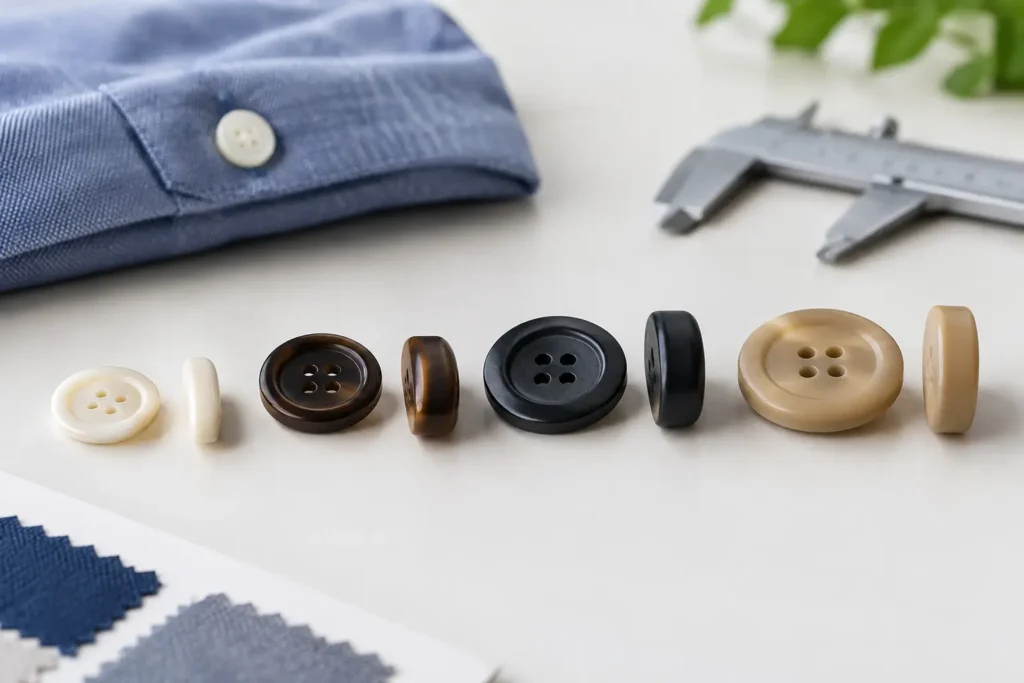
A button can match the approved diameter, color, and logo artwork yet still cause production problems when its thickness is unspecified. A useful garment button thickness guide starts with the garment’s button stand, fabric weight, sewing method, and intended wear – not with a single “standard” thickness. The right profile must look proportionate, pass through the buttonhole cleanly, sit correctly after sewing, and remain consistent from sample approval through bulk production.
For apparel development teams, thickness should be treated as a controlled button dimension alongside size, Ligne, material, hole or shank construction, finish, and logo placement. It affects both the appearance of the garment and the practical decisions made by the factory sewing the trim.
What Button Thickness Means in a Production Spec
Button thickness is the total measurement from the front face to the back face at the button’s thickest point. On a flat four-hole button, this is usually measured at the outside edge or central body, depending on the specified profile. On a shank button, the body thickness and the overall height including the shank should be recorded separately.
This distinction matters. A domed button may have a moderate edge thickness but a much deeper center. A molded shank button may appear compact from the front while needing substantial clearance behind the button for sewing. If a tech pack simply states “3 mm thick,” the supplier and garment factory may interpret the measurement differently.
A production-ready specification identifies the measurement point. For example: “24L polyester four-hole button, 3.0 mm edge thickness, shallow dome profile,” or “20L metal shank button, 2.5 mm body thickness, 5.0 mm total height including shank.” This gives the button manufacturer, sample room, and sewing line one clear reference.
Why Thickness Changes Garment Performance
Thickness determines how a button sits against the garment. A thick button on a lightweight shirt placket can pull the fabric forward, create visible distortion, or make the buttonhole feel oversized. A very thin button on a heavy wool coating may look underscaled and can become difficult to handle when worn with gloves.
The relationship with buttonhole thickness is equally important. The buttonhole must accommodate the button’s effective depth as it passes through, particularly with domed, rimmed, or shank constructions. A button that measures correctly across its diameter can still be difficult to fasten if its profile is too deep for the finished buttonhole.
Sewing clearance also changes with thickness. Four-hole buttons need enough body depth to form holes with usable clearance for thread, while the underside should sit appropriately on the garment. Shank buttons need a shank opening sized for the sewing thread and attachment method. For coated fabrics, padded garments, or thick button stands, the garment maker may require a thread shank to prevent the button from compressing the fabric layers.
Thickness is therefore not only a visual choice. It is part of the connection between trim design and garment construction.
Typical Thickness Ranges by Button Construction
There is no universal thickness chart that applies to every material and silhouette, but initial ranges can help teams build a workable development brief. These are starting points only. Final dimensions depend on diameter, material density, molding or machining limits, logo treatment, and the garment’s construction.
Flat sew-through buttons
For smaller shirt buttons, a flat sew-through construction often uses a relatively slim profile. At 14L to 18L, many programs begin by considering approximately 1.8 mm to 2.8 mm, depending on material and hole design. At 20L to 24L, approximately 2.5 mm to 3.5 mm may provide a more balanced appearance for shirting, blouses, and light overshirts.
A larger 28L to 32L flat button can require additional body depth to avoid appearing weak or visually thin. However, increasing thickness without reviewing the buttonhole can create fastening issues. A deep rim around the holes may also alter how the button catches light and how prominently it sits on the garment.
Domed and concave sew-through buttons
Domed buttons usually need both an edge thickness and a center height specification. Their curved face can make a button feel more substantial without creating an excessively thick edge. This can suit polos, cardigans, outer shirts, and casual jackets where a rounded profile is desired.
Concave buttons can create a lower central area around the holes and a raised perimeter. The apparent depth may be high while the usable sewing area remains limited, so hole depth, hole diameter, and needle access should be reviewed in physical sampling. A highly sculpted profile may look strong in a rendering but be less practical for factory sewing or automated handling.
Shank buttons
Shank buttons should be specified by body thickness, total height, shank type, and shank opening. A shallow metal shank button for a tailored garment behaves differently from a deep resin shank button intended for a thick coat. The shank height must provide clearance for the fabric stack without making the button unstable or prone to catching.
For jackets, coats, uniforms, and heavier garments, the shank is often more important than the body thickness. If the shank is too short, the garment layers can bunch around the button. If it is too high, the button may tilt during wear. The button and the finished garment sample should be reviewed together rather than approved as separate items.
Material Affects the Practical Thickness
Materials do not perform identically at the same measurement. A 3 mm corozo button, for example, may have different edge strength, machining behavior, and visual depth than a 3 mm resin button. Metal buttons can sometimes achieve a crisp, relatively slim profile, while certain molded constructions may need more material around holes, posts, or decorative details.
Natural materials such as horn, shell, wood, and corozo also introduce variation that needs to be managed within an agreed production tolerance. Grain, natural surface character, and finishing methods can affect the visual impression of thickness. These materials can be highly distinctive, but development teams should avoid approving a concept based only on a digital color or profile representation.
For custom resin and polyester buttons, thickness can support embedded effects, layered colors, translucent looks, or raised logos. Yet greater depth may increase molding complexity, cooling considerations, and the visibility of internal effects. For engraved, debossed, embossed, or laser-marked logos, the available face depth must be sufficient for the intended mark without weakening the button body or making the design difficult to read.
How to Specify Thickness in a Button Tech Pack
A concise specification prevents avoidable revisions. Include the button diameter in millimeters and Ligne, the material, construction, finish, and exact thickness measurement point. For shaped buttons, provide a side-view drawing or approved physical reference showing the face profile.
For sew-through buttons, state the hole count, hole diameter, hole spacing, and whether the holes are countersunk or straight. For shank buttons, state the total height, body height, shank height, shank opening, and attachment construction. Where the garment is thick, identify the fabric stack at the button position rather than describing the fabric only as “heavyweight.”
Tolerance should also be discussed during development. A tolerance suitable for a simple molded button may not be appropriate for a natural material, a hand-finished effect, or a highly sculpted metal component. The acceptable visual and dimensional range should be agreed before bulk production, especially when buttons are used across multiple garment colors, factories, or delivery periods.
Sample the Button With the Actual Garment
A button card confirms basic size and appearance. It does not confirm how the button performs on a finished garment. The most useful approval sample includes the intended buttonhole, interfacing, fabric layers, sewing thread, and attachment method.
Ask the garment factory to check fastening force by hand, buttonhole recovery after repeated opening, button alignment on the placket, and whether the button stands away from the garment as intended. For outerwear, check the button while the garment is worn and the front is under tension. For uniforms or workwear, review the trim in the actual use position rather than on a flat table alone.
NZXTRIM can develop custom thickness and profile options alongside material, logo, color, and construction details, but final feasibility should be confirmed from the approved specification and physical sample. Tooling requirements, sample timing, minimum order considerations, and bulk production planning can vary by button material and construction.
Common Thickness Mistakes to Avoid
The most frequent mistake is copying a millimeter value from another garment without comparing fabric, buttonhole, and construction. A 4 mm button may be appropriate for a wool overcoat and completely unsuitable for a lightweight poplin shirt.
Another issue is specifying only the front appearance. A product team may approve a deep dome or prominent shank because it looks correct in a presentation sample, then find that the sewing method, buttonhole, or packing process needs adjustment. Finally, do not assume buttons of different materials can be substituted at the same thickness without resampling. Similar dimensions do not always produce similar feel, weight, fastening behavior, or visual balance.
The best next step is to place the proposed button on the actual garment construction early, then document the approved thickness and measurement point as clearly as the diameter. That small detail gives designers the intended profile and gives sourcing and production teams a far more reliable basis for bulk execution.