
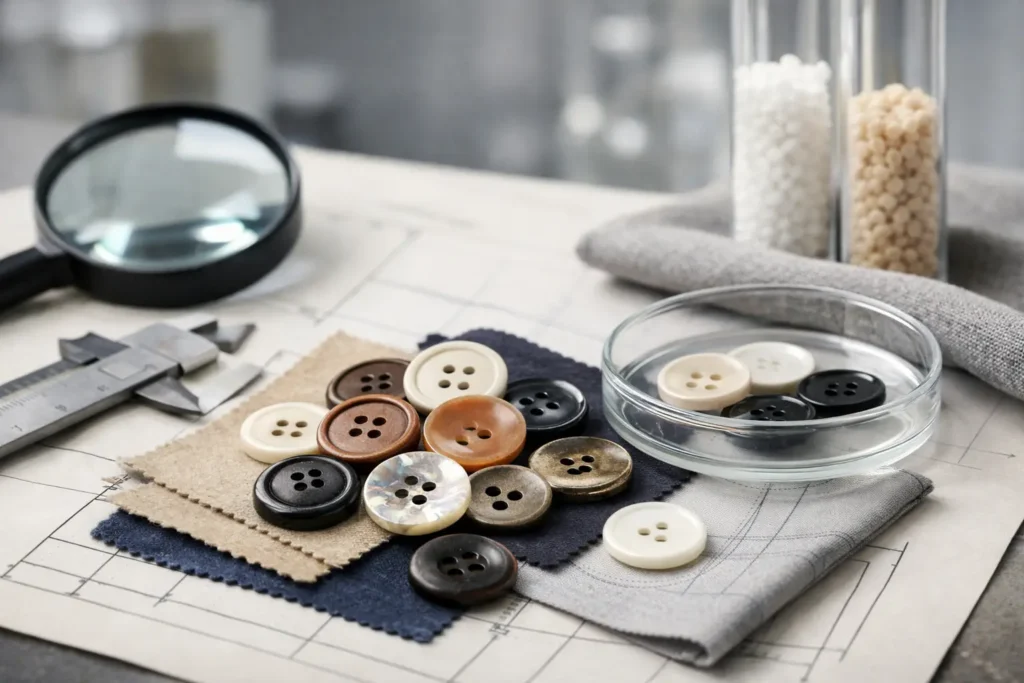
A button can look approved in a material board and still be unsuitable for the finished garment program. The gap is usually not design intent. It is an incomplete button material certification guide: the team has not defined which material evidence, test scope, construction details, and shipment documents are required for that exact button.
For apparel teams, certification should not be treated as a broad supplier promise or a label applied to a whole button category. A corozo button, recycled resin button, shell button, or metal snap-style button may each require different evidence depending on its composition, finish, intended market, garment type, and supply route. The production-ready specification must state what needs to be verified before sampling and bulk approval.
Start With the Garment Requirement, Not the Button Name
“Need certified buttons” is not a complete sourcing instruction. It does not identify the applicable customer requirement, restricted-substance scope, material-origin evidence, testing method, or documents needed for shipment. A factory cannot accurately confirm feasibility from that phrase alone.
Start by identifying where the garment will be sold, who is setting the requirement, and how the button will be used. A fashion shirt, children’s garment, uniform, denim program, outerwear style, and workwear product may present different performance concerns. The button’s location also matters. A front closure can face more abrasion, laundering, dry cleaning, or pull force than a decorative cuff button.
The material description should be equally specific. “Metal button” may mean a solid metal construction, plated component, painted surface, metal-look resin, or a multi-part button with different base materials. “Recycled button” requires a defined material and a clear understanding of what recycled-content evidence, if any, the buyer expects for the selected item. Visual intent is useful at the concept stage, but it is not a production specification.
What a Button Material Certification Guide Should Define
A workable guide aligns the brand, garment factory, sourcing team, and button manufacturer before tooling or bulk material purchasing begins. It should identify the exact button reference and the evidence needed for that reference, rather than relying on general documents from a prior order.
At minimum, define these five points:
- Button construction: material, size or Ligne, thickness, hole or shank construction, back profile, edge shape, and any multi-part components.
- Surface and color: natural material appearance, plating, coating, paint, dye, laser marking, engraving, debossing, or embossed logo requirements. Include the approved color reference and the acceptable production tolerance where relevant.
- End use: garment category, intended care process, expected abrasion exposure, and whether the button is functional, decorative, or both.
- Required evidence: customer-required declarations, material traceability documents, laboratory reports, or other records requested for the specified market and product.
- Approval route: who reviews the physical sample, who approves submitted documents, and whether approval is required before bulk production or before shipment.
This level of detail prevents a common failure: testing or documenting a base material while overlooking the finish, logo treatment, attached component, or construction used in the actual bulk button.
Material Evidence and Finished-Button Evidence Are Different
Material documentation can help establish what was supplied into production. It may concern the resin grade, metal substrate, natural material source, coating system, or other input used for the order. That does not automatically confirm the performance of the completed button.
Finished-button evaluation concerns the actual manufactured item. It may need to account for the selected size, thickness, hole design, shank attachment, coating, plating, color process, and logo method. A deep laser mark, for example, changes the surface differently from a printed logo. A painted metal button has different considerations from an uncoated metal construction.
For this reason, documentation should be reviewed against the approved construction drawing or signed sample. If the material, finish, supplier source, color process, or construction changes after approval, the original evidence may no longer represent the bulk item. The appropriate response depends on the buyer’s requirement and should be confirmed before production continues.
Choose the Material With Its Production Trade-Offs in View
The right material is not always the one with the strongest visual story. It must also support the requested construction, decoration, care expectations, available documentation, and production schedule.
Corozo provides a natural, organic appearance and accepts engraving or dye development differently from molded resin. Natural variation is part of the material character, so a brand should decide whether tonal and grain variation is acceptable in bulk. Horn, shell, wood, and similar natural materials also require early review of appearance range, thickness availability, and the practical consistency expected across an order.
Resin offers broad flexibility for custom shapes, colors, and molded details. However, a button specified as recycled resin should not be assumed to carry a particular recycled-content claim or supporting documentation. The exact resin formulation, component structure, and order-specific supply documentation must be reviewed against the buyer’s requested evidence.
Metal buttons can support crisp logos, dimensional forms, plating, and durable-looking finishes, but the selected construction and surface treatment need close definition. A plated finish, enamel-style color fill, painted coating, or laser mark can affect both the visual approval route and the testing scope requested by the garment program.
Ceramic, shell, wood, and specialist materials can create a distinctive result, yet they may introduce more constraints around breakage risk, color variation, shaping, or lead time. Sampling is where these trade-offs become visible. It is better to adjust a construction during sample development than after a bulk color or tooling decision has been released.
Build Certification Review Into Sampling
A physical sample should be more than a visual sign-off. It is the reference point for confirming the actual material, dimensions, color, logo execution, and construction intended for bulk production. Where evidence or testing is required, determine whether it must relate to the sample, a production-representative item, or bulk production material.
For custom buttons, the sample sequence commonly begins with artwork and a technical brief, followed by material and construction feasibility review. Tooling may be required for a new shape, face design, or logo detail. Once a physical sample is available, the buyer can assess appearance and function while the required document path is clarified.
Do not assume a concept rendering proves manufacturability. Fine lines may fill during molding, shallow logos may lose definition after coating, and a Pantone reference may need adjustment based on the button material and finish. The sample approval should record any agreed deviations, including natural material variation, logo depth, gloss level, and color range.
Avoid Late Changes to Material or Finish
Late changes create certification and quality risk because they can separate approved evidence from the product actually produced. A switch from one resin source to another, a revised plating tone, a different paint system, or an added laser logo can change the relevant review scope.
If a change is necessary, document it and ask the buyer to confirm whether revised samples, documents, or testing are needed. This is especially relevant when garment production schedules are tight. Moving quickly is useful only when the approval record remains clear.
Assign Responsibilities Before Bulk Release
Button manufacturers can provide technical input, samples, production records, and available material documentation for the selected project. The brand or buyer should define the commercial and regulatory requirements that apply to the finished garment and confirm the acceptance criteria with its own compliance, quality, or customer teams.
The garment factory also has a role. It should verify that the button specification matches the sewing process, buttonhole dimensions, attaching method, and finished-garment care instructions. A button approved in isolation can still cause production issues if the hole size, shank clearance, or edge profile does not suit the factory’s operation.
NZXTRIM recommends confirming the evidence request at the same time as the custom button brief. Share the material preference, size, construction, logo artwork, color target, expected order quantity, destination market, garment use, and required review documents. This gives the manufacturing team a basis to identify whether the concept is feasible and what must be checked before bulk production planning.
Keep an Order-Specific Approval Record
The most useful document is often a concise approval record tied to the button style and purchase order. It should identify the approved sample, revision level, material, finish, color reference, construction, required evidence, and any stated production limitations. Store photographs alongside the physical approved sample, but do not use photographs as the only color or material reference.
For repeat orders, compare the new request with the approved record rather than assuming it is identical. A new logo, color, size, material source, finish, or destination market can change the review needed. This approach also makes handover easier when designers, sourcing managers, or garment factories change during a program.
The practical goal is not to collect the largest stack of documents. It is to make sure the material evidence, finished-button specification, and garment requirement all describe the same item before it enters bulk production.