
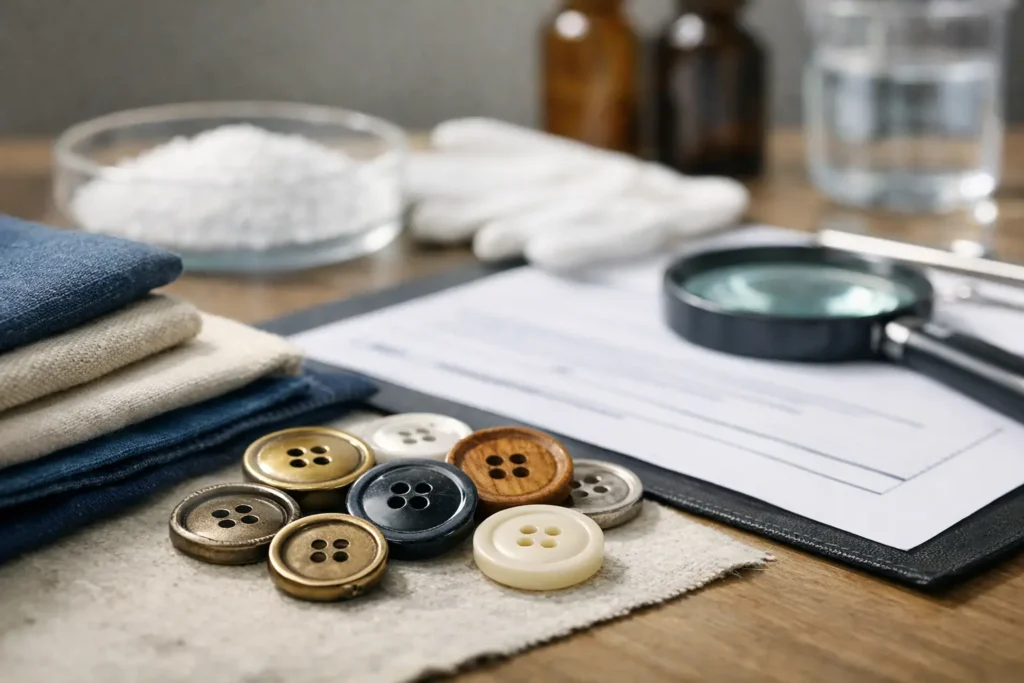
A button that looks approved at sample stage can still create an EU market issue if its plating, pigment, resin, coating, or supplied material data has not been reviewed. Button REACH requirements should therefore be addressed while the button is being specified, not after bulk production has started. For apparel teams, the practical task is to identify the button’s full material construction, assess relevant chemical risks, and agree what evidence is needed for the intended supply route.
REACH is not a single test that applies equally to every button. The required review depends on the material, whether the button contacts skin, its use on the garment, the destination market, and the obligations held by the brand, importer, distributor, or manufacturer. A production-ready button specification needs more than a visual reference and a Pantone callout.
What Button REACH Requirements Mean in Practice
REACH is the European Union framework governing chemical substances. Garment buttons are generally supplied as articles: finished objects whose shape and design are more important to their function than their chemical composition. That classification does not remove chemical responsibilities. It means the review must consider substances contained in the finished button and, where relevant, information from the material supply chain.
For most apparel button programs, the initial review centers on two areas. The first is whether substances of very high concern, often referred to as SVHCs, may be present above the applicable threshold in the finished article. The second is whether a restriction may apply to a particular material or application under REACH Annex XVII.
A generic statement such as “metal button” or “resin button” is not enough to complete this review. A metal button may include a base metal, plating layers, lacquer, ink, enamel fill, solder, and a back fastening component. A dyed corozo button may involve the natural blank, dyes, sealers, and engraving fill. Each layer can change both the technical performance and the documentation needed.
The current Candidate List and restrictions can change. Brands should confirm the applicable legal requirements for their specific EU market route and product category with their responsible legal, regulatory, or testing team. A supplier can support the material review and provide available information, but a general declaration should not be treated as a permanent conclusion for every color, finish, or future order.
Button REACH Requirements Start With Construction
The most effective point to manage risk is before tooling and color development are finalized. Start by defining what the button actually is, rather than what it resembles in a mood board.
For a two-hole or four-hole button, specify the base material, diameter or Ligne size, thickness, hole shape, dye or color system, surface finish, and logo method. For a shank button, also define the shank material, attachment method, back shape, and whether the shank is integral or assembled. On plated metal styles, the base metal and finish sequence matter. “Antique brass” is a visual description, not a material specification.
Skin-contact assessment needs particular care with metal buttons. A jeans tack placed against the body, a shirt-front snap, and a decorative button on an outer coat can present different use conditions. Nickel release may be relevant for articles intended to come into direct and prolonged contact with skin. Whether this applies should be evaluated from the actual garment construction, wear position, and intended use, rather than assumed from the button category alone.
Material selection also affects what can be controlled in production. Natural materials such as horn, shell, wood, and corozo have visual variation. Recycled-content resins can vary by input stream and color response. Plated finishes may require a different review from painted or resin-molded alternatives. These are not reasons to avoid a material. They are reasons to confirm the performance, appearance tolerance, and verification scope before bulk approval.
Common Button Areas That Need Review
The highest attention usually goes to material systems with multiple inputs or variable finishes. These can include metal alloys and plating, colored resin compounds, soft-touch or protective coatings, printed artwork, enamel fills, adhesives, and dyed natural materials. A button with a laser-marked logo may have fewer added components than one with a filled engraved logo, but the exact construction still needs confirmation.
Certain restricted substances may be relevant depending on the button’s composition. Examples can include nickel in skin-contact metal articles, certain phthalates in applicable plasticized materials, cadmium or lead in particular material systems, chromium VI considerations for leather components, and restricted azo colorants in relevant dyed materials. The correct scope cannot be determined from a product photograph. It must follow the bill of materials and intended use.
Build the Requirement Into the Button Specification
A workable sourcing file gives the factory and the brand the same decision points. It should identify the style number, material, size, construction, finish, color reference, logo artwork, use on the garment, target markets, and requested verification documents. It should also state whether the button is expected to contact skin and whether the same component will be used across several product categories.
This detail helps prevent a common problem: approving a development sample made with one finish, then changing the plating supplier, pigment package, or coating during production without recognizing that the material evidence may no longer match. Any material or process change should trigger a review before it is released for bulk use.
For custom buttons, document requests should be tied to the exact style and material family where possible. A broad supplier statement for “all buttons” may be useful as background information, but it may not cover a new resin blend, a newly requested metallic coating, or a special logo fill. If testing is requested, define the target sample, required quantity, test scope, responsible party, and timing before production starts.
NZXTRIM can review a custom button concept for manufacturing feasibility and identify where the material construction, finish, or requested documentation needs clarification. This is especially useful when a design moves from a visual render to a production-ready component specification.
Sampling Is Where Technical Assumptions Become Visible
Physical sampling should confirm more than color and logo placement. It is the point to inspect assembly quality, edge finishing, plating appearance, hole cleanliness, shank alignment, coating coverage, and the relationship between the button and garment fabric. For chemical review, it also establishes the actual version of the item being assessed.
When an initial sample uses a substitute material because the final tooling, plating, or color formulation is not ready, record that clearly. A concept sample may be suitable for design sign-off but not for final material verification. The bulk production sample should reflect the agreed construction as closely as possible.
Color is another area where commercial expectations need to be realistic. Pantone references guide development, but material type, surface texture, gloss, opacity, and dyeing or molding process affect the result. A matte recycled resin, polished corozo, and coated metal cannot be expected to produce identical visual color behavior. Agreeing an approved physical standard and acceptable batch variation is more useful than relying only on a digital reference.
Testing and Documentation Should Follow Risk, Not Habit
Testing every button for every possible substance can add cost and time without producing a better sourcing decision. Conversely, relying only on a general material claim can leave an avoidable gap. The right approach is a risk-based plan based on the construction, intended market, prior material history, and any brand restricted substances list.
A basic program may begin with traceable material information and supplier declarations. Higher-risk constructions, new material sources, skin-contact metal parts, regulated customer programs, or styles with complex coatings may require additional laboratory verification. The exact test method, limit, and sample preparation should be agreed with the responsible technical team because methods can differ according to the material and legal question being evaluated.
Keep records organized by button style, revision, material source, finish, and purchase order. This makes it easier to respond when a customer asks about a specific garment season or when a material change is proposed. It also avoids treating one test report as automatic coverage for visually similar buttons made from a different alloy, pigment, dye lot, or coating system.
Plan MOQ and Lead Time Around the Approval Path
Custom button lead time is shaped by more than manufacturing. Tooling, raw material availability, color development, physical sampling, laboratory scheduling where requested, and approval cycles all affect the release date. A simple stock-like shape in an established material may move through development differently from a new shank construction with custom tooling and a specialized finish.
MOQ also depends on material, size, construction, finish, and production route. Small quantities may limit available processes or make dedicated color development less practical. Combining related styles into a shared material or finish program can sometimes improve production efficiency, but only if the approved construction remains consistent.
For an apparel launch, set the button approval gate early: first approve construction, then physical appearance, then the agreed material evidence or verification scope, and only then authorize bulk production. That sequence protects the garment calendar better than trying to solve a chemical documentation question after trims have already been allocated to factories.
The useful question is not simply, “Is this button REACH approved?” It is, “Can we show what this exact button is made from, what market requirements apply, and whether the evidence matches the final production version?” When that question is answered before bulk release, custom button development becomes more controlled, more traceable, and easier to manage across seasons.