
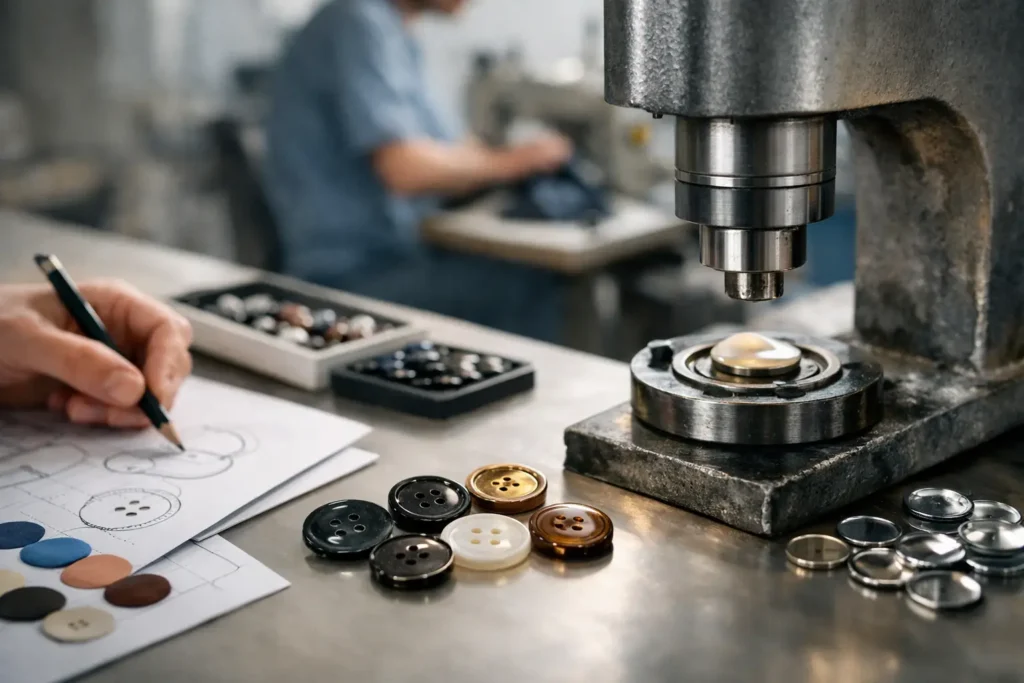
A button can look correct in a presentation board and still fail as a production component. The difference is usually specification: material behavior, size tolerance, attachment construction, logo definition, color control, and the ability to repeat those decisions across a bulk order. For apparel teams evaluating button suppliers, the practical question is not simply who can make a similar-looking button. It is who can translate a design intent into a documented, sample-approved component that suits the garment, production route, and delivery plan.
NZXTRIM works with fashion brands, product developers, sourcing teams, and garment manufacturers on custom button programs where those details need to be resolved before bulk production. The most useful supplier discussions begin with the garment and its use case, not with a reference image alone.
What button suppliers need before quoting
A clear request reduces avoidable sampling rounds and helps establish whether a visual concept is technically feasible. A button supplier can often advise on options from a sketch or existing sample, but a production quotation needs more than a photo and a diameter.
Start with the intended material. Corozo, metal, ceramic, horn, shell, wood, resin, and recycled-material options each create different visual effects and have different production considerations. A natural material may show variation that supports its character, while a molded resin button can offer a more controlled surface and color direction. Metal can provide weight and a defined edge, but its finish, plating approach, and garment care requirements should be considered early.
The construction matters as much as the face design. Confirm whether the button is a two-hole, four-hole, shank, snap-style, or specialist construction. Specify the diameter in millimeters or Ligne, the thickness target, hole diameter, shank height where applicable, and whether the back needs a logo, cavity, or clean finish. These details affect tooling, sewing performance, appearance on the garment, and packing.
A useful inquiry also identifies the garment category, anticipated order quantity, target delivery window, destination, and any relevant performance expectations. A tailored wool coat, a lightweight rayon blouse, a denim overshirt, and an industrial uniform can call for very different material and construction choices. If the button will be garment dyed, washed, dry cleaned, exposed to high heat, or used near sensitive fabrics, say so at the start. Requirements should be reviewed for the specific material, finish, garment process, and supply route.
Choosing materials for the garment, not just the mood board
Material selection is a design and manufacturing decision. The same silhouette can behave differently depending on what it is made from.
Corozo is often selected for its natural, dense appearance and ability to accept dye and engraving. Its organic composition means variation can be part of the material character, so approval should define the acceptable range rather than assume every piece will look identical. Horn, shell, and wood carry similar considerations: they can create distinctive surface variation, but the reference sample needs to establish what variation is acceptable in bulk.
Resin offers broad freedom in color, translucency, marbling, shape, and molded detail. It is often suitable where the design needs a specific Pantone direction, a polished or matte surface, or an engineered visual effect. Pantone matching is a development target, not an automatic promise of identical appearance across materials and finishes. Color perception can change with gloss level, texture, button thickness, surrounding fabric, and lighting. The approved physical sample should remain the color reference for production.
Metal buttons can be made with stamped, cast, or assembled constructions depending on the design. Relief, engraved artwork, edge profile, finish, and attachment method should be evaluated together. A deep emblem may require a different construction from a flat logo mark. Ceramic buttons offer a distinct hard surface and crafted appearance, but shape, thickness, and artwork should be reviewed for production feasibility rather than assumed from a digital rendering.
Recycled-content materials may be available for some button types. The recycled-content claim, source information, appearance, and suitability must be confirmed for the exact material and order. It should not be inferred from a concept description or applied broadly across unrelated button constructions.
Logos require a method, not just artwork
A logo can be engraved, debossed, embossed, laser marked, printed, or incorporated through the button’s construction. Each method has limits around line weight, depth, contrast, and repeatability. Fine artwork that reads clearly on a screen may fill in, soften, or disappear when reduced to a 15 mm button face.
Provide vector artwork when possible, along with the intended logo size and placement. A supplier should review whether the artwork needs simplification, whether a raised or recessed mark is more appropriate, and whether the logo will remain legible after the chosen finish is applied. This is particularly important for metal finishes, tonal resin marks, and natural materials with visible grain or variation.
Sampling is where a concept becomes a specification
Physical sampling is not a formality. It is the stage where the team checks whether the selected material, size, color, construction, and logo treatment work together on the actual garment.
A production-ready sample review should consider face appearance, back construction, edge quality, hole or shank finish, logo placement, and consistency across a small sample set. Place the sample on the fabric and assess it from normal viewing distance, not only under a desk lamp. A button that looks balanced on a card can appear oversized on a placket or too dark against the garment color.
Keep sample approval disciplined. Record the approved material, size, finish, artwork version, color reference, construction, and any agreed tolerance for natural variation. If changes are made after approval, identify whether they affect tooling, color development, lead time, or cost. A small revision to a logo depth or edge profile can become a new development path rather than a simple production note.
Digital visuals are useful for alignment, but they do not replace a physical sample. Surface sheen, tactile weight, hole finish, and color interaction are difficult to judge from a render or photograph alone.
Tooling, MOQ, and lead time are connected
Custom buttons often require tooling, especially when the design includes a unique shape, molded face, stamped metal form, or tailored logo relief. Tooling is part of the commercial and technical evaluation, not merely an upfront line item. It affects how accurately the design can be formed, how efficiently the button can be produced, and whether future repeat orders can use the same approved specification.
Minimum order quantity depends on the material, size, construction, tooling requirement, color development, and production setup. There is no useful universal MOQ for custom buttons. A simple repeat construction may have a different threshold from a specially developed ceramic form or a multi-part metal button. Ask for MOQ guidance after the supplier has reviewed the full specification, rather than selecting a material solely from an early estimate.
Lead time also has stages. Artwork review, material confirmation, tooling where required, sample development, approval, bulk production, quality review, packing, and international delivery planning all need to be considered. The fastest route is not always the best route if it removes time for sample approval or forces a material choice that does not suit the garment. For seasonal programs, begin development early enough to make decisions based on physical evidence instead of deadline pressure.
Quality review should reflect the approved sample
Quality review is more effective when the approved sample and written specification are treated as the reference point. Visual checks can address appearance, logo placement, color direction, surface finish, and obvious defects. Dimensional checks can address size, thickness, holes, or shank construction according to the agreed requirements.
The acceptable level of variation depends on the button material. Natural shell, horn, wood, and corozo may present differences in grain, tone, or surface character. Those differences should be defined during sampling, not rejected unexpectedly during packing. Conversely, a uniform molded resin style may require closer control of color and surface consistency.
For garments with particular wear, laundering, or attachment demands, raise those conditions before sample approval. The appropriate evaluation approach depends on the finished button, garment construction, intended use, and buyer requirements. Do not assume a material is suitable for a condition simply because it has been used on another program.
How to make supplier communication more productive
The strongest supplier relationship is based on a shared production file rather than repeated interpretation of email descriptions. Include the button schedule alongside the tech pack: style name, quantity by size and color, material, dimensions, construction, artwork, finish, garment application, sample deadline, and bulk delivery target.
If the request is exploratory, say so. A supplier can then suggest material and construction options without presenting those options as final production specifications. If the program is already approved internally, identify what is fixed and what remains open. That distinction saves time and prevents a visual concept from being mistaken for an executable factory instruction.
A well-specified button does more than close a garment. It carries brand identity, supports the garment’s use, and removes uncertainty from the production line. Request physical samples early, approve against the actual fabric, and treat every confirmed detail as part of the finished garment standard.