
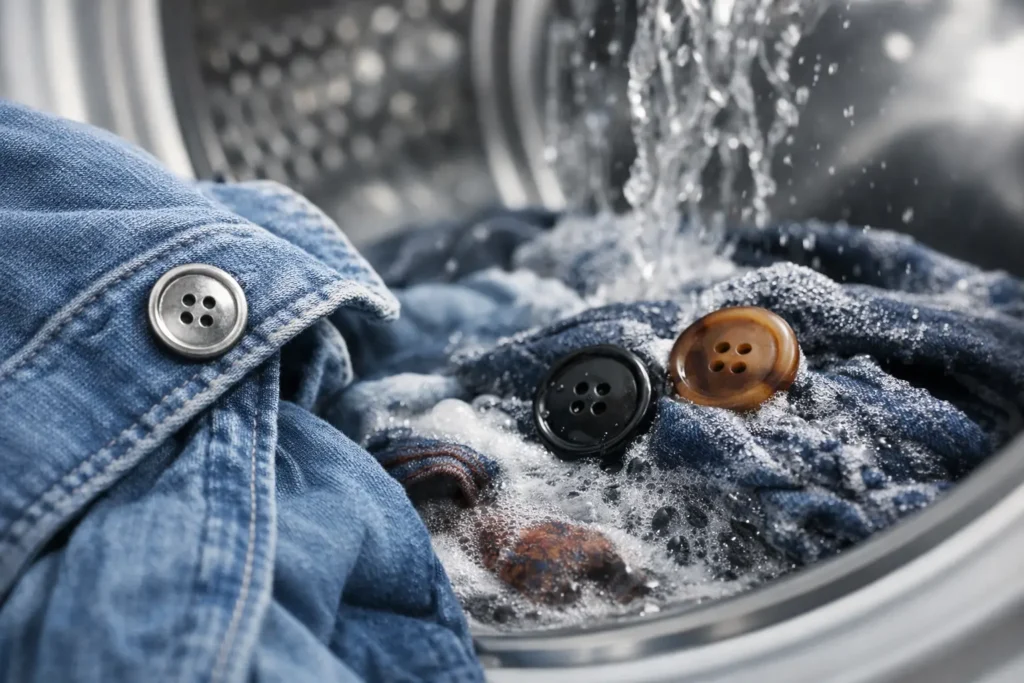
A button can look correct on the sample table and still become the reason a garment fails after retail launch. Fading, corrosion, cracking, loss of shine, loosened shanks, and damaged logo details often appear only after repeated laundering. For apparel brands and garment manufacturers, button wash resistance is not a minor trim detail. It is a product-performance requirement that should be defined before sampling and controlled through bulk production.
The right standard depends on the garment, wash process, intended wearer, and button construction. A fashion blouse with occasional home laundering has different needs from denim that receives enzyme washing, a hotel uniform exposed to industrial laundry, or children’s apparel requiring frequent washing. Clear specifications help the button factory select suitable materials, finishes, attachment methods, and test conditions from the start.
What Button Wash Resistance Actually Covers
Wash resistance describes how well a button maintains its function, appearance, and attachment after a defined laundering process. It is not one single property. A proper evaluation considers several performance points together: color stability, surface condition, corrosion resistance, dimensional stability, logo clarity, mechanical strength, and compatibility with the garment fabric and wash chemistry.
For example, a dyed resin button may remain physically intact but show unacceptable color change after bleaching. A plated metal button may retain its shape but develop edge corrosion after salt, detergent, or moisture exposure. A natural horn or corozo button may maintain an attractive surface in gentle washing yet require a different finish or care recommendation for aggressive commercial laundering.
Buyers should also distinguish between button testing and finished-garment testing. Testing the button alone helps assess the raw component. Testing it after sewing onto the intended fabric shows whether thread, backing, buttonholes, garment dye, stone washing, and other production steps create additional risk. Both stages can be valuable for higher-performance programs.
Button Wash Resistance by Material
Material selection is the first production decision. No material is universally best, because wash resistance always involves a balance of appearance, cost, environmental goals, and required care conditions.
Resin and polyester buttons
Resin and polyester buttons are widely used because they offer stable molding, broad color options, custom logo capability, and good suitability for standard home laundering. Their performance depends on the resin formulation, pigment quality, curing process, and surface finish. For dark colors, bright shades, or garments using bleach, colorfastness and surface durability should be confirmed through testing rather than assumed from a previous color or style.
Metal buttons
Metal buttons require particular attention when the garment will be washed frequently or processed with strong chemicals. The base metal, plating system, protective topcoat, edge coverage, and assembly construction all influence corrosion performance. A decorative antique finish may be appropriate for a fashion item but may not meet the same repeated-wash expectations as a protected uniform button.
Metal buttons used on denim, workwear, outerwear, and uniforms should be reviewed together with the full wash recipe. Enzyme washing, acid washing, bleaching, softeners, and high-temperature drying can each affect plated surfaces differently. A button that passes a standard domestic wash may not be suitable for a garment finishing process used by a denim factory.
Corozo, horn, and natural materials
Corozo and horn buttons bring depth, natural variation, and a premium hand feel to tailored clothing and luxury collections. However, natural materials require realistic specifications. Their organic structure can respond differently to moisture, heat, detergent, and repeated drying than molded synthetic materials. Proper conditioning, sealing, polishing, and sorting are essential, but the garment’s care label and end use should remain part of the design decision.
For a tailored jacket intended for dry cleaning or gentle care, natural material buttons can be an excellent choice. For a frequently laundered school uniform or industrial garment, a high-performance resin or protected metal construction may offer more predictable long-term results.
Ceramic and specialty buttons
Ceramic buttons can provide a refined, distinctive surface with strong color and heat stability. Their key consideration is impact resistance rather than ordinary wash exposure. They need appropriate thickness, edge design, and secure sewing methods to reduce chipping or breakage during garment handling and laundering.
Recycled buttons can also achieve reliable wash performance when the recycled input is properly controlled and the material formulation is suited to the application. Recycled content should not be treated as a performance shortcut. It requires the same disciplined sampling, inspection, and testing approach as any other material.
Specify the Wash Process Before Sampling
The most useful request to a button manufacturer is not simply, “Make this button washable.” It is a clear description of the garment’s actual conditions. This allows development teams to evaluate the appropriate material and finish rather than offering a generic answer.
A complete button specification should identify whether the garment will receive home washing, dry cleaning, commercial laundering, or factory garment washing. It should also state the expected wash temperature, number of cycles, detergent type, bleaching exposure, drying temperature, and any special processes such as garment dyeing, enzyme washing, or stone washing.
For uniforms, hospitality textiles, medical apparel, and children’s wear, it is often practical to define performance around repeated laundering cycles. For fashion garments, the priority may be preserving plating color, logo definition, or surface gloss after a more limited test sequence. The point is to set an acceptance level that matches the product’s real use, not an arbitrary claim.
Testing Should Match the Garment Risk
Wash testing is most effective when it follows a staged development process. During initial sampling, the factory can review material suitability and produce prototype buttons in the requested color, finish, and logo treatment. The brand or garment factory can then conduct a preliminary wash evaluation on sewn samples.
Before bulk production, approved samples should be retained as the reference standard. If the order includes special plating, custom color matching, printed details, laser engraving, or a new recycled material formulation, pre-production samples provide an additional safeguard. They confirm that the approved appearance can be reproduced under production conditions.
After washing, inspection should go beyond asking whether the button is still attached. Review color change, staining or color transfer, gloss loss, cracking, warping, scratches, plating wear, corrosion spots, sharp edges, logo legibility, and shank or sew-through hole condition. On garments, also inspect the sewing thread, buttonhole wear, and any interaction between the button surface and surrounding fabric.
There are trade-offs. A high-gloss plated finish may need more careful protection than a matte coated finish. Fine engraved logos can require a different surface treatment from large debossed branding. A lighter-weight button may suit drape-sensitive apparel but need a stronger attachment plan. Early discussion prevents these choices from becoming costly bulk-order corrections.
Production Controls That Protect Bulk Consistency
Reliable button wash resistance comes from controlled manufacturing, not from a single successful sample. Raw material verification, color matching, molding parameters, curing time, plating thickness, coating application, polishing, and final inspection all affect performance. Small variation in any stage can change how a button responds after laundering.
For custom orders, factory teams should maintain documented approval samples and production specifications. The same button style should be checked across multiple production lots, especially when colors, finishes, or raw-material batches change. For metal buttons, inspection should focus on plating coverage at edges, holes, and shank areas. For resin buttons, consistent curing and surface finishing help prevent brittleness, staining, or uneven appearance.
Packaging also matters. Buttons that are properly protected before sewing are less likely to arrive scratched or contaminated, which can be mistaken for wash damage later. Clear lot identification supports traceability if a garment factory needs to compare samples, investigate an issue, or reorder the same approved style.
NZXTRIM supports this process by helping customers evaluate button materials, custom finishes, sample requirements, and bulk-production controls against the garment’s intended care conditions. The strongest result comes from sharing the wash requirement early, before molds, color standards, and finishing methods are finalized.
Avoid Broad Performance Claims
“Machine washable” can be useful consumer language, but it is too broad for a manufacturing specification. Without stated conditions, it leaves room for different expectations between the brand, garment factory, and trim supplier. A button may perform well at warm home-wash temperatures while failing under high-heat industrial drying or chlorine bleach exposure.
Purchasing teams should request performance requirements that are measurable and relevant. Instead of asking for general wash resistance, define the intended wash method, cycle count, appearance standard, and acceptable degree of change. If the garment has special compliance requirements or a recognized test method, include that information in the development brief.
This approach also protects cost planning. Specifying performance beyond the garment’s actual need can increase material and finishing cost without adding customer value. Under-specifying can lead to claims, rework, and delayed deliveries. The right target is the one that supports the garment’s expected life and brand position.
A button is a small component with a visible role in every wear and every wash. When wash conditions, material selection, testing, and production control are aligned from the first sample, it becomes a dependable part of the garment rather than a late-stage quality risk.