
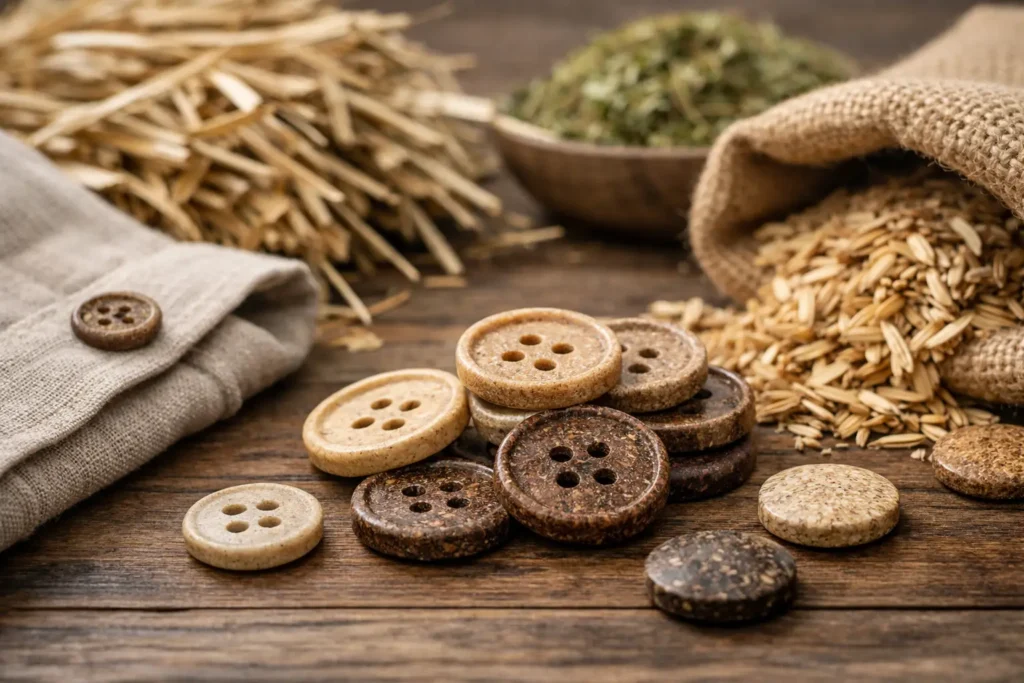
A shirt button may weigh only a few grams, but across a 50,000-piece garment order, that trim becomes a material decision measured in millions of units. Buttons made from agricultural waste give apparel brands a practical way to introduce reclaimed natural feedstocks into a visible design detail, without treating the button as an afterthought.
For product developers and sourcing teams, the opportunity is not simply to select a material with a stronger sustainability story. The real task is to specify a button that looks right, survives garment care, runs consistently in bulk production, and arrives on schedule. Agricultural-waste buttons can meet those requirements when the material, construction, finish, and testing plan are aligned from the sampling stage.
What Agricultural-Waste Buttons Are Made From
Agricultural waste refers to byproducts left after farming or food processing. Depending on local supply and the intended button appearance, usable feedstocks may include rice husks, coffee grounds, coconut shell powder, bagasse fiber, wheat straw, corn-based residues, and nutshell particles. These materials are typically cleaned, dried, milled, and blended into a compound before button production.
The finished button is rarely made from raw plant residue alone. Most commercial applications require a binding system, often a resin or polymer matrix, to give the material sufficient strength, stable dimensions, and a reliable surface. The percentage of agricultural content can vary significantly by formulation. This is why buyers should request clear material information rather than assuming that a button described as plant-based is fully biodegradable or plastic-free.
The agricultural particles influence the visual character of the button. Rice husk and wheat straw compounds can create fine speckling and a matte, natural look. Coffee grounds can produce warmer brown tones and visible grain. Coconut shell powder may support deeper earthy colors and a denser appearance. Each material behaves differently during molding, polishing, engraving, and dyeing.
Why Apparel Brands Are Considering Agricultural-Waste Buttons
For many collections, trims are one of the most accessible places to make material changes. A button can reinforce a garment’s natural, recycled, workwear, outdoor, or responsible-luxury positioning while remaining functional and brand-specific. The material story is tangible: customers can see and touch the detail rather than finding sustainability claims only on a hangtag.
These buttons are also well suited to brands that want a less uniform finish than conventional polished plastic. Natural flecks, slight tonal variation, and a dry matte touch can add character to overshirts, knitwear, casual tailoring, denim, outerwear, uniforms, and childrenswear. For premium programs, a custom logo, engraved rim, contrast thread holes, or carefully selected finish can turn that texture into a recognizable brand element.
There are limits to consider. Natural inclusions may create more variation between pieces than a solid-color polyester button. Very bright white, highly transparent, or perfectly glossy effects can be difficult to achieve. If a collection requires exact repeatability across multiple seasons, the approved color standard, particle size, and surface treatment must be controlled carefully.
How Buttons Made From Agricultural Waste Are Manufactured
The production route depends on the selected compound and button design. In a typical molded composite process, agricultural particles are prepared to a controlled moisture level and blended with the binder, pigments, and performance additives. The compound is then injection molded or compression molded into blanks or directly into the final button shape.
After molding, buttons may be trimmed, drilled, polished, tumbled, laser engraved, printed, dyed, or coated. Shank buttons may require separate metal or plastic shank components, while sew-through styles need accurate hole drilling and smooth edges that will not damage sewing thread. For brands requiring a matte organic appearance, the finishing process should preserve the visible texture instead of polishing the surface until it resembles standard plastic.
Tooling matters as much as the material. Custom molds determine the button diameter, thickness, hole position, rim shape, logo depth, and back construction. A poorly designed mold can create uneven filling, weak hole areas, or inconsistent logo definition. Before bulk production, the factory should confirm that the proposed design is suitable for the chosen compound, especially for thin buttons, small diameters, deep engraving, and complex shapes.
Sampling Before Bulk Production
A physical sample is essential because photographs cannot accurately show particle distribution, hand feel, sheen, and shade variation. During sampling, product teams should assess the button against the actual garment fabric and sewing thread. A brown coffee-ground composite may look refined on natural cotton twill but appear too dark against a lightweight beige poplin. Likewise, a textured button that works well on a jacket may be unsuitable for a fine blouse where a smoother hand is expected.
Sampling is also the right time to approve practical specifications: diameter, thickness, hole size, shank type, logo artwork, color target, finish, packing method, and acceptable variation. For repeat orders, retaining a signed approval sample and written specification gives both buyer and manufacturer a reference point for production consistency.
Performance Requirements for Garment Production
A lower-impact material does not remove normal trim performance requirements. Buttons must still withstand sewing, packing, transport, retail handling, laundering, and expected end use. The required tests depend on the garment category and destination market, but a sourcing specification should address pull strength where relevant, impact resistance, dry cleaning or washing performance, colorfastness, dimensional stability, and resistance to cracking.
For childrenswear, workwear, uniforms, and heavy outerwear, mechanical performance deserves particular attention. Small buttons may need a tougher formulation than a large decorative button on a low-stress garment. Industrial laundering, high heat drying, bleach exposure, or frequent dry cleaning can also affect certain composite materials. It depends on the binder system, finish, and agricultural filler content, so the garment care label should be discussed early with the button supplier.
Color matching requires similar discipline. Agricultural particles can affect the final shade, particularly in pale colors. A factory can work from a Pantone reference, fabric swatch, approved button, or physical color standard, but natural-fiber compounds may still show subtle flecks. When exact tone-on-tone matching is critical, consider whether a coated surface, a darker color direction, or a conventional material is the better production choice.
Questions to Ask Before Sourcing Agricultural-Waste Buttons
A good supplier discussion starts with the garment, not only the material claim. Share the intended use, care process, button quantity per garment, target delivery date, and desired price range. This allows the manufacturer to recommend a realistic compound and construction.
Buyers should also confirm the agricultural feedstock, estimated content level, binder type, available colors, minimum order quantity, tooling requirements, and lead time for samples and bulk production. Ask whether the selected compound has been used on comparable garments and which tests can be performed before shipment. If sustainability documentation is required for a brand program, define exactly what evidence is needed before development begins.
For large orders, consistency controls are especially important. Reliable production requires incoming material checks, controlled blending, in-process size and color inspection, hole and shank checks, surface inspection, count verification, and final packing review. Agricultural materials may vary by harvest and supplier, so a factory should manage batch records and approved standards rather than relying on visual judgment alone.
NZXTRIM can support this development process from material selection and custom mold preparation through sample approval, bulk manufacturing, inspection, and export packing. The most efficient projects begin with clear artwork, garment details, target quantity, and an honest discussion of the finish and performance the brand expects.
Choosing the Right Application
Agricultural-waste composites are often strongest when their natural character is treated as part of the design. Matte four-hole buttons with light speckling, engraved logo buttons for casualwear, and larger shank buttons for overshirts or outerwear are practical starting points. They may be less suitable when the design demands jewel-like transparency, mirror gloss, extremely thin profiles, or zero visible variation.
Material selection should also reflect the collection calendar. A new custom compound, logo mold, and performance-testing program needs more development time than an existing stock shape in a standard color. Brands launching a first responsible-trim program may benefit from beginning with a proven construction, then expanding into more complex custom designs after the bulk standard is established.
The best agricultural-waste button is not the one with the most dramatic claim. It is the one that complements the garment, meets the required performance level, and can be reproduced reliably from the first sample through the final carton. When those details are specified early, a small trim can carry a credible material story while giving the finished garment a more distinctive identity.