
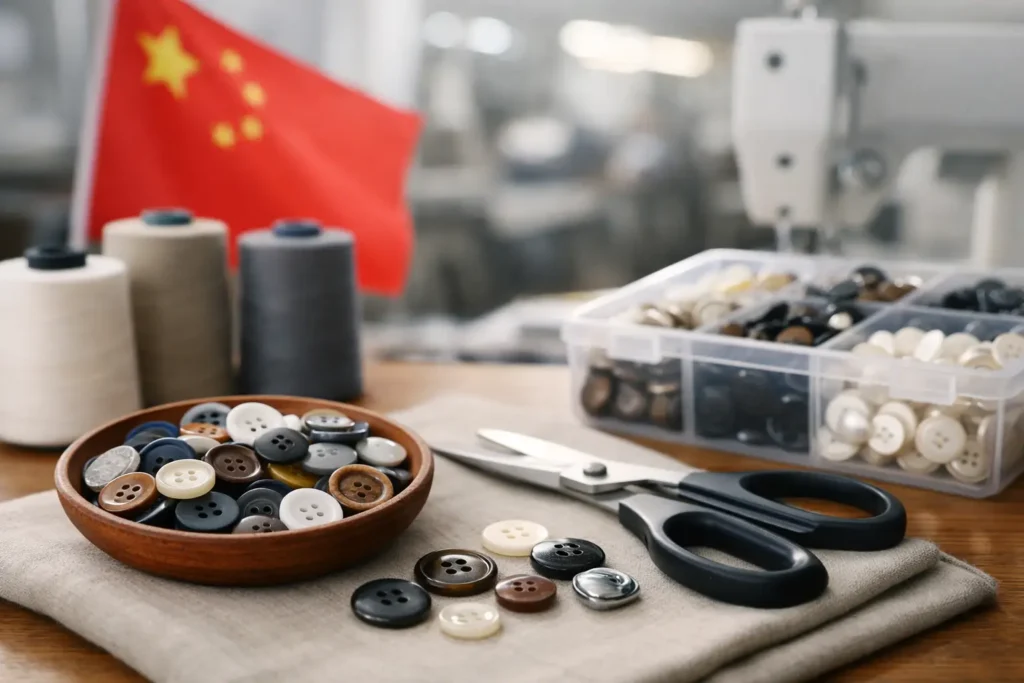
A button that looks correct on a mood board can still fail at the factory stage. The practical purpose of a China button production guide is to turn a visual direction into a specification that can be sampled, reviewed, repeated, and delivered with the garment program. For apparel teams, the decision is not simply which button looks best. It is which material, construction, finish, logo method, and approval process will remain consistent across bulk production.
NZXTRIM coordinates custom button projects from Hong Kong with production support in China. The most efficient projects begin with a clear technical brief, because material behavior, tooling needs, minimum order expectations, and production timing all change with the button design.
Start With a Production-Ready Button Brief
A reference image is useful, but it is not a complete manufacturing instruction. It may show the desired appearance while leaving unanswered questions about thickness, edge profile, back construction, hole size, finish, and color tolerance. Those details affect feasibility and cost as much as the front-face design.
For a quotation and initial feasibility review, provide the garment use, target quantity, required size, material preference, logo artwork, color reference, and target delivery window. If the button will be exposed to repeated laundering, dry cleaning, abrasion, heat, or a specialized end use, state that early. The right construction often depends on the garment and care method, not only the collection aesthetic.
A production-ready brief should normally confirm:
- Button diameter in millimeters or Ligne, plus thickness and permissible tolerance
- Material and visual target, such as matte corozo, polished horn effect, plated metal, or colored resin
- Construction, including 2-hole, 4-hole, shank, snap-style component, or special back
- Logo artwork and the preferred marking method
- Color reference, such as a Pantone reference, approved swatch, or physical garment fabric
- Quantity by size, color, and style, together with the delivery destination
The more precisely these points are defined before sampling, the less likely it is that a late design change will require new tooling or another approval cycle.
Select Material for Use, Not Appearance Alone
The same visual direction can be produced in several materials, but each option creates different manufacturing conditions. A dark natural-look button, for example, may be developed in corozo, horn, resin, wood, shell, or metal. These alternatives differ in surface variation, weight, achievable detail, edge durability, color consistency, and available finish.
Natural Materials Need Realistic Tolerances
Corozo, horn, shell, and wood bring material character that is difficult to reproduce exactly in synthetic alternatives. They may also show natural grain, tonal movement, or surface variation. That can be desirable for premium outerwear or tailored collections, but it must be accepted in the approval standard. A digitally rendered flat black surface and a naturally variable black horn button are different product expectations.
Color matching on natural materials also has limits. A dyed target can be developed, but final shade and visual uniformity must be reviewed on physical samples from the selected material. If strict color consistency is central to the garment program, resin or another engineered material may provide a more controlled route.
Engineered Materials Support Controlled Color and Form
Resin, plastic-based materials, and certain recycled-content options can support consistent molding, detailed forms, and broader color development. They are often appropriate where a program needs a defined Pantone target, a shaped silhouette, or a repeated branded face across multiple garment sizes.
However, a recycled-content claim, color result, and performance expectation must be confirmed for the specific material, button construction, order, and supply route. Recycled material is not one universal specification. Feedstock, finish, color, and production method can all affect the final button.
Metal, Ceramic, and Specialist Buttons Require Early Review
Metal can provide weight, plating options, cast or stamped detail, and a structured appearance. Ceramic offers a distinctive hard surface and visual depth. Both may require different tooling, assembly steps, and quality review methods than a standard sew-through button. Their suitability depends on the garment, intended care, attachment method, and design geometry.
Do not select a material only from a product photograph. Request physical material and finish samples where practical, especially when the button is a visible signature component of the garment.
Choose Construction Before Finalizing the Artwork
Button construction affects both how the garment maker attaches the trim and how the logo can be placed. A 4-hole button is a practical choice for many shirting, knitwear, and uniform applications. A 2-hole construction can create a cleaner face. Shank buttons provide a raised profile and are often used where the button needs to sit above a thicker fabric or where the front face should remain uninterrupted.
The back of the button deserves as much attention as the front. Hole diameter must suit the thread and sewing operation. Hole countersinking affects how the thread sits. A shank’s geometry needs to work with the expected stress and garment thickness. These are small details, but they can determine whether a button runs efficiently through garment production.
For custom shapes, review draft angles, edge thickness, recesses, and fragile features before approving artwork. Fine lines and deep logos may look attractive in a screen visual but become difficult to read after molding, polishing, plating, dyeing, or coating. A supplier should distinguish between a design concept and a form that can be repeatedly manufactured.
Match the Logo Method to the Material
Engraving, debossing, embossing, laser marking, printing, and applied finishes each produce different results. The correct choice depends on the material and the desired permanence, contrast, texture, and logo scale.
An engraved logo can create a refined recessed mark on suitable materials. Embossing creates raised detail but needs enough surface area and material depth. Laser marking can be effective for selected materials and finishes, although contrast varies. A logo that is highly visible on a pale resin sample may appear subtle on a dark natural material.
Artwork should be supplied in a clean vector format where possible. Avoid approving logo scale from an enlarged artwork file alone. The relevant question is whether the mark remains legible at the actual button diameter, after the selected production process. A 15 mm shirt button has very different space constraints from a 28 mm coat button.
Use Sampling to Resolve Risk Before Bulk Production
Sampling is where a custom button moves from specification to evidence. The first sample may be used to review shape, material feel, logo placement, color direction, and construction. It is not automatically a final bulk standard. If the first sample reveals a change in material, finish, or tooling detail, allow for a further revision before bulk approval.
Physical approval should compare the button with the garment fabric, thread, hardware, and overall collection palette. This is particularly useful for satin versus matte finishes, plated metal tones, dyed natural materials, and color-sensitive programs. A button that looks right by itself can look too cool, too warm, too glossy, or too heavy once placed on the actual garment.
Keep an approved sample or clearly documented approval record as the bulk reference. Define which details matter most: face appearance, size, logo clarity, plating tone, hole condition, back construction, or pack assortment. Without an agreed reference, quality review becomes subjective.
Plan Tooling, MOQ, and Lead Time as One Decision
Custom tooling may be needed for a new shape, special face, logo, or construction. Tooling can improve repeatability for ongoing programs, but it also adds a development step. Existing shapes with a custom color, finish, or marking method may be faster to evaluate than a fully new molded or cast button.
Minimum order quantity is not a fixed number across all button types. It depends on material, size, number of colors, tooling, production method, and whether the order uses an established component or a new development. Ask for MOQ by style and color rather than assuming one program-wide threshold.
Lead time should be discussed from the first inquiry, but it should be calculated from the real approval path: artwork confirmation, material sourcing where needed, sample making, sample approval, bulk scheduling, inspection, packing, and shipping. A compressed garment calendar may require simplification of the button design or earlier material decisions. The fastest route is not always the most customized route.
Set Quality Expectations Before Bulk Starts
A quality review should use the approved sample and written specification, not a general description such as “high quality.” Clarify the measurable and visual checkpoints relevant to the button: dimensions, hole cleanliness, shank alignment, logo position, finish consistency, color range, surface marks, and packing ratios.
Where the garment program has specific performance, regulatory, or restricted-substance requirements, communicate them before material selection and bulk production. The applicable scope must be reviewed for the exact button material, finish, construction, intended use, and destination. Do not assume that a requirement applying to one trim automatically applies to another.
For mixed-size or mixed-color orders, packing instructions matter as well. Clear labels by style, size, color, and quantity reduce receiving errors at the garment factory and help production teams keep button assortments matched to the correct garment style.
A well-specified button gives your garment factory a component it can sew, inspect, and reorder with confidence. Send the design direction early, but reserve final approval for the physical sample that reflects the material, finish, and construction you intend to place into bulk production.