
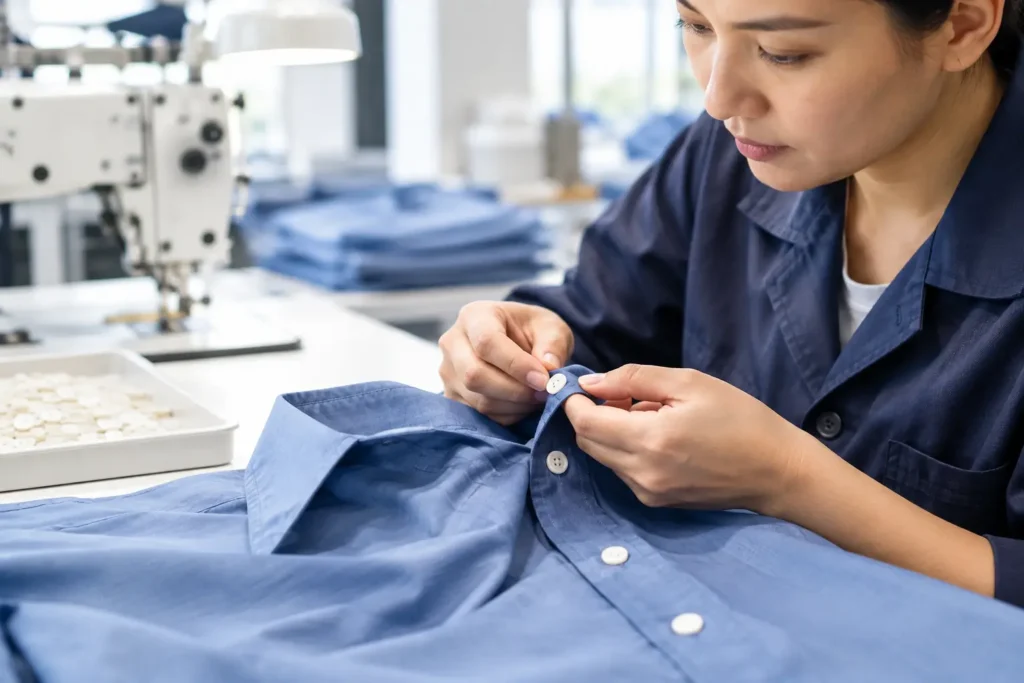
A button that cracks after washing, detaches during wear, corrodes in transit, or arrives in the wrong shade is rarely a single-component problem. For apparel teams asking how to reduce garment button failures, the practical answer is to define the button, the garment, the attachment method, and the intended care conditions as one production system before bulk approval.
A visually correct button is not automatically production-ready. The same design can perform differently when made in metal rather than resin, attached to denim rather than a lightweight woven shirt, or exposed to industrial laundering rather than occasional home washing. Early technical decisions cost less than rework, claims, delayed shipments, and replacement trims after production has started.
Start with the failure mode, not the button appearance
The fastest way to prevent repeat issues is to identify what “failure” means for the specific garment program. A four-hole shirt button may fail through cracking around the sew holes, while a jeans tack button may fail through insufficient attachment retention, cap distortion, or damage to the garment fabric. A plated metal button may look acceptable at sample stage but show surface change after exposure to moisture, chemicals, or repeated washing.
Product teams should define the likely stress points before selecting a material or construction. Consider garment category, fabric weight and thickness, seam location, wearer activity, wash process, dry-cleaning exposure where applicable, pressing temperatures, and expected product life. Uniform, workwear, outerwear, childrenswear, and fashion shirting should not be treated as equivalent applications simply because the visible button diameter is similar.
This step also separates a visual concept from a usable specification. A reference image can establish shape, finish, and branding direction. It does not define the base material, thickness, shank or sew-hole construction, attachment components, plating system, color tolerance, or performance expectations required for bulk production.
Choose material for the garment environment
Material selection has a direct effect on button durability, appearance consistency, lead time, and cost structure. No material is best for every project.
Corozo offers a natural, dense appearance and can be dyed or engraved, but its natural composition means tone and grain can vary. Shell, horn, wood, and other natural materials also require realistic agreement on visual variation, surface character, and available sizes. These variations may be desirable for a premium or heritage aesthetic, but they should be approved intentionally rather than treated as defects after delivery.
Resin can support precise shapes, consistent color development, and detailed logo work. Its formulation, thickness, edge design, and hole placement still matter. Thin sections, sharp internal corners, and holes positioned too close to an edge can create weak points, particularly on garments subjected to high mechanical stress.
Metal buttons provide weight, definition, and a broad range of finishes, but material and construction must match the use case. Solid and hollow forms behave differently. Plated, painted, coated, and antique finishes have different appearance and wear characteristics. Where moisture, washing chemistry, or abrasion is expected, surface performance should be discussed and evaluated against the actual garment process rather than assumed from a finish name.
Ceramic buttons can provide a distinctive surface and substantial feel, yet they need careful review for impact exposure and garment application. Recycled-content materials may also be suitable, but recycled content, color variation, performance, and any related claims must be confirmed for the exact material and order.
Engineer the button construction and attachment together
Many garment button failures originate at the interface between button and fabric. A button can be correctly manufactured and still fail because the attachment setup was not matched to fabric thickness, reinforcement, or machine settings.
For sew-through buttons, hole diameter, hole spacing, button thickness, and edge radius influence sewing performance. Holes that are too small can cause thread abrasion or inconsistent stitching. Holes that are too close together may concentrate stress. On heavy garments, a larger or thicker button may need stronger thread, adjusted stitch density, or reinforcement on the reverse side of the fabric.
For shank buttons, assess shank height and opening size in relation to the garment thickness and buttonhole construction. A shank that is too short can pull against thick layers and place unnecessary force on the button. A shank that is too tall may allow excessive movement or create an unstable appearance.
For tack buttons, snaps, and other post-attached constructions, specify every mating component, not only the visible cap. Post length, tack type, fabric stack-up, reinforcement, and machine die condition all affect retention and appearance. Changing one component during garment production can change the result. The approved sample should therefore represent the intended bulk attachment system as closely as possible.
Use physical samples to test the real application
Digital artwork, CAD visuals, and finish references are useful for alignment, but they cannot confirm attachment behavior or garment compatibility. Physical sampling is where many preventable failures are found.
Request samples in the intended material, size, construction, finish, and logo treatment. Then attach them to the actual or representative garment fabric using the planned production method. Evaluate not only the button itself but also the surrounding fabric, thread, buttonhole, backing, and appearance after handling.
A useful sample review looks beyond whether the logo is centered. Check for sharp edges, burrs, cracking around holes, unstable shanks, uneven finish, excessive movement, fabric damage, thread cutting, and mismatch between button color and the approved garment standard. For dyed buttons, confirm the acceptable color tolerance under the lighting conditions used by the product team. Pantone references can guide development, but color matching depends on the substrate, finish, production method, and approved physical standard.
If the garment will be washed, pressed, or treated after button attachment, review samples after those processes. A trim approved before garment washing may not remain visually or structurally acceptable afterward.
Build testing into the development plan
Testing should reflect the risks of the garment program, not a generic checklist. The appropriate scope depends on button type, material, attachment method, end use, market requirements, and buyer standards.
For example, teams may need to assess attachment retention, buttonhole and thread interaction, repeated opening and closing, wash exposure, dry-cleaning exposure, abrasion, corrosion-related appearance changes, or dimensional stability. Programs for young children or specialized workwear may have additional requirements that must be confirmed by the responsible brand or buyer.
Set acceptance criteria before testing begins. “Pass” should mean more than no immediate breakage. It may include an agreed range for color change, surface wear, attachment condition, logo legibility, and garment damage. If third-party testing, certification, or specific compliance documentation is needed, confirm the required scope, test method, laboratory, timing, and responsibility for the exact product and supply route before placing bulk orders.
Control artwork, tooling, and approval changes
Branding details create another common source of button failure, particularly when artwork is transferred informally between design, sourcing, and production teams. A logo that is too fine for embossing, debossing, engraving, or laser marking may fill in, lose clarity, or vary between production runs.
Provide vector artwork and define the logo size, orientation, placement, and preferred marking method. The most detailed method is not always the most durable or commercially practical. Fine laser marks can suit certain surfaces, while molded or stamped details may be better for other constructions. Tooling may be required for custom shapes, logos, or specialized constructions, which should be reviewed early because it affects sample timing and bulk readiness.
Once a physical approval standard is signed off, manage changes carefully. A revised finish, a new material source, a different logo depth, or a change in button thickness can alter both appearance and performance. Treat these as controlled changes requiring review, not as minor production substitutions.
Set bulk controls that mirror the approved sample
Bulk consistency depends on a clear production specification and disciplined inspection. The specification should cover material, size or ligne, thickness, color or finish, construction, logo details, attachment components where relevant, approved sample reference, packaging requirements, and agreed defect criteria.
Incoming material variation is especially relevant for natural materials, dyed components, metallic finishes, and mixed-material buttons. Production teams should establish what variation is acceptable and what needs segregation or rejection. For buttons supplied across multiple garment factories or delivery windows, retaining approved reference samples helps maintain alignment.
NZXTRIM supports this process by reviewing feasibility before bulk production, developing physical samples, and confirming project-specific requirements for material, tooling, testing scope, minimum order quantity, and production timing. The earlier these points are fixed, the fewer assumptions move into the production line.
A button is a small component with an outsized effect on garment quality. Give it the same specification discipline as fabric, labels, and construction details, and the most common button failures become easier to prevent before they reach the finished garment.