
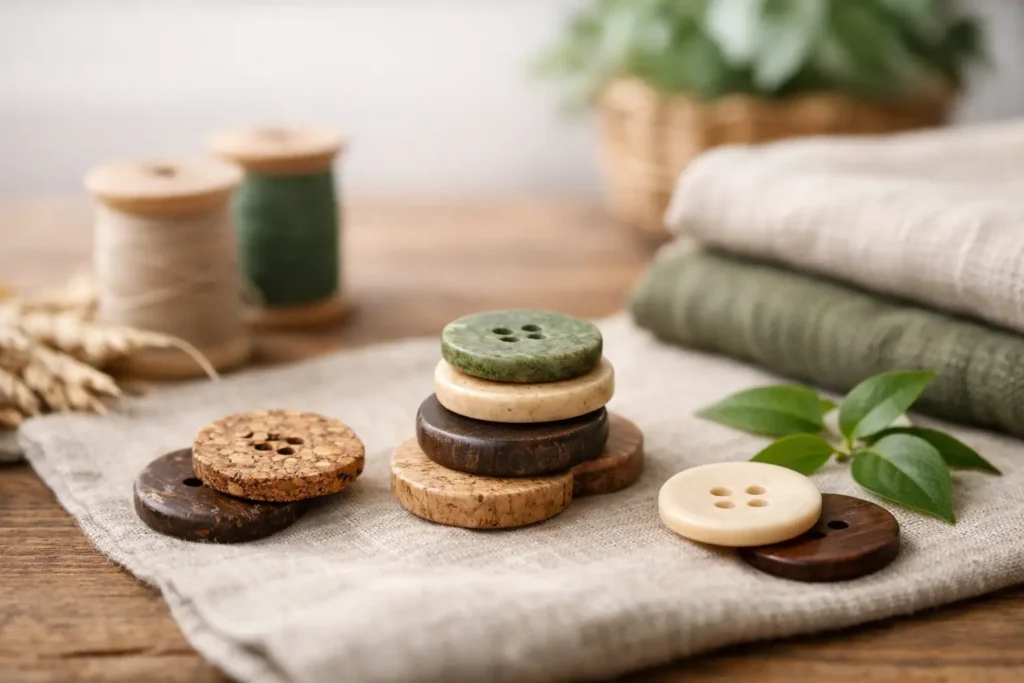
A sustainable button is not defined by appearance alone. For an apparel program, it must also be possible to specify, sample, manufacture, inspect, and repeat at bulk scale without creating uncertainty around material origin, finish, performance, or delivery. That makes sustainable buttons a product-development decision, not simply a material selection.
For fashion brands, sourcing teams, and garment factories, the practical question is: which button material and construction best supports the intended product while allowing sustainability-related claims to be supported by documents and controls appropriate to the specific order? The answer depends on the garment category, wash process, target price, visual direction, order volume, and required consistency.
Start With a Production Definition of Sustainable Buttons
A concept board may identify a button as recycled, natural, plant-based, or lower-impact. Those descriptions are only a starting point. A production-ready specification needs to define the actual button material, size, construction, color, surface finish, logo treatment, and quality requirements.
The material should be named precisely. For example, “recycled polyester-look button” is more useful than “eco button,” but it still leaves questions: What is the declared recycled input for the selected compound? Is the finish matte, polished, or coated? Can the requested Pantone color be achieved within acceptable lot variation? Will the button withstand the garment’s wash, dry-clean, dye, or press process? These points need review before a sustainability statement is used in product copy or hangtags.
The same principle applies to natural materials. Corozo, wood, horn, shell, and other natural-origin options can offer distinctive grain, depth, and variation. That variation may be part of the design value, but it must be agreed as an acceptable production characteristic. A brand seeking identical visual uniformity across every garment may need a different material or a tightly controlled finish specification.
Choose Materials by Garment Use, Not Label Language
There is no universal best material for sustainable buttons. The right choice depends on where the button will be used and what the garment must endure.
Corozo and other natural-origin materials
Corozo is often selected for tailored apparel, shirts, knitwear, and elevated casualwear because it can be dyed, engraved, polished, or finished with a natural-looking surface. Its character is different from molded plastic: color absorption, grain, and edge appearance can vary by batch and finish. A physical approval sample is particularly valuable when a collection requires a specific shade or a uniform logo definition.
Wood can support a warm, tactile visual direction, but species, grain, moisture behavior, coating choice, and intended wash exposure need early evaluation. Shell provides natural luster and is often considered for shirts and lightweight apparel, while its thickness, hole strength, edge finish, and color variation should be assessed against the garment’s use. Horn may suit premium outerwear or tailoring, but natural variation and sourcing documentation should be considered project by project.
Natural materials should not be treated as automatic proof of a particular environmental outcome. Their suitability depends on the specific material supply, processing route, finishing system, and documentation available for the order.
Recycled and engineered button materials
Recycled-content resin buttons can offer useful flexibility in shape, color, logo detail, and repeatability. They may be appropriate for uniforms, denim, casualwear, outerwear, and programs where a molded construction is required. However, recycled input, final color, surface texture, and mechanical performance can vary by compound and design. The requested claim must match the evidence available for that particular material and supply route.
Metal buttons can be used where durability, weight, or a workwear aesthetic is required. Their construction might include stamped, cast, covered, or assembled components. Surface treatments influence the final appearance and may affect how a button performs in laundering or abrasion. Ceramic, resin, and specialist composite buttons can also be viable, but feasibility should be reviewed against the required shape, attachment method, and end use rather than selected only from a visual reference.
Construction Often Matters as Much as Material
A material may look suitable on a sample card but become impractical once the button is scaled to the selected size or paired with a specific garment construction. A four-hole shirt button, a two-hole knitwear button, a shank button, and a jeans tack button have different stress points and production considerations.
For instance, reducing a button to a small Ligne size can limit logo legibility, wall thickness, hole spacing, and edge strength. Increasing thickness may improve presence and handling, but it can change the garment drape or create problems at the buttonhole. A large outerwear button may need a reinforced sewing area, while a lightweight blouse button may prioritize low weight and a smooth underside.
Construction should be developed alongside the garment, not after fabric and buttonhole dimensions are finalized. The apparel team should provide the intended buttonhole size, fabric thickness, garment use, wash or care process, and any attachment requirements. This allows a supplier to identify potential issues before tooling or bulk material is committed.
Turn the Visual Brief Into a Usable Specification
A mood board is useful for direction, but it is not enough to control a bulk order. Sustainable button development becomes more reliable when the brief separates visual intention from measurable requirements.
A workable button specification normally records at least these points:
- Material and any substantiated material-content requirement
- Size in millimeters or Ligne, plus thickness and tolerance expectations
- Construction, including hole count, shank style, back shape, and attachment method
- Color target, finish reference, logo artwork, and marking method
- Garment end use, wash process, quantity forecast, packing, and delivery requirements
This information helps determine whether the proposed design is ready for sampling or whether it remains a concept requiring material trials. It also prevents a common sourcing problem: approving a beautiful first sample without defining the acceptable variation range for later production lots.
Pantone references are useful starting points, especially for dyed corozo or colored resin programs, but they are not a substitute for a physical master standard. Material base color, surface texture, gloss level, and finish can all change how a color is perceived. A matte button and a polished button may read differently even when developed to the same reference. Where color is critical, approve actual samples under the relevant viewing conditions and retain a signed standard for production comparison.
Sample Before You Make a Broad Sustainability Claim
Sampling is where design assumptions meet real material behavior. It is the right stage to review color, logo clarity, hand feel, edge quality, thickness, hole finish, and overall proportion on the actual garment.
For custom work, the first sample may reveal that an engraved logo needs deeper lines, a debossed mark needs a larger diameter, or a requested color requires adjustment because of the selected material base. These are normal development findings. Resolving them in sampling is more efficient than trying to correct them after bulk production begins.
The sample stage should also establish what will be checked during production. Depending on the button and garment program, this may include dimensions, appearance, logo position, hole condition, edge finish, and functional performance relevant to the intended use. Any required testing, restricted-substance review, or claim-support documentation should be discussed early and confirmed for the exact product and order. Requirements can differ by market, customer program, material, finish, and garment application.
Plan MOQ and Lead Time Around Material Reality
Custom sustainable buttons may involve material procurement, color development, tooling, sampling, approvals, and bulk scheduling. Each step has commercial consequences. A stock-like shape in an available material may reduce development work, while a new profile, special color, custom logo, or complex construction may require additional preparation.
MOQ and lead time cannot be assumed from a button image or a previous project. They should be confirmed once the material, size, construction, finish, logo method, quantity, and delivery route are known. Small runs can be possible for some developments, but the cost structure and available options may differ from a repeat bulk program. Conversely, larger programs can justify dedicated tooling or more controlled color development when the forecast supports it.
NZXTRIM approaches this process by reviewing feasibility before treating a visual concept as a final manufacturing specification. That review should cover what can be made, what needs a physical trial, where variation is inherent to the material, and which approvals are needed before bulk release.
Build Consistency Into the Purchase Process
The most dependable sustainable button programs have a clear approval path. The buyer approves the material direction, then the physical sample, then the bulk standard and inspection points. Any change to material source, finish, logo artwork, color target, construction, or garment care process should trigger a review rather than being treated as a minor substitution.
For repeat orders, retain the approved sample, technical drawing, artwork version, color reference, packing requirement, and prior quality observations. This record is especially useful when multiple garment factories, delivery windows, or seasonal replenishment orders are involved. It gives purchasing teams a practical basis for comparing new production with the approved standard.
The strongest result is not a button described with broad language. It is a button whose material story, visual quality, construction, and production controls are aligned well enough for the garment program to repeat with confidence.