
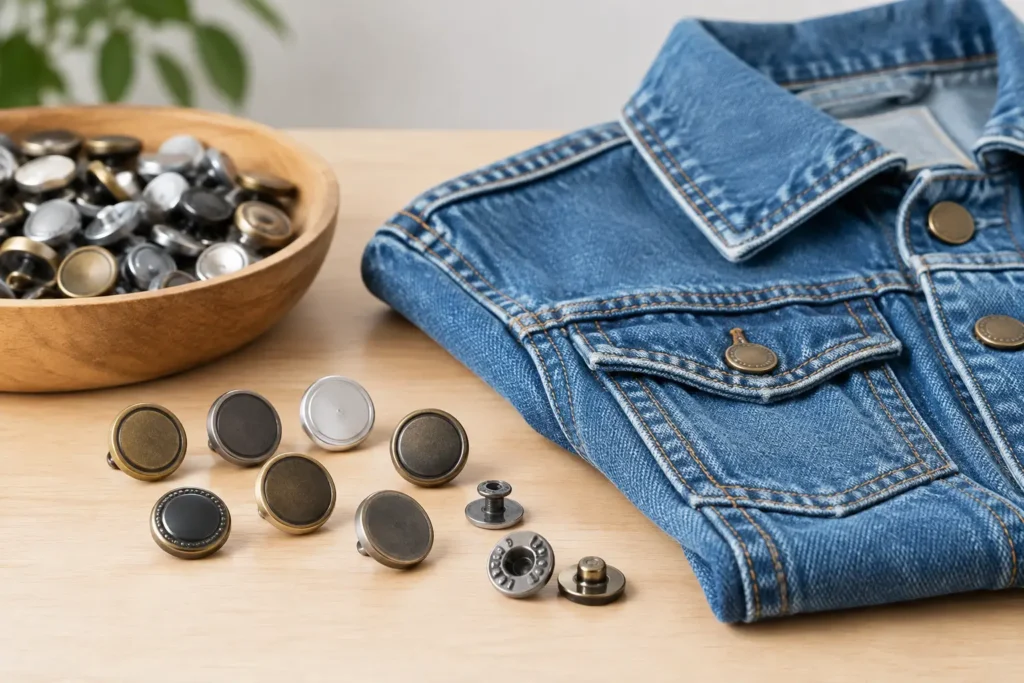
The best buttons for denim jackets are usually metal tack buttons for classic front closures, with coordinated cuff buttons selected for the garment’s weight, wash process, and brand identity. But “best” is not a single material choice. A button that looks right on an untreated denim sample may perform differently after garment washing, stone effects, abrasion, or repeated industrial laundering. For production teams, the right decision starts with the jacket specification, not with a finish board.
A denim jacket button must work as a closure component, a visible branding surface, and a repeatable bulk-production trim. The material, attachment method, size, logo treatment, and finish should be defined together. If one of those elements changes late in development, the visual result and production timing can change with it.
Best Buttons for Denim Jackets: Start With Construction
For most traditional denim jackets, a two-part metal tack button is the practical starting point. The visible button cap attaches to a nail or tack through the garment fabric. This construction creates the familiar raised profile associated with denim outerwear and can accommodate a branded face, rim text, embossed artwork, or a central logo.
Tack buttons suit front plackets and cuffs where the garment construction includes buttonholes. They are particularly appropriate for medium- to heavy-weight denim, but the nail length and attachment setup must match the finished fabric thickness. This point is often missed when a development sample uses raw denim but the final program includes lining, quilting, seam reinforcement, or a heavy wash.
Sew-through buttons are another option, especially for overshirts, lightweight denim jackets, chore-jacket styles, and designs seeking a flatter, less traditional appearance. A four-hole metal, resin, corozo, or horn-look button can give product teams more flexibility in color and material expression. The trade-off is that thread selection, sewing density, and buttonhole construction become more visible parts of the overall quality standard.
Shank buttons can also be used for fashion-led denim styles, although they require careful review of fabric thickness and buttonhole stability. A shank creates separation between the button face and garment, which can be useful on bulky layers. On a flat denim placket, however, it may create more movement than the design intends.
Metal Tack Buttons for Core Denim Programs
Metal is the most common choice when a jacket needs a recognizable denim character. It can be produced with a clean plated appearance, antique treatment, painted surface, matte finish, or darker coated look. The best finish depends on the garment’s wash, hardware story, and desired level of contrast against the denim.
A bright silver-tone button can look sharp on indigo or black denim, while antique brass or aged gunmetal often suits heritage, workwear, and washed-vintage directions. Black finishes create a more tonal result, but small scratches, edge wear, and color variation should be reviewed against the intended garment treatment. A finish that appears uniform before washing may reveal a different character after abrasion.
Logo method matters as much as finish. Raised embossing and recessed debossing are generally reliable choices for metal buttons because they create physical definition rather than depending only on surface print. Engraved or laser-marked details may suit fine artwork, but small lettering, shallow linework, and densely packed logos should be evaluated on a physical sample at the actual button size.
For a new custom metal button, tooling may be needed for the face artwork, rim, or special shape. Standard shapes can reduce development complexity, while a custom profile provides stronger brand distinction. The commercial choice depends on expected order volume, repeat use across seasons, and whether the button design will become a long-term brand hardware component.
Size Should Follow the Jacket Pattern
Button size is often specified in ligne, commonly written as L. A front denim-jacket button is frequently larger than a cuff button, but there is no universal size that fits every pattern. Placket width, buttonhole length, pocket flap proportions, and garment scale all affect the right selection.
A larger cap creates a stronger visual statement and offers more room for logo detail. It can also feel too heavy or oversized on a cropped jacket, a women’s fitted silhouette, or a lightweight denim fabric. Smaller buttons can look refined, but logo legibility becomes more limited. Product teams should review the complete button set on a sewn garment sample rather than approving components in isolation.
When Resin, Corozo, or Other Materials Make More Sense
Not every denim jacket needs metal hardware. Resin buttons can be suitable where a brand requires exact color development, including Pantone-referenced colors, translucent effects, marbling, or a more contemporary matte surface. Resin is often useful for color-blocked denim, uniforms, children’s apparel programs, and collections where buttons need to align with printed graphics or other trim colors.
Corozo can provide a natural, structured appearance that works well on denim chore coats and elevated workwear. Because it is a natural material, shade and grain variation should be considered part of the material character rather than treated as an identical molded surface. A physical approval standard is especially useful when the design expects a controlled color range.
Horn, shell, wood, ceramic, and specialist materials can create a distinctive surface, but they should be selected with the garment end use in mind. Natural materials may vary in pattern and shade. More brittle materials may not be appropriate for every wash or handling environment. Wood can support a casual visual direction, yet it requires consideration of moisture exposure and the garment’s intended care process. The material concept should be reviewed as a production specification, not just a design reference.
Recycled-content materials may be considered where they fit the design brief, but the available composition, color tolerance, documentation, and supply conditions must be verified for the specific material and order. A recycled material is not automatically interchangeable with a conventional resin or metal specification.
Specify the Jacket Wash Before Approving the Button
Denim development is often led by fabric wash, but trims must be included early. Enzyme washing, stone effects, bleach processes, pigment treatments, coating, sanding, and distressing can all affect the button’s appearance. A button selected before wash development may need a different plating, coating, attachment construction, or protective approach once the final garment route is known.
The most useful sample is not simply a loose button card. It is a garment-representative sample with the proposed denim, interlining or lining where applicable, attachment method, wash process, and intended buttonhole construction. This allows teams to assess visual balance, logo readability, surface change, and attachment behavior together.
If the program has internal requirements for wash durability, corrosion resistance, pull strength, or restricted substances, these should be communicated at the inquiry stage. Requirements, evaluation methods, and documentation scope need to be confirmed for the exact button material, finish, garment process, and delivery route.
Build a Production-Ready Button Specification
A visual reference alone is rarely enough for bulk production. A usable button specification should identify the button type, size in ligne and millimeters where needed, material, color or finish reference, attachment construction, logo artwork, logo placement, and quantity by size.
It should also state whether the button will be washed on the garment, whether the garment uses a lined or reinforced placket, and whether multiple factories will attach the hardware. These details help prevent a correct-looking button from being paired with an unsuitable nail, incorrect attachment pressure, or inconsistent placement.
For branded buttons, provide artwork in a clean vector format whenever possible. Designers should identify the areas that must remain legible at production scale and avoid treating every line in a large logo file as equally essential. A button face has limited real estate. Simplifying fine details often produces a stronger result than forcing complex artwork into a small circle.
Sampling, MOQ, and Lead-Time Decisions
Sampling is where a visual concept becomes a manufacturable trim. Early samples can confirm material direction, finish, logo depth, and approximate color. Pre-production approval should then focus on the final construction and the actual garment conditions. Where custom tooling is required, allow time for tool development, sample review, revisions, and final approval before bulk timing is fixed.
MOQ and lead time depend on material, size, finish, tooling, customization level, order quantity, and the production schedule at the time of inquiry. A standard-size button with a straightforward finish may follow a different development path from a fully custom embossed tack button. Combining similar button designs across multiple jacket styles can sometimes improve production efficiency, but only where the specification is genuinely shared.
NZXTRIM can support product teams with custom button development, physical sampling, and bulk-production planning. The most productive inquiry includes a tech pack or reference image, required sizes, estimated quantity, garment fabric information, wash details, target delivery window, and any logo artwork.
A denim jacket button earns its place when it still looks intentional after the fabric, wash, construction, and brand mark are all brought together. Approve that full combination early, and the button becomes a dependable part of the garment rather than a late-stage trim problem.