
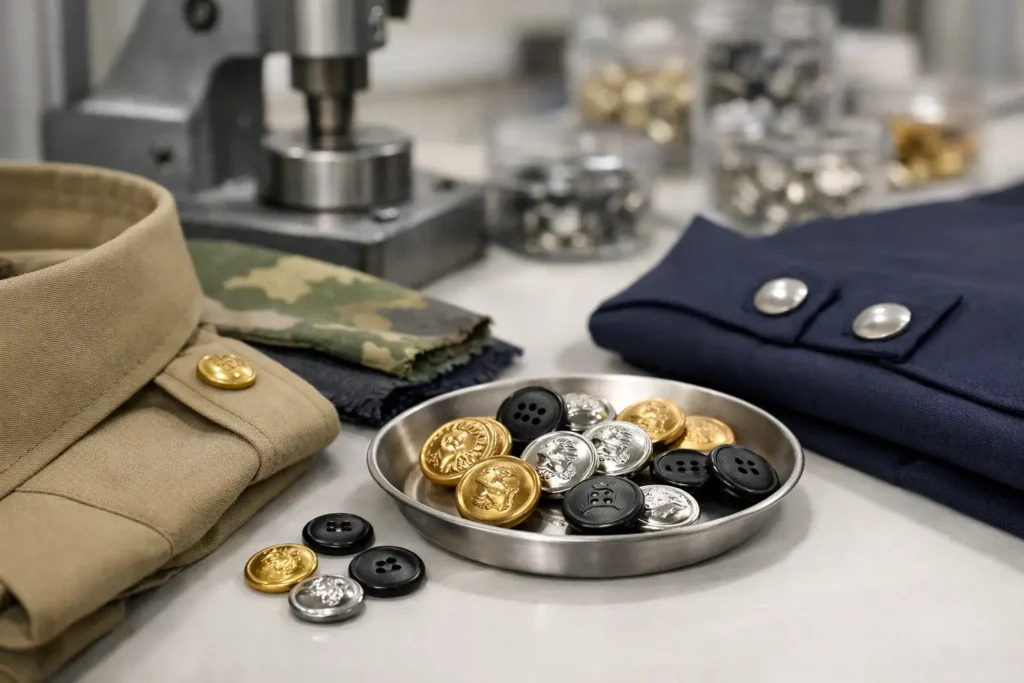
A uniform button manufacturer is not simply a source for garment closures. For workwear, schoolwear, hospitality uniforms, military-style apparel, and corporate clothing, buttons must protect a consistent visual standard through repeated wear, frequent laundering, and large production runs. A button that chips, fades, cracks, or varies in color can make an otherwise well-made uniform look unreliable.
For apparel brands, factories, and sourcing teams, the right manufacturing partner should understand both the design requirement and the production reality behind it. That means selecting suitable materials, developing accurate samples, maintaining repeatable specifications, and delivering the same quality from the first carton to the last.
What Uniform Buttons Must Do
Uniform buttons are expected to work harder than many fashion buttons. A fashion collection may use a distinctive button for one season or a limited run. Uniform programs often require the same component across multiple garment styles, sizes, locations, and reorder cycles. The button must remain consistent even when production is divided across different factories or scheduled months apart.
Durability is the first concern. Depending on the application, buttons may be exposed to industrial washing, dry cleaning, ironing, moisture, chemicals, sunlight, abrasion, and daily handling. A restaurant jacket, security uniform, hotel coat, and school blazer face different conditions. Material selection should follow the actual use environment rather than appearance alone.
Function also matters. Button size, thickness, hole configuration, shank construction, edge shape, and back profile affect how the button is sewn and how it performs on the garment. A button that looks correct on a presentation board may still be unsuitable if it pulls on the fabric, catches during pressing, or does not fit the selected buttonhole.
Brand presentation is equally important. Uniforms represent an organization in public. A clean, well-proportioned button with a clear logo or consistent finish can reinforce a professional image. Small differences in gloss, plating tone, or engraving depth become visible when hundreds of employees wear the same garment.
How a Uniform Button Manufacturer Supports Development
The best development process begins with a clear brief. A buyer may provide a technical drawing, reference sample, logo file, garment photo, or only a concept. An experienced manufacturer should help turn that information into workable production specifications, including material, diameter, thickness, color, finish, attachment style, and packaging requirements.
Sampling is where many production issues can be prevented. Before placing a bulk order, review the physical sample on the intended fabric and garment construction. Check the button under normal lighting, test the logo visibility, sew it through the production buttonhole, and assess the balance of the garment when worn. For uniforms that need repeated laundering, washing trials should be part of the approval process.
Custom mold development may be necessary for a proprietary shape, embossed emblem, recessed logo, special rim, or distinctive shank. While a custom mold adds development cost and lead time, it gives a uniform program stronger identity and reduces the risk of relying on a commonly available stock button. For basic programs, an existing mold combined with custom color or logo treatment may offer a more economical route.
The right choice depends on the order volume, brand requirements, reorder forecast, and product positioning. A sourcing decision should not focus only on the initial unit price. A button that causes quality claims, inconsistent reorders, or sewing delays can cost far more than a properly engineered alternative.
Material Selection for Uniform Programs
Resin buttons are widely used because they offer strong color flexibility, stable shape, and good value for many uniform applications. They can be produced in solid colors, imitation horn effects, marbled finishes, pearlescent looks, and engraved designs. For corporate apparel and school uniforms, resin often provides a practical balance of appearance, durability, and cost control.
Corozo buttons offer a natural, refined appearance and are well suited to premium blazers, hospitality garments, and tailored uniforms. Their organic character gives each button subtle variation, which can be desirable for elevated collections but may require realistic expectations about exact visual uniformity.
Metal buttons are often selected for formal uniforms, outerwear, security apparel, ceremonial garments, and military-inspired styles. They can be made with engraved logos, embossed crests, antique effects, enamel details, and different plating colors. Because plating and base metal selection influence corrosion resistance and appearance, the intended care method should be specified early.
Horn and horn-effect buttons can create a premium tailored look. Genuine natural materials have visual variation, while imitation versions can provide more controlled color consistency. Ceramic buttons may be appropriate for specialized premium designs, although their weight and impact resistance must be considered. Recycled button materials are increasingly relevant for brands with sustainability targets, but the available color range, surface appearance, and minimum order quantity may differ from conventional materials.
Quality Control Is a Production Requirement
A sample approval alone does not guarantee bulk consistency. The production process should include defined quality checks for dimensions, color, surface finish, logo accuracy, attachment construction, and packing quantity. For a uniform order, variation between batches can create a visible mismatch on the finished apparel.
Color management deserves particular attention. A navy button can appear noticeably different when compared side by side if shade control is weak. Buyers should provide approved color references when possible and clarify whether the button needs to match fabric, trim, a corporate identity standard, or an existing previous order. Material type and finish can change how color is perceived, especially between matte and glossy surfaces.
For metal components, quality control may include checks for plating coverage, sharp edges, shank strength, engraving definition, and surface defects. For resin and natural-material buttons, inspection should focus on cracks, bubbles, uneven polishing, irregular holes, thickness variation, and finish consistency. The appropriate inspection standard depends on the garment category and end-use expectations.
Testing should be relevant to the program rather than generic. Pull strength may be important for shank buttons. Wash and dry-clean resistance may be critical for professional uniforms. Corrosion testing may matter for metal buttons used in humid environments. When a garment factory has specific compliance requirements, share them with the button supplier before sampling, not after bulk production begins.
Plan for Reorders, Not Only the First Purchase
Uniform supply is often ongoing. A school may reorder each term, a hotel group may expand to new locations, or a workwear supplier may replenish inventory throughout the year. The original button specifications need to be documented so future orders can be reproduced reliably.
A complete specification should record the material, size, thickness, color standard, finish, mold number, logo artwork version, hole or shank type, packing method, and approved sample reference. This documentation reduces uncertainty when purchasing teams change or when production moves between garment factories.
It is also useful to discuss production capacity and lead times before the program launches. Low-volume sample orders and large-scale uniform contracts require different planning. A factory that can support flexible minimum order quantities during development but scale efficiently for repeat bulk orders provides valuable supply-chain stability.
Packaging should match the garment factory’s workflow. Buttons may be packed by size, color, garment style, purchase order, or factory destination. Clear labeling helps prevent line mistakes, particularly when a uniform collection uses several similar button designs across jackets, shirts, trousers, and outerwear.
Questions to Ask Before Selecting a Supplier
A capable supplier should be able to answer practical questions clearly: Can the design be manufactured in the required material? Can the logo remain legible at the selected button size? What sample and bulk lead times are realistic? Which finish will withstand the garment’s care process? How will color and dimensional consistency be controlled on repeat orders?
Ask for guidance, not just confirmation. If a design has a shallow shank, overly fine engraving, fragile edge, or unsuitable material choice, a production-focused manufacturer should identify the risk before tooling begins. That advice can protect the garment schedule and avoid costly revisions later.
Price should be evaluated alongside tooling, sampling, inspection, packaging, freight planning, and reorder reliability. The lowest quotation may be suitable for a basic short-term requirement, but long-term uniform programs usually benefit from stable manufacturing control and documented specifications.
Build the Button Into the Uniform Standard
Buttons deserve the same attention given to fabric, embroidery, and garment construction. They influence how the garment closes, how it survives care, and how consistently the organization presents itself. When the button specification is developed early, approved through practical testing, and managed as a repeatable component, it becomes a dependable part of the uniform system rather than a last-minute trim decision.
NZXTRIM works with apparel buyers from custom button development through bulk production, helping uniform programs balance material performance, brand identity, and reliable delivery. A well-prepared button brief and approved sample can give every future order a stronger starting point.